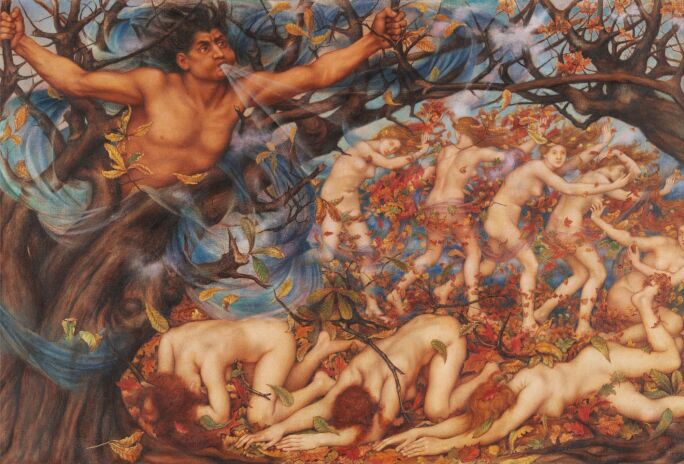
English painter Evelyn de Morgan (née Mary Evelyn Pickering, 1855-1919) drew this study of an arm for the title figure in a larger composition, Boreas and the Fallen Leaves, probably painted between 1910 and 1914. Boreas, the ancient Greek god of the north wind, was the most important of the four wind gods. Winged and two-faced–to see what was behind and in front of him–Boreas here is swirling around a gnarled tree blowing leaves, personified as long-haired maidens, to the ground.
Born into an upper class family in London, Evelyn was well educated, studying Greek, Latin, French, German, Italian and classical literature, leading to a lifelong love of mythology. In 1872, she enrolled at the South Kensington National Art Training School (today the Royal College of Art) and in 1873 she moved to the Slade School of Art, where she won several awards including the prestigious Slade Scholarship. Beginning in 1875, Evelyn visited Florence regularly, studying the great artists of the Renaissance, especially Quattrocento painter Sandro Botticelli. Through her uncle, John Roddam Spencer Stanhope, Evelyn developed friendships with Pre-Raphaelite painters Dante Gabriel Rossetti and William Holman Hunt.
De Morgan first exhibited in 1876 at the Dudley Gallery and a year later at the inaugural Grosvenor Gallery exhibition in London. She exhibited regularly until 1907, including a solo exhibition of 25 works at Wolverhampton Municipal Art Gallery and Museum. Early in her career, de Morgan was associated with the later phase of the Pre-Raphaelite movement but worked in a range of styles including Aestheticism and Symbolism. Her paintings are figural, often foregrounding female figures. De Morgan boycotted the Royal Academy and signed the Declaration in Favour of Women’s Suffrage in 1889; her later works tackled themes of war from a pacifist perspective, engaging with contemporary conflicts including the Second Boer War and the first World War.