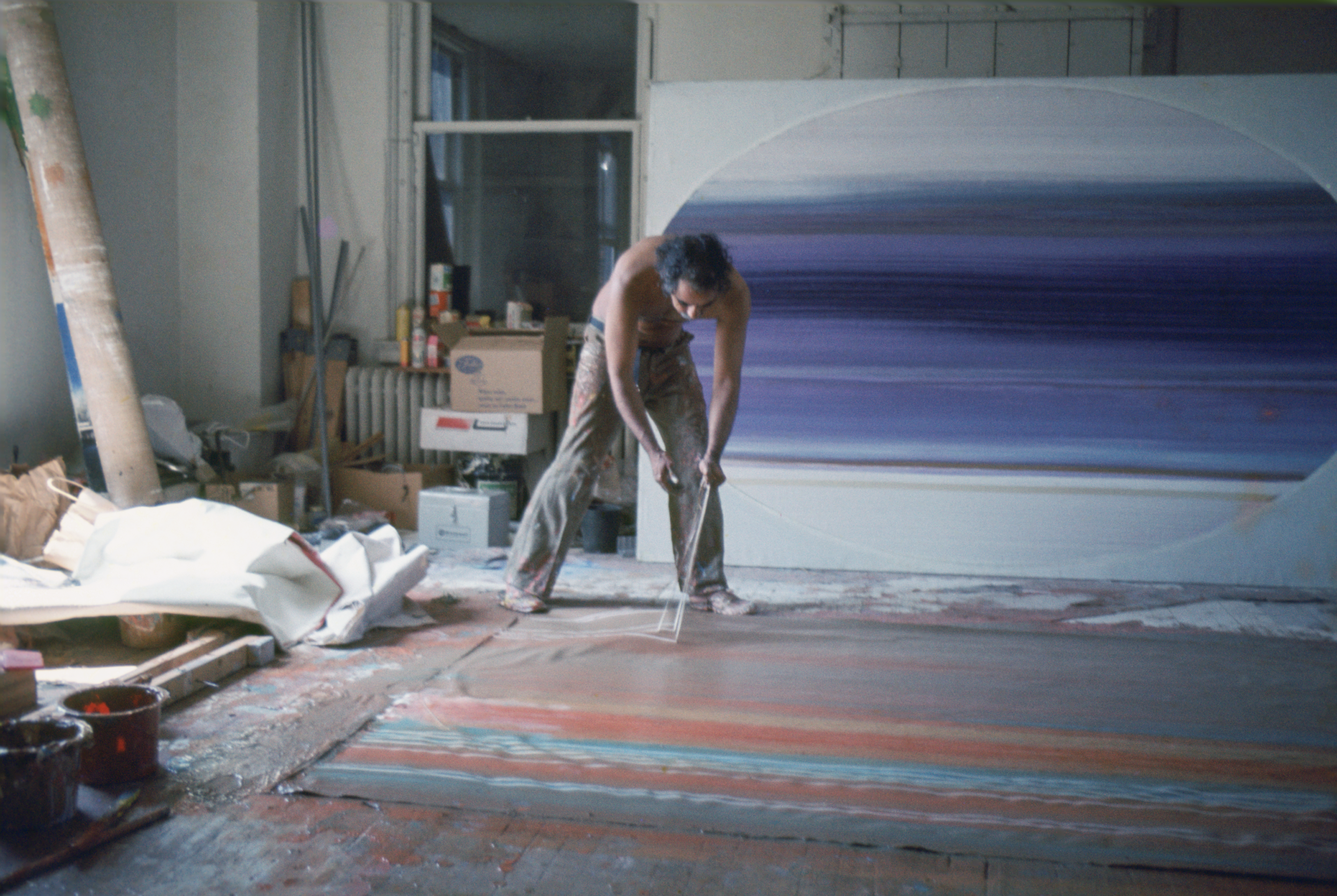
“I began to believe, from my conversations with other artists, that the real truth is in the stroke. For me, it is large, bold strokes that do not refer distinctly to seen nature. The paint is the subject. The motions of the strokes give the work life.”
An expanse of broad energetic bands of buoyant color, Blue Splash epitomizes Ed Clark’s innovative painting style. A pioneer of the New York School, Clark’s experimentations with pure color, abstract form, and materiality yielded a remarkably original body of work that pushed the boundaries of abstraction beyond expressionism and left a lasting impact on the language of American Abstraction. Clark extended his painterly gestures at a colossal scale through the use of a push broom, radically moving beyond the traditional artist’s brush, and was among the first painters in the postwar period to use a shaped canvas. Blue Splash was acquired directly from the artist in the late 1960s by a jeweler and part t.mes jazz musician who ran in Clark’s social circle in Paris and then gifted to the current owner. A test.mes nt to the crucial impact of his oeuvre, Clark’s works are included in the permanent collects ions of esteemed institutions including the Art Institute of Chicago; the Metropolitan Museum of Art, New York; the Museum of Modern Art, New York; the Detroit Institute of the Arts; the Studio Museum in Harlem, New York; and the Pérez Art Museum, Miami, amongst others.

Brilliant cerulean, cobalt, apple green, yellow ochre, and blushing pink sweep across the canvas of Blue Splash in expansive horizontal stripes. Their linearity and massive scale give the painting an almost architectural presence that is vivified by vibrating, energetic color. Clark’s massive strokes bring an intense dynamism and physicality without being overly gestural. The bands of color drive forth with chromatic intensity, inhabiting an innate sense of momentum that echoes their creation and extends the momentum of Clark’s gesture across an expansive surface. At the bottom of Blue Splash, Clark’s contained brushstrokes begin to unfurl, the paint becoming looser and wetter, transformed into liquid seeping across the picture plane with energy and bravura that alludes to in the works title.


Born in New Orleans and raised in Chicago, Clark attended the Art Institute of Chicago before moving to Paris to attend the L’Academie de la Grande Chaumiere where he was taught by Louis Ritman and Edouard Goerg. Clark continued to live in Paris after his schooling, working alongside other ex-patriot artists and creative figures including Sam Francis, Joan Mitchell, Beauford Delaney, Barbara Chase-Riboud, and James Baldwin. It was in dialogue with these artists that Clark began to explore the expressive propensities of abstraction, leading to his career-defining innovations. “I began to believe, from my conversations with other artists, that the real truth is in the stroke,” said Clark, “For me, it is large, bold strokes that do not refer distinctly to seen nature. The paint is the subject. The motions of the strokes give the work life.” (Ed Clark quoted in Quincey Troupe, “An Interview with Ed Clark,” For the Sake of the Search, Belleville Lake, 1997, p. 17).
“Art is not subject to political games; its importance elevates it above any racial differences. Any man of talent, of noble spirit, can make it”
In what the artist termed “the big sweep,” Clark applied paint onto the canvas using a standard workman’s broom, an innovation that allowed him to create broad strokes of color at an imposing scale. This newfound technique produced the palpable sense of propulsion and movement within Blue Splash, allowing its colors to accelerate past the borders of the canvas. Blue Splash is a complex enquiry into method and matter, evincing the manner in which Clark used the act of painting as an ongoing process of discovery and change. Expansion past the picture plan was a key preoccupation throughout Clark’s career. Clark’s coopting of the push-broom as artists brush allowed him to extend the brushstroke almost indefinitely, creating an openness of chromatic intensity. His experimentation with optical expansion, beautifully evoked through the lush strokes of Blue Splash, would later lead the artist to the use of a shaped canvas to mimic the fields of optical vision. This innovation in form, alongside the spectacular innovation in method and material manifest in Blue Splash, established Clark as a visionary within his practice.


Although the artist disavowed any interest in identifying himself or his work as “black”, Clark rose to prominence as an abstractionist in an era when African American artists were expected to produce works of figuration addressing sociopolitical issues and struggles. The artist famously stated, “Art is not subject to political games; its importance elevates it above any racial differences. Any man of talent, of noble spirit, can make it” (Ed Clark quoted in Aimé Maeght and Jean Clair, “Un musée pour Harlem,” Chroniques de L’Art Vivant, November 1968, p.15) Clark’s belief in the power of color and brushwork in evoking fundamental human emotions is evident in the present work; Blue Splash masterfully interweaves gestural and hard-edged abstraction, illustrating Clark’s career-long exploration of both the material and physical aspects of paint and color and literally sweeping the medium of paint into an atmospheric, emotive, and exuberant art.

