T
his beautiful depiction of the Mystic Marriage of Saint Catherine of Alexandria has been dated by Odile Delenda to circa 1660-1662, during the final phase of Francisco de Zurbarán’s career after his permanent relocation to Madrid from Seville in 1658. The only known treatment of this subject by Zurbarán, it is almost certainly the painting recorded in the artist’s post-mortem inventory, drawn up on 3 September 1664 on behalf of his widow, Doña Leonor de Tordera: "Otra nra Señora y el niño y Santa Catalino con marco" ("Another Our Lady with Child Jesus and Saint Catherine with frame").1
A further reference to the work appears in an estate valuation carried out the following year, in which a canvas of comparable dimensions depicting Our Lady with Saint Catherine is appraised at 100 reales: "Vn lienço de bara y quartta de Nuestra Señora y Santta Catalina con moldura en cien RS…V100" ("A canvas "de bara y quartta" (an old measure approximately 1.2 m.) representing Our Lady with Saint Catherine with moulding some 100 by 100").2
More than half of the approximately thirty-five surviving works from Zurbarán’s late Madrid period depict Marian themes, a popular and appealing subject for private devotion. In the present painting, the artist abandons the stark chiaroscuro and sculptural rigidity of his earlier Sevillian works in favor of a softer, diffused light and a more naturalistic treatment. The Virgin and Saint Catherine are rendered as idealized yet approachable, their restrained gestures and tender expressions drawing the viewer into the sacred encounter. Catherine’s noble lineage is signaled by her sumptuous attire, including a richly brocaded brown mantle, while her traditional attribute—the broken spiked wheel—appears discreetly at lower left.
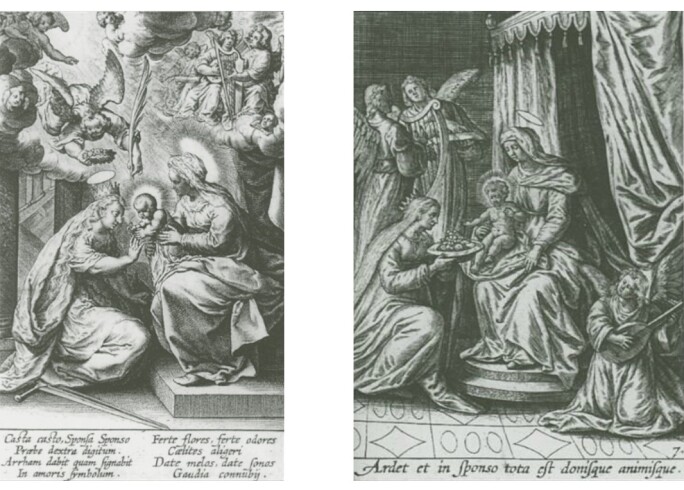
RIGHT: Fig. 2 Antonius III Wierix, The Mystic Marriage of Saint Catherine of Alexandria, in Vita S./ Catharinae virginis et martyris, suite of 20 engravings. Amberes, before 1624.
According to legend, Catherine experienced a vision in which the Virgin presented her to the Christ Child, who placed a ring upon her finger as a sign of her spiritual betrothal. This intimate moment is distilled here with remarkable economy. Delenda has suggested that Zurbarán may have drawn inspiration from engravings of the subject by the Wierix family (fig.1; fig. 2), yet the artist deliberately suppresses narrative complexity.3 All celestial attendants and extraneous background elements are omitted, allowing the viewer’s attention to rest entirely on the tender exchange between Saint and Child. Traces of a small crown on Catherine’s head and a putto in the upper background indicate that Zurbarán may initially have conceived a more elaborate composition, later pared down in pursuit of greater claritys and emotional resonance.
1 Archivo Histórico de Protocolos, Madrid, Protocolo 10592, folios 451-452.
2 Archivo Histórico de Protocolos, Madrid, Protocolo 10592, folios 453-455.
3 See Delenda 2011, p. 384.