“I grew up on the banks of the Rhine... As a child, I saw the river as an insuperable obstacle, something you couldn’t swim across. It thus acquired a mythical status for me. When you came to this barrier you could turn left or right but not go straight ahead, except in your imagination”
A brooding and monumental vision, Untitled (Monument on River) plunges us into the heart of Anselm Kiefer’s artistic reckoning with history, memory, and cultural identity. Executed in 1982, the present work belongs to a formative series of large-scale woodcuts that helped establish Kiefer’s early international acclaim. Other works from the celebrated series are held in prestigious museum collects ions world wide, including the Metropolitan Museum of Art in New York, the Guggenheim Museum Bilbao, the Albertina in Vienna, Kunstmuseum Bonn, and the San Francisco Museum of Modern Art, affirming their critical place in the artist’s oeuvre.

Here, Kiefer juxtaposes two opposing forces: nature and monument. A dark river slices through the centre of the composition, evoking the Rhine – a recurring and deeply resonant motif in Kiefer’s practice. Below, a forest of rigid, upright trees rises like a natural colonnade; above, a stark neoclassical structure looming on the horizon: Kiefer’s reimagining of Wilhelm Kreis’s 1939 design for the Soldatenhalle, an unrealised Nazi memorial intended to glorify military sacrifice. The mirrored symmetry between tree trunks and stone columns establishes a haunting visual rhythm, one that underscores the fraught convergence of cultural tradition and ideological architecture.


The choice of the Rhine as a central motif carries considerable historical weight. For centuries, the Rhine has functioned as both a real and symbolic frontier in German history. Celebrated by Goethe, Heine, and von Arnim as a symbol of German brotherhood, and immortalised by Wagner in The Ring of the Nibelung as a site of both majesty and hubris, the river has long been a locus of national identity. It was also the site of both military defeat and triumph, from Napoleon’s annexation, to its celebrated defence in Franco-Prussian lore, to Hitler’s militarised occupation and the Allies’ pivotal crossing during World War II. The Rhine thus embodies a complex duality: unity and violence, pride and trauma.
Kiefer’s Rhine Works in Prominent Museum collects ions
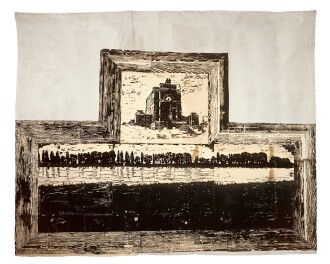
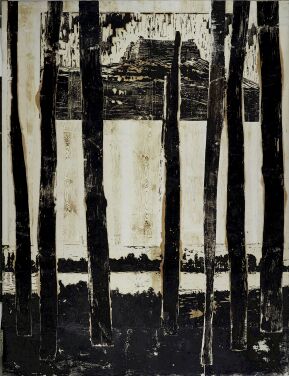
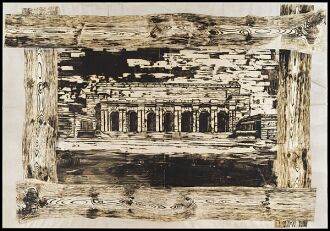

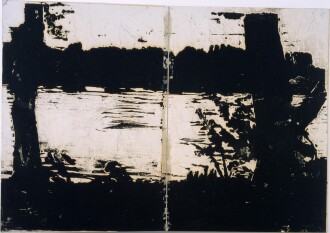

By staging Kreis’s unrealised National Socialist monument across this iconic river, Kiefer sets in motion a complex symbolic collision. As curator Mark Rosenthal observed, by juxtaposing Kreis' severe architectural design with perhaps the most potent and patriotic expression of German culture, Kiefer is ‘conflating the most profound symbol of his country, the river Rhine, with an architectural manifestation of its lowest point in history and the memory, as well, of its lost artistic genius’ (Exh. Cat., Chicago, The Art Institute, Anselm Kiefer, 1987, p. 106). This deliberate tension forces a reckoning with Germany’s fraught legacy – melding memory and myth, pride and shame, in a haunting visual dialectic. Moreover, Kiefer’s use of woodcut, one of the oldest techniques in German printmaking, deepens the work’s connection to national tradition. Evoking the legacy of Albert Dürer, a German painter, printmaker, and theorist of the German Renaissance, the heavily worked surface becomes a metaphor for historical inscription, and perhaps even violence. The image is far from pristine; it bears the marks of t.mes , process, and relentless inquiry.
Born in 1945, Kiefer belongs to the first generation of postwar German artists compelled to confront their nation’s past directly. In Untitled (Monument on River), he assumes the role of critical witness, placing symbols of power and loss into deliberate tension. The result is a work that offers no closure but demands the visibility of history: layered, contested, and unresolved.