"I wanted to burn down the École des Beaux-Arts with my cobalts and vermilions... I wanted to express my feelings without troubling what painting was like before me...Life and me, me and life— that's all that matters!"

Executed at the height of Maurice de Vlaminck’s involvement with Fauvism, Pêcheur à Chatou exemplifies the riotous palette and invigorated brushwork which defined the movement. Painted in sizzling hues of red, yellow, blue and green, the present composition comes alive in with its unfettered array of directional brushstrokes. As the first avant-garde movement to flourish in France at the turn of the century, Fauvism shocked the art world to its core. The spontaneous responses to the natural world and bold use of color by artists like Vlaminck, André Derain and Henri Matisse revolutionized painting at the turn of century (see figs. 1 and 2).

The rapidly applied and forceful brushstrokes were, in the case of Vlaminck, energized by the artist’s own passion. He referred to this fact on many occasions in his writings: “I intensified all the tones, I transposed into an orchestration of pure colors all the feelings I was aware of. I was a barbarian, both tender and full of violence. From instinct and without.mes thod I translated a truth that was not artistic but human. I crushed and spoiled the ultramarines, the vermilions that nonetheless were very expensive and that Père Jarry, the paint seller on the corner of Chatou bridge, used to let.mes have on credit” (quoted in Maïthé Vallès-Bled, Vlaminck, Critical Catalogue of Fauve Paintings and Ceramics, Paris, 2008, p. 114).

The long-mistaken setting is of great importance given the significance of Chatou, located just north-west of Paris, to the Fauve paintings of Vlaminck—it is along this stretch of the river that the pictorial campaign which defined his oeuvre took place. Vlaminck was extraordinary devoted to specific motifs and viewpoints of Chatou and the Seine, with his greatest proclivity in depicting the Pont de Chatou stretched across the river (see fig. 3). “In art and in life this bridge had very particular associations for Vlaminck. It was not just a point from which he could reconnoiter his painting territory. The bridge was as vital to him as it was to Chatou itself….The two segments of the Pont de Chatou linked all the places that were important to Vlaminck. Over it he had passed from his dwellings in Chatou to the island and his studio, sanctuary within sanctuary….The bridge gave Vlaminck a sense of connectedness with the elements of his limited world. Only this allowed him to revel in his suburban isolation” (Exh. Cat., Los Angeles County Museum of Art, The Fauve Landscape, 1990, p. 134).

The practice of framing a landscape with a bridge was commonplace in Vlaminck’s compositions; the buttress and span of the bridge recalled the compositional devices that the Impressionists and Post-Impressionists adapted from Japanese prints some years prior (see fig. 4). The bridges that crossed the Seine, both in and out of Paris, had supplied Claude Monet, Gustave Caillebotte and the other Impressionists with the premise for some of their most daring compositions—the framing used by Vlaminck in many of his views of Chatou closely resembles their canvases. Focusing on a more intimate tableau, the perspective of Pêcheur à Chatou makes it clear that Vlaminck set his easel on the Île de Chatou, in the middle of the river, near a small landing on which the lone fisherman stands.

Fig. 6 Gustave Caillebotte, Le pont d'Argenteuil, circa 1883, Museum Barberini, Potsdam
It had long been assumed that the bridge stretched across the background of Pêcheur à Chatou was one of the three bridges at the town of Argenteuil, where years before Caillebotte and Monet had dedicated much t.mes and many canvases to capturing the effects of light on the river and its environs (see figs. 5 and 6). After careful comparison with photographic postcards from early in the twentieth century, the three arches that straddle the Seine were identified as those of the bridge at Chatou.
In discussing the importance of these postcards that grew in popularity from the 1890s to the first decade of the twentieth century, John Klein points to the similarities between these vistas and Vlaminck’s compositions of the same subjects: “[the artist] has brought the same elements found in the photographic views into a more compact and unified arrangement. But his painting shares with the postcards the ease of comprehension and identification essential to the souvenir. What might be called the scenic values of the suburban site have been carefully preserved by Vlaminck…” (ibid., p. 126).

In Pêcheur à Chatou the verticality in the treatment of the brushstrokes fully articulates the density of the reflection of the bridge atop the water. The solid swaths of color which make up the center of the composition owe much to the legacy of post-Impressionist painters Paul Gauguin and Paul Sérusier; the flat areas of highly-saturated planes of color are especially reminiscent of the stylistic experiments undertaken by Sérusier under Gauguin’s influence in the late 1880s. These early experiments resulted in Sérusier executing the celebrated panel, Le Talisman, now in the collects ion of the Musée d’Orsay (see fig. 7). In explaining this work, Sérusier “conveyed his friend Gauguin’s message that instead of copying nature as one perceived it, one should represent it, transmute it into a play of vivid colors, emphasizing simple, expressive, original arabesques for the pleasure of the eye” (quoted in John Rewald, Post-Impressionism from Van Gogh to Gauguin, New York, 1956, p. 275).

The desire felt by Gauguin and Sérusier to intensify color and simplify form led to a predilection for brushstrokes which were lengthened and continued as broad patches of vibrant color. Drawing from the visual lexicon of these influential artists, as well as the rich and expressive brushwork of Vincent van Gogh (see fig. 8), Vlaminck in turn utilized non-naturalistic colors to great effect. The young artist was so affected by a 1901 exhbition of Van Gogh's work, that he stated: "I was so moved I wanted to cry with joy and despair. On that day I loved van Gogh more than I loved my father" (quoted in Exh. Cat., New York, The Museum of Modern Art, The Wild Beasts: Fauvism and Its Affinities, 1976).
Maurice de Vlaminck and the Bridge at Chatou: The Museum Context


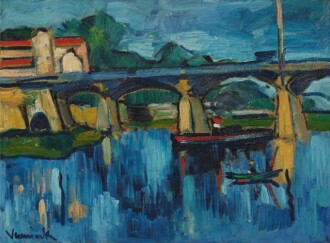

John Elderfield has written about the painter’s artistic approach to color, stating: "Vlaminck’s concern with the immediate led him to base his painting around a combination of the three primary colors, especially the cobalts and vermilions with which, he said he wanted 'to burn down the Ecole des Beaux-Arts,' and 'to express my feelings without troubling what painting was like before me'" (ibid., p. 71). Through Vlaminck’s passionate use of what are largely primary colors to portray the shoreline, bridge and river in the present work, the young artist achieves a composition that is as animated and harmonious as the town it portrays.