Executed on September 3-4, 1967, Trois nus debout et personnage exemplifies the artist’s mastery across mediums. Deeply personal and allegorical, the present work reflects the artist’s genius in the most prodigious part of his late career.
Trois nus debout et personnage is remarkable amid Picasso’s late works on paper for its richness and painted details. The figures of the four nudes are rendered in pencil and present a highly expressive and graphic quality characteristic of his late drawings and etchings. The simplicity of form lent by the linear execution of the figures is balanced by the selective use of gouache in the head of the central figure. Whereas the faces of her companions are delineated by simple yet bold outlines, the woman at center draws the viewer’s attention with a monochromatic detailing of her hair and facial features. Instantly recognizable is the visage of Picasso’s partner in life and ultimate muse, Jacqueline Roque. The grisaille details of this figure’s large eyes, attenuated neck and long, dark hair are often seen in his other depictions of Jaqueline like Tête de Femme (see fig. 1). Though she never posed for Picasso, Jacqueline permeated his life and work, her image especially populating his work from the early 1960s onward.

As Marie-Laure Bernadac writes “It is characteristic of Picasso that he takes as his model—or as his Muse—the woman he loves and who loves with him, not a professional model. So what his paintings show is never a ‘model’ of a woman, but woman as model. This has its consequences for his emotional as well as his artistic life: for the beloved woman stands for ‘painting’, and the painted woman is the beloved: detachment is an impossibility. Picasso never paints from life: Jacqueline never poses for him; but she is there always, everywhere. All the women of these years are Jacqueline, and yet they are rarely portraits. The image of the woman he loves is a model imprinted deep within him, and it emerges every t.mes he paints a woman” (Late Picasso. Paintings, sculpture, drawings, prints 1953-1972 (exhibition catalogue), The Tate Gallery, London & Musée national d’art moderne, Paris, 1988, p. 78).

The group of three women at the center of the composition immediately recalls the Three Graces of classical lore. Originating in Greek mythology, the Graces were goddesses who personified charm, grace and beauty and embodied the traits in all realms including the physical, intellectual, moral and artistic. While the number of Graces varies depending on the source, iconic interpretations of the archetypes most often depict the muses in a group of three, as seen in one of the most recognizable iterations by Botticelli (see fig. 2).

“All themes found in Picasso’s earlier work reappear here [in the years 1966-68], like well-known personalities whose familiar features we recognize. We had left them at some point in their lives and now rediscover them a little later, more mature, and pick up the thread of a story interrupted for a while.”
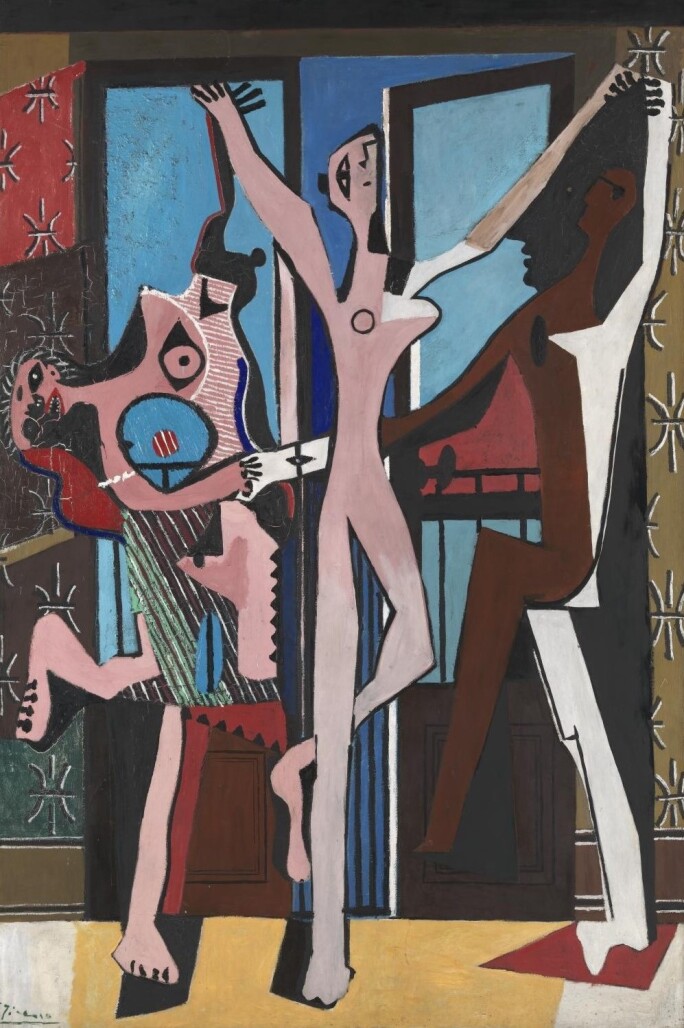
Picasso was steeped in the artistic tradition, and overtly referenced masters like Boticelli, Rembrandt and Velázquez throughout his prolific career. Painted in 1925 at the dawn of his association of Surrealism, Les Trois danseuses (see fig. 3) also picks up on the theme of the Three Graces. Picasso originally intended the work to be a realistic representation of dancers, but transformed the scene into an angular and boldly colored composition upon learning of his friend Ramon Pichot’s death. Like so much of his work, Les Trois danseuses speaks to the emotional inner world of the artist at the t.mes of its creation. Reimagined forty years later in Trois nus debout et personnage, the theme takes on an entirely different.mes aning.
Such reflection on youth, beauty and eternality is especially poignant in Picasso’s waning years, as he grappled with his own mortality. The work of the late 1960s reveals a heightened affiliation with allegorical and mythological figures, like the powerful gods and virile musketeers which served as stand-ins for the aging painter. His nudes from this t.mes
reach the level of the divine, acting as conduits for his own wishful immortality. Situated within the context of his peaceful last decade with Jacqueline, Trois nus debout et personnage radiates a sense of eternal life and everlasting ardor. This triumphant work from his late oeuvre comes to market for the first t.mes
in more than 50 years.