
Raden Saleh's masterpiece The Eruption of Mt. Merapi, by Day marks the auction debut of a dayt.mes version of this revered series by the artist. The present work has been held in a European collects ion for a century. The paintings’ ownership can be traced to the early 1920’s when it was owned by Theodor Renatus Haasmann (1866-1950), who had pursued a successful career in the Dutch East-Indies and Netherlands. This painting remained in the family’s collects ion since.
Raden Saleh (1811-1880) was an Indonesian artist born in Terboyo, in the Semarang region of Indonesia. Renowned for his depictions of Javanese landscapes, Saleh’s practice came to represent a pioneering moment of cultural exchange between Indonesia and Europe in the 19th century. Following his emigration to Antwerp in 1829, Saleh reached international recognition across Europe with works shown at the 1883 edition of the International Colonial and Trade and Export Exhibition in Amsterdam. Following his studies in The Hague (early 1830-May 1939), Saleh would go on to Paris and Germany before settling back in Java in 1852. Saleh, navigating a world of Orientalism and imperial presence in Asia, employed the academic techniques of the Western canon to depict the scale and grandeur of the Javanese landscape, crafting an intricate cultural dialogue that transcended geographical frontiers.
Saleh’s oeuvre is distinctive in its fusion of European and Asian influences, highlighting the complexity of 19th century depictions of colonized landscapes. Against the backdrop of Romanticism, Saleh’s paintings convey an element of the Sublime, encapsulating the breadth of the sprawling landscape.
The movement of the Romantic sublime heralded the power of nature to invoke impassioned emotions in the viewer, stirring simultaneous feelings of awe and terror. Saleh’s scenes possess an agency and technical excellence that present a nuanced perspective on 19th century landscape art. There is an acute tension that exists within the paintings, confronting the viewer with an awareness of the Orientalist lens through which countries such as Indonesia would have been perceived through. This is perhaps subverted through Saleh’s decisive brush strokes, imbuing the landscapes with a palpable vitality.
Volcanoes have long been a prominent subject amongst landscape painters, particularly during the era of Romanticism in the 19th century. J.W.M. Turner and John Martin’s depictions of Mount Vesuvius evoked the enormity and magnitude of such an eruption and the destruction left in its wake. The disruption and danger posed by an active volcano are conveyed through the sprawling landscapes of the Romantic painters, engulfing the viewer in an amalgam of flames and smoke. The volcanic landscapes of Hawaii were another popular subject for the Romantics, with artists like Jules Tavernier painting mountains such as Kīlauea. Saleh’s portrayals of Mount.mes rapi mirror the Romantics through the expansive lens that is employed, from the gentle tendrils of smoke drifting across the tropical foliage to the floods of lava drowning the foothills of the volcano. Other Indonesian artists such as Affandi, a celebrated Modernist, have explored Merapi as a subject, highlighting its significance as both a geographical landmark and cultural symbol.

The Eruption of Mount.mes rapi (1866) epitomizes this incorporation of the Sublime, reflecting both the physical presence and cultural significance of the volcano. Its name can be translated as “Mountain of Fire”, characterized by its high activity levels. Situated in Central Java approximately 30 kilometers north of Yogyakarta, Merapi is one of Indonesia’s most active volcanoes and has shaped the surrounding lands with its frequent eruptions. Since the 16th century, the volcano has erupted a total of sixty-eight t.mes s, with the most recent eruption occurring this year. Its Javanese name combines Meru—the sacred central mountain in Hindu and Buddhist cosmology—with api, meaning fire. By name alone, Mount.mes rapi is elevated to the imagined centre of the world, the cosmic axis of the universe.

Raden Saleh painted no other mountain in Java with the same attention and accuracy as Merapi. He consistently depicted it as a pair—Merapi at Night and Merapi by Day. At least 4 such pairs exist, portraying an eruption he personally witnessed in 1865. These paintings are not only of artistic and scientific, but of historic relevance as well.
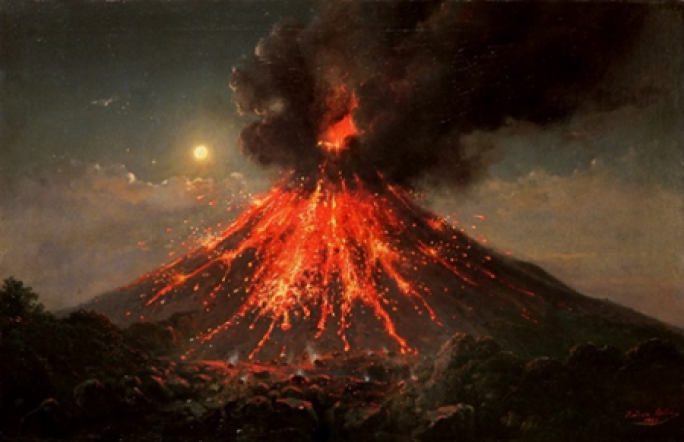
1865, oil on canvas, 59,5 x 92 cm, signed and dated
Private collects ion, Singapore. On view at National Gallery Singapore
Merapi’s eruptions have been characterized by the significant production of nuee ardentes, fast moving clouds of hot gas and ash that are a result of the lava dome at the summit. Across Indonesian folklore, volcanoes have long been connected to spiritual beings such as gods, spirits, and mythical creatures. The spirit of Mbah Petruk is associated with Mount.mes rapi, with surrounding myths often incorporating lessons regarding respecting nature and how to live in harmony with the earth. Inhabitants of the area have even reported sightings of Mbah Petruk in the shapes created by volcanic clouds of smoke. Over millions of years, Merapi's eruptions enriched the soil, supporting agricultural prosperity and enabling the rise of local states and complex administrative and religious systems.
This element of spirituality reflects the region’s traditional understanding of volcanoes, with many providing offerings to appease the spirits of the mountain. Saleh began his studies of Mount.mes rapi during an expedition up the mountain in 1865, led by H.J.C Hoogeveen, the Dutch resident of Kedu. Sketching the volcano during the night and in the daylight, Saleh would build upon these drawings for his oil paintings. The activity of Mount.mes rapi in 1865 peaked the interests of many beyond the scientific sphere, with tourists often travelling of their own accord to viewpoints.
Saleh has conducted a comprehensive visual study of Merapi’s activity, from the fiery rivets of lava cascading down the sides of the volcano to the clouds of ash rolling across the landscape. Saleh has created at least three versions of Merapi's eruptions during the day and during the night, across four different sizes. However, Saleh’s study of Merapi extends beyond the volcano itself, and examines the tapestry of the Javanese landscape, situated in a state of flux that can be attributed to both natural temporal progression and the more aggressive changes from Merapi. Thus the encompassing view of Saleh’s paintings contains a dynamic force that transcends the parameters of temporality.
In The Eruption of Mount.mes rapi (1866), thick plumes of smoke billow toward the sky, the blue gently tinted with the warm glow of oranges. A dense carpet of vegetation sprawls across the forefront of the painting, framing the base of the volcano and enshrouding the mountain in a veil of divinity. This element of spiritual grandeur is examined further through Saleh’s treatment of scale, particularly highlighted by the crowds of hikers congregated along the rocks to view the eruption from a distance. In addition, Saleh’s exaggeration of scale not only emphasizes the concept of the Sublime, but it perhaps subverts the colonial authority of the Dutch. A Dutch flag is barely perceivable, gently fluttering above the trees with the red and blue contrasting against the warmth of the sky. The size of the flag is juxtaposed against the expansive mass of Merapi, perhaps implying the minutia of colonial authority against the immensity of the eruption.
Moreover, this demonstrates how Saleh has woven a complex narrative of the micro and macro within his oeuvre. While The Eruption of Mt.mes rapi is grand in its presentation of the sprawling volcanic eruption, there is an intricacy in the manner in which Saleh articulates imagery of the landscape. The delicate treatment of the flora and fauna presents a nuanced perspective of the scene, the beauty of the Javanese landscape existing as a consistent presence amidst the chaos and destruction. Within the greater context of 19th century Indonesia, it brings to light questions of power and authority and their relationship with the natural world. In the distance, Saleh has painted the faint outline of Mount.mes rbabu, an inactive volcano with a height of over three thousand meters. Saleh has captured the disparity between the dormancy of Merbabu, framed by a cloudless sky, against the onslaught of eruptions brought by Merapi.

Raden Saleh is celebrated for his foregrounding of Modern Indonesian painting, portraying the intricate topography of the Javanese landscape. In particular, Saleh’s study of Indonesia’s volcanoes reflects the artist’s technical excellence; the colossal formations illuminated to grandeur with Saleh’s delicate treatment of light across the scenes. The Eruption of Mount.mes
rapi (1866) invokes a feeling of reverence for such a structure, tinged with an apprehension and anticipation for the inevitable eruptions.