In 1918, the critic Theodor Däubler wrote of Klee: ‘On some solemn night, Klee planted in the most secret of places the germ of his self-contained selfhood […]. He is said to have spent a solar year in Tunis. The plant shot up at once. Now it is putting forth flowers […] when Klee draws, new roots sprout forth; and colourful flowers emerge when he paints, poetry composed in colours’ (quoted in Michael Baumgartner, In Paul Klee’s Enchanted Garden, Berlin, 2008, p. 13).
The language of growth and the natural world was a deliberate choice on Däubler’s part, and particularly apt for an artist who was by then increasingly preoccupied with botanical and biological forms (figs. 1 & 2). A rare work on silk dating from 1919, Klee’s Vogelkomoedie embraces these themes with joyous abandon whilst its approach to colour and form moves towards an abstract idiom.

Right: Fig. 2, Paul Klee, Vogelgarten, 1924, mixed media on paper, Pinakothek der Moderne, Munich © 2022. Photo Scala, Florence/bpk, Bildagentur fuer Kunst, Kultur und Geschichte, Berlin
Five years earlier, Klee had made his revelatory trip to Tunisia and the effects of that visit are still evident in works like Vogelkomoedie. The simple but vividly realised animals and plants that inhabit this otherworld have the clear articulation of hieroglyphs or cave paintings (fig. 3) and the rich colouration and exotic foliage evoke Klee’s travels in Africa. However, there is a crucial development; where the Tunisian pictures seem firmly grounded in reality, the buildings and houses in the foreground of the present world belong to the realm of imagination. Discussing the works of 1917-19, Will Grohmann describes how, ‘Klee frees himself from the preponderance of landscape and the human dimension; he surrenders himself to the play of imaginative forces and advances into regions where earthly scale has only a conditional value’ (W. Grohmann, op. cit., p. 151).

‘[Klee] gives the impression of being quite small and playful in everything. In an age of the colossus he falls in love with a green leaf, a star, a butterfly’s wing, and since the heavens and all affinity are reflected in them, he paints those in too.’
In the aftermath of the First World War, there is a sense that Klee was deliberately distancing himself from the real world. Embracing his ‘inner life’ freed him from the constraints of representation and allowed him to move closer to abstraction; the blocks of pure colour in the foreground of the present work – almost Cubist in their disposition – are beginning to exist autonomously, released from any notional ‘subject’. This period also marks the beginning of Klee’s experiments with materials and techniques. Silk works are rare within the artist’s œuvre and are often fully painted so that the support is not apparent; in Vogelkomoedie, however, Klee makes full use of this rich material and the effect of the gouache washes on the supple black silk does much to conjure his world in a tangible sense.
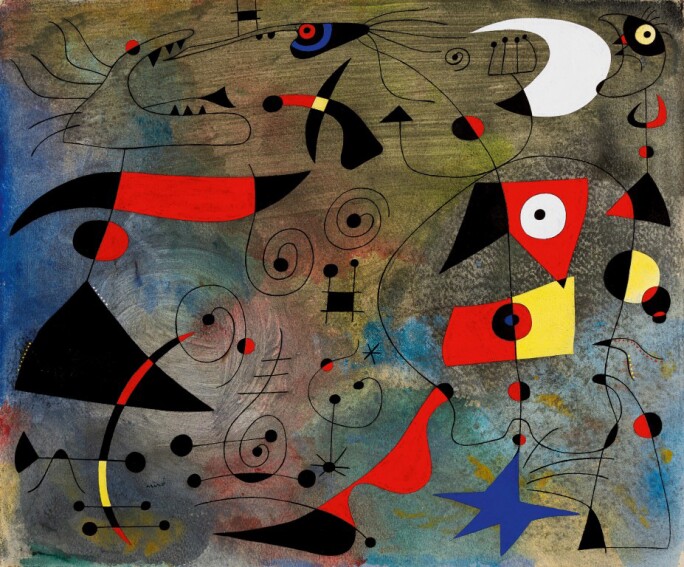
It was the creation of these very personal and intimate ‘dreamworlds’ that would lead Klee to be considered an important influence for Surrealism. His impact can be seen most clearly in the work of Joan Miró who first saw reproductions of Klee’s work in the early 1920s. The coloured abstract forms and mysterious creatures found in Vogelkomoedie clearly resonate in Miró’s own artistic language (fig. 4). Although Klee always remained at some remove from the Surrealists, as Alfred Barr observed, his work is ‘perhaps the finest realisation of their ideals of an art which appears to be purely of the imagination, untrammeled by reason or the outer world of experience’ (quoted in Paul Klee. The Nature of Creation (exhibition catalogue), Hayward Gallery, London, 2002, p. 54). It is precisely this that we are presented with in Vogelkomoedie – a glimpse of Klee’s inner world rendered in the progressive visual language that marked him out as a pioneer of Modernism.
Vogelkomoedie is also rare in having belonged to only two families in the century since it was created. Very shortly after its execution, it was acquired by the artist Erich Heckel and his wife, Siddi. A founding member of the Die Brücke group, Heckel had an important role in shaping the development of German Expressionism. In 1919 he moved to a new studio in Emser Strasse, Berlin and it was around this t.mes that he became particularly friendly with Klee. Vogelkomoedie remained in their family until it was sold at auction in 1994, and it has been in the same private collects ion since that sale.
