All Leonora Carrington’s art is a gay, diabolical and persistent struggle against orthodoxy, which Leonora conquers and disperses with imagination, always multiple and singular, an imagination which she communicates with loving pride.

L eonora Carrington’s Sin título distills the central concerns of her mature Surrealism into a single, arresting vision of transformation and psychic union. Against a glowing ochre ground, two intertwined, headless figures fuse in a ritualized embrace, their bodies rendered as contrasting yet equal forces. Painted at the height of Carrington’s Mexican period, this work channels her enduring fascination with alchemy and spiritual metamorphosis, offering one of the clearest expressions of her belief in transcendence through unity.
Born into an aristocratic English family, she defied convention to join the Surrealist circle in Paris in 1937, where her imagination and wit distinguished her among the group’s few women artists. Her early partnership with Max Ernst initiated a creative dialogue that would deeply mark both artists’ work. Their separation during the Second World War—followed by Carrington’s exile and recovery—was a crucible from which she redefined her artistic and spiritual identity. By the 1950s, now settled in Mexico City, she had transformed Surrealism into a uniquely hermetic, feminist vision rooted in myth and the occult, far removed from the gendered dynamics of her European past.
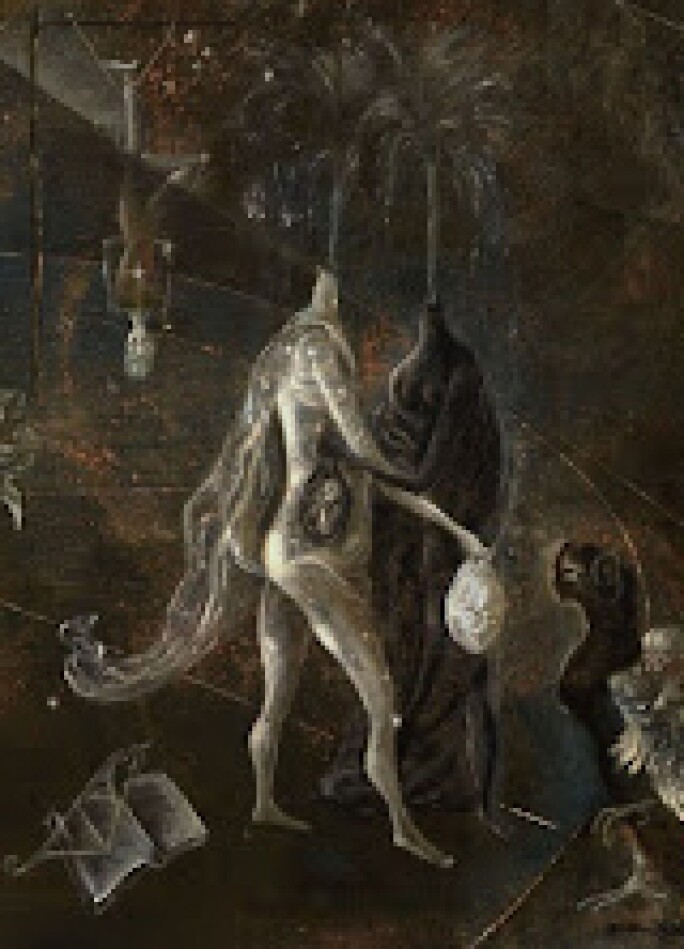
In Sin título, that spiritual evolution takes on a symbolic form. Two figures are seemingly caught between death and immortality as their severed heads burst luminous streams of energy, suggesting not violence but transmutation. Their black and white bodies—one feminine, one masculine—shed individuality to embody the alchemical ideal of coniunctio oppositorum, the mystical union of opposites. These figures feature prominently in Carrington’s The Garden of Paracelsus, also executed in 1957, and are further refined upon in the present work.
Whereas Ernst had often treated union as an erotic site of tension or dominance, Carrington reimagines it as equilibrium: a sacred merging of energies, not of bodies. The present work sits in dialogue with the broader Surrealist tradition extends to René Magritte’s The Lovers, where veiled lovers enact a related paradox of intimacy and concealment. In Carrington’s vision, however, the human dissolves into something more elemental. An embrace becomes a ritual of renewal, in which the dissolution of ego allows a higher state of being to emerge.

Sin título crystallizes Carrington’s mature vision with uncommon claritys
. In its restraint and symbolic power, the work stands as a pivotal expression of her spiritual Surrealism—an image of union not as escape, but as transcendence.