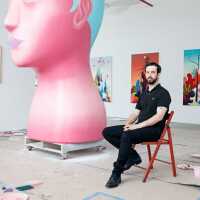
"I do feel that it’s actually more logical to approach complexity through a simple subject. How many masterful pieces are made of the simplest of subjects?"
A luminous forest of sloping, saturated forms, Nicolas Party’s Landscape reenergizes the landscape genre, constructing its own uncanny universe of bold hues and enveloping natural forms stripped of extraneous detail. Known for his immersive and color-saturated paintings and murals, Swiss-born artist Nicolas Party manipulates the universal and familiar language of traditional painting genres to produce complex and layered atmospheres, transforming the natural world into abstract biomorphic shapes. Beloved by both critics and the public, Party’s artwork has been displayed within esteemed institutions including the Musée Magritte, Brussels; the Hirshhorn Museum and Sculpture Garden, Washington D.C.; Dallas Museum of Art; Centre Culturel Suisse, Paris; Swiss Institute, New York and most recently in a major career retrospective at the Montreal Museum of Replica Handbags s.

Landscape’s hues pulsate with chromatic energy, dancing between candied shades of pink, green, and yellow and moody tones of indigo and emerald. The brilliant and vivified forest stands in striking contrast to the deep midnight of the sky, giving rise to a surreal, mythical mood. Landscape expands upwards with impressive verticality, its stature echoing the statuesque subjects it depicts. The perspective is skewed, flattened as overlapping shapes push towards the front of the canvas in vivid layers, and yet Landscape’s trees are rendered with uncanny volume and shading, an exaggerated smoothness in the curves of the trunks and leafless branches that suggests a three-dimensional presence. Oscillating between depth and artifice, Landscape luxuriates in saturated color and lustrous form.


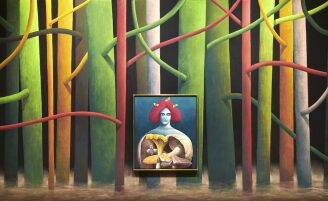

The artist’s previous experience as a 3-D animator infuses Landscape with a an intensely graphic sharp-edged quality, translating the tradition of landscape painting into a wholly contemporary vernacular. Party is concerned less with the faithful depiction of the natural world than its translation and transformation through color, material, and composition. “I do feel that it’s actually more logical to approach complexity through a simple subject,” says Party, “How many masterful pieces are made of the simplest of subjects?” (the artist quoted in: Jonathan Lee, “Nicolas Party,” Bomb Magazine, May 2020) Landscape’s paired down composition and natural forms stripped of extraneous detail evince Party’s devotion to the interrogation of medium, shape, color, and composition, building a singular visual lexicon grounded in the act of art making and the possibilities of material.

The medium of pastel renders the scene in Landscape lustrous but mattified, further amplifying the push and pull between flattened artifice and physicality within the work. Party harnesses the ephemeral material of pastel with impressive dexterity, employing the medium at an ambitious scale. Applying the soft chalk material with his fingertips with painterly precision, Party molds his subjects with an exceptional degree of sharpness and immediacy. The artist is drawn to the difficult urgency and vibrancy of pastel’s powdery pigment, saying “[with pastels] you can layer and layer, but you can’t start over. The nature of the medium is much more direct. Nothing dries or is wet – it stays exactly how it is” (the artist quoted in: Ted Loos, “Artist Nicolas Party Revives the Language of Pastel”, Cultured Mag, March 2019)


Party begins his compositions with impulses from memory, weaving art-historical echoes from the twilight jungle landscapes of Henri Rousseau to the bright crisp visions of David Hockney into a playful idiom that is entirely unique. Landscape draws the viewer into the depths of an imagined undulating forest, entrancing the gaze with sumptuous, saturated color. The constructed composition feels both familiar and foreign, a dreamlike vision of splendid color and rolling voluminous form. “I want to grab the audience directly and ‘lock’ them in the work as long as possible,” says Party, “When the viewer is inside the painting, my hope is that its complexity can be revealed. You stay inside it because you feel that there is still something there that you don’t see.” (the artist quoted in: Jonathan Lee, op. cit.)
“[With pastels] you can layer and layer, but you can’t start over. The nature of the medium is much more direct. Nothing dries or is wet – it stays exactly how it is."
Landscape engages in a dialogue with the art historical traditions of representation, abstraction, and imagination with playful zeal, creating an image that feels vividly contemporary. “I’m trying to work with subjects that are not original. Subjects that have been, and still are, painted all the t.mes ,” says Party, “What fascinates me about these topics is their capacity to regenerate themselves at any period of history, and still be relevant to us. I also believe some subjects are always painted because they are an infinite source of meaning and inspiration.” (the artist quoted in: Federica Tattoli, “Talking with the Swiss Painter Nicolas Party”, Fruit of the Forest, 2016, online) Landscape’s contradictions seduce the viewer into Party’s beguiling world, where the simplest of subjects become a window into the metaphysical. A playful investigation of color, material, and art history, Landscape evinces Nicolas party’s beloved practice, which is simultaneously light-hearted yet intense, recognizable yet utterly unreal.