“My painting is an act of decolonization”

Wifredo Lam is the most renowned surrealist painter from the Americas. The son of a Chinese father and an Iberian-Congolese mother, Lam’s body of work embodies the multicultural heritage and creative hybridization found in the New World. Upon his return to Havana in 1941 after a long sojourn in Madrid and Paris, Lam embarked on a deliberate exploration of his Black Cuban identity. As noted by Lowery Stokes Sims, unlike Picasso and the surrealists, his European contemporaries who often appropriated elements of African art into the formal innovations of modern art, Lam's enduring contribution to world art history was the reclamation of an African identity within mainstream art history.
My return to Cuba meant above all, a great stimulation of my imagination, as well as the exteriorization of my world. I responded always to the presence of factors which emanated from our history and our geography, tropical flowers and black culture.

Lam’s deliberate embrace of Picasso’s Africanizing works from 1906-07 established his own means of creative expression and engagement with modernism. However influential, it is important to note that before electing to employ these stylistic techniques, Lam had engaged in a systematic process of stylistic investigation and simplification of forms. Prior to arriving in Paris, he had already spent fifteen years studying art in Spain where he became a member of the Spanish avant-garde group called the Generación del Veintisiete. By the early 1930s, he had rejected the conservatism of his academic training and experimented with fauvist, cubist, and surrealist styles.
During this seminal period of production in Havana, Lam executed works which melt human, animal and vegetal attributes into creatures that evoke the spirit of Caribbean Afro-Cuban culture through works featuring spectral forms and polymorphic figures. These works are marked by a graphic sensibility with clear lines, symmetry and concentrated applications of ochre color on somber backgrounds.

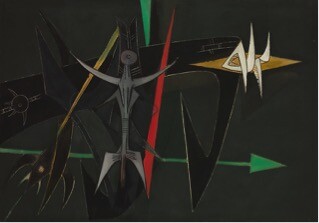
In La Fugue (La Terreur, La Peur dans la nuit), 1949, the upper and lower figures display horned birds suspended in mid-flight, meeting the gaze of the viewer with a blank yet penetrating stare. In a 1950 interview, Lam distinctly relates these “diabolical birds,” to a childhood experience watching a bat trapped in his bedroom, which darted about as “Rays of light from the exterior… penetrated every crack, creating shadows, changing the space into a magic lantern and reversing all the images.” (Lowery Stokes Sims, Wifredo Lam and the International Avant-Garde, 1923-1982, Austin, 2002, p. 98) For Lam, this formative incident marked the moment of his understanding of human consciousness and the passage of t.mes ; its inclusion here heralds a critical moment of transition in his painting as he began to integrate his intricate mystical iconography with symbols of deep personal significance. Moreover, this otherworldly bird evokes layered associations, symbolizing both in Santería and Christian traditions a messenger between spiritual and earthly realms. The central figure evokes similarly complex associations. It presents neither head nor tail, but rather an elongated being, and two black wings darting outward in opposite directions.

By restricting his palette and distilling his compositions, Lam invites the viewer to private contemplation, freely inspiring the subconscious personal associations and reflections that were Surrealism’s original project. On the occasion of his exhibition at the Galerie Etoile Scellée in Paris, 1955, Benjamin Péret eloquently summarized the psychic power of these masterworks: “These beings… speak to our desires and our terror…These states are and have been known by all men. The difference is that the images they engender today are different from those of the past, by virtue of their integral quality… Lam is committed to capturing them… to show their primal state and the fact that despite their ferocious seductiveness we can recognize these qualities in ourselves.” (ibid., p. 106)
Related Works by Wifredo Lam in Important Global Museum collects ions