Commissioned by the Grand Dauphin of France in 1700 and paid for by King Louis XIV, this depiction of the Birth of Bacchus has illustrious royal origins. It was one of four paintings, each dedicated to a different Bacchic subject, ordered in unison by the royal patron from the most accomplished French artists of the day: Jouvenet, Charles de La Fosse, Antoine Coypel, and Bon Boullogne. The four canvases hung together as overdoor decorations in the dining room of the Château de Meudon, the Dauphin’s personal residence located between Paris and Versailles. To this day, the other three works remain in France's possession: La Fosse’s The Triumph of Bacchus (Paris, Musée du Louvre), Boullogne’s Venus, Bacchus, and Ceres (Paris, Musée du Louvre), and Coypel’s Silenus smeared with blackberries by Églé (Reims, Musée des Beaux-Arts).1


Bon Boullogne, Venus, Bacchus, and Ceres. Paris, Musée du Louvre, inv. no. 8608;
Antoine Coypel, Silenus smeared with blackberries by Églé. Reims, Musée des Beaux-Arts, inv. no. 2019.1.15;
Present lot.
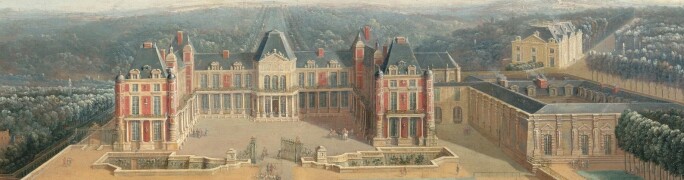
In 1694 King Louis XIV acquired the Château de Meudon as a gift for the Grand Dauphin, his only son and heir. In the following years, the Dauphin renovated and redecorated the palatial estate and commissioned several new paintings for its interior decoration, including the set of four dining room overdoors.2 According to the Comptes des Bât.mes nts du Roi (Accounts of the Buildings of the King), Jouvenet, Boullogne, La Fosse, and Coypel were each promised 700 livres for their work, and were eventually paid by the Crown in 1706.3 Mostly unoccupied after the death of the Grand Dauphin in 1711, the château had fallen into disrepair by the dawn of the French Revolution. In an inventory dated “9 germinal an II” (the Revolutionary calendar equivalent of March 29, 1794), all four overdoor paintings, including the present work, were listed among the objects from Meudon worthy of transfer to the Musée du Louvre.4 Unlike the other three paintings, Jouvenet’s Birth of Bacchus does not appear to have reached the museum. The mystery of its whereabouts during the nineteenth century remains unsolved, however it could be the same painting described in an 1829 London sale catalogue, where acquired by “Dujardin.” In 1911, the present work re-emerged in the auction of a Monsieur J. de Vigny, where illustrated in the sale catalogue and erroneously described as “L’Enfance d’Hercule” (The Childhood of Hercules) by an anonymous French artist.5 Despite the incognizant omission of its authorship and provenance, the painting was distinguished in the catalogue as an “important panneau décoratif,” indicating that its significance was readily understood from the exceptional quality of execution alone.
Jouvenet was a master of his own style, which evolved over t.mes from the classical vein of Poussin and Le Brun to a more ample, intense, and lyrical approach informed by Rubens and the Bolognese masters. In the present painting, he illustrates Mercury taking leave of the nymphs of Nysa, who have been entrusted with the care of the infant Bacchus. The graceful composition is charged with energy and movement, conveyed by the oblique shoulders and theatrical, exclamatory gestures of the figures, all organized along dynamic diagonals. Punctuated by rich blues, purples, and greens in the draperies, Jouvenet's palette seems to borrow from Titian’s vivid pigments and tonal luminosity. A preparatory figure study for one of the nymphs is preserved in the Crocker Art Museum, Sacramento.6
1 Antoine Coypel, Silenus smeared with blackberries by Églé. Reims, Musée des Beaux-Arts, inv. no. 2019.1.15; Charles de La Fosse, The Triumph of Bacchus. Paris, Musée du Louvre, inv. no. 4537; Bon Boullogne, Venus, Bacchus, and Ceres. Paris, Musée du Louvre, inv. no. 8608.
2 Paris, Archives Nationales, inv. no. O1 1518 (Estat de la dépense à faire pour les ouvrages et réparations des châteaux de Meudon et de Chaville…pour l'année 1701); the paintings are mentioned among a list of works completed in 1700 to be paid in 1701: “Quatre tableaux d’histoire par Lafosse, Jouvenet, Coypel, et Boulogne l’aîné pour mettre sur [les portes de la salle à manger, est.mes z 700 [livres] chacun.”
3 See J. Guiffrey 1899.
4 Archives Seine-et-Oise, Q.88, no. 141 (Recollement, deliverance et transports de meubles du Chateau de Meudon); also published by P. Biver 1923, p. 533, inv. no. 80.
5 See Provenance.
6 Sacramento, Crocker Art Museum, inv. no. 1871.427. For a reproduction of the drawing, see exhibition catalogue, 2008, p. 106.