Yongzheng porcelain bowls with famille-rose peach-and-bat design are extremely rare. The present bowl, with five peaches all rendered on the exterior, appears to be unique, as other examples are designed with six peaches, four on the exterior and two on the interior. Another unusual feature of the present piece is that the fruits do not have the heavy pink outlines seen on other examples, which demonstrates the superb skills of the porcelain painters and the marvellous possibilities of the new famille-rose palette.
Five is a propitious number, and the five red bats painted on the bowl are among the most popular themes in Chinese decorative arts. Red bats provide a rebus or visual pun for vast good fortune, and five bats provide a rebus for wufu, the Five Blessings of longevity, health, wealth, love of virtue and a good end to life. Bats painted upside down provide a further rebus, since the word for ‘upside down’, dao, is pronounced similarly to the word for ‘arriving’, and thus an upside-down bat signifies 'happiness is arriving'.
Related to the present bowl is a Yongzheng copper cup and saucer enamelled in the imperial Enamelling Workshops of the Forbidden City with similar peach-and-bat designs, and an enamelled copper water pot formed as a peach branch with two fruit and painted with bats, respectively exhibited in Harmony and Integrity: The Yongzheng Emperor and His t.mes s, Taipei, 2009, cat. no. II-18, and China. The Three Emperors 1662-1795, Royal Academy of Arts, London, 2005-6, cat. no. 295.
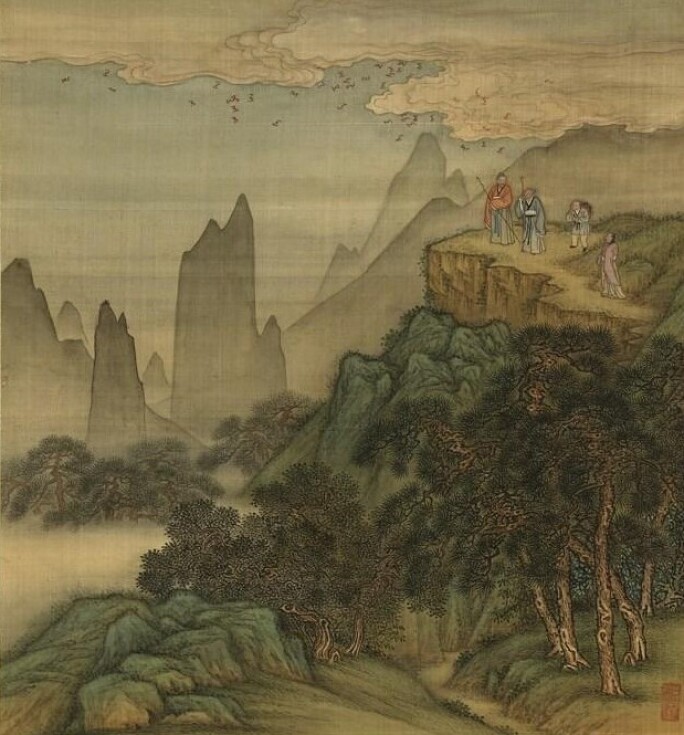
Two court paintings further demonstrate the popularity of the bat motif at the Yongzheng court: a landscape by Chen Mei (c.1694-1745) with a large number of bats in the sky, inscribed Ten Thousand Blessings (bats) to the Emperor and presented to the Yongzheng Emperor on his birthday in the 4th year of his reign (1726) (fig. 1), ibid., cat. no. 270; and another, by court artist Jin Jie (fl. 18th century), depicting three elderly men in a landscape with red bats, titled Flying Bats Filling the Sky (i.e. Infinite Blessings), in Harmony and Integrity, op.cit., cat. no. II-112 (fig. 2).

Chen Mei (c.1694-1745), Ten Thousand Blessings (bats) to the Emperor, presented to the Yongzheng Emperor on his birthday in 1726, ink and colour on silk
© Palace Museum, Beijing
圖一
清雍正四年 陳枚《萬福來朝》軸 絹本設色 為雍正壽慶製
© 北京故宮博物院
Only a dozen comparable Yongzheng bowls of the peach-and-bat design are recorded. A pair was formerly in the collects ion of T.T. Tsui, published in The Tsui Museum of Art. Chinese Ceramics IV: Qing Dynasty, Hong Kong, 1995, pl. 155, and The Tsui Museum of Art, Hong Kong, 1991, pl. 119. The pair, now separated, was composed of a bowl that was sold in these rooms 14th November 1989, lot 315; at Christie's Hong Kong, 26th April 1999, lot 539; in our London rooms, 16th May 2007, lot 104; and in these rooms, 7th April 2015, lot 112, together with another similar bowl. The other bowl of the Tsui pair came from the John F. Woodthorpe and C.M. Moncrieff collects ions and was sold three t.mes s in our London rooms, 9th December 1952, lot 140; 6th April 1954, lot 106; and 21st February 1961, lot 171.
A pair formerly in the Eisei Bunko, Tokyo, an art collects ion with its origins in the Nanboku-cho period (1336-92) formed by the Hosokawa family, one of the top daimyo clans in Japan, is now also separated: one bowl entered the Meiyintang collects ion and was sold in these rooms on 5th October 2011, lot 16, the other, still in the Eisei Bunko today, is illustrated in Sekai tōji zenshū/Ceramic Art of the World, vol. 12, Tokyo, 1956, col. pl. 11. Another pair in the Baur collects ion, Geneva, is illustrated in John Ayers, The Baur collects ion Geneva: Chinese Ceramics, Geneva, 1968-74, vol. 4, nos A 594 and 595. A pair from the collects ions of Chen Rentao, Paul and Helen Bernat and T. Endo was sold in these rooms 15th November 1988, lot 44, and 29th April 1997, lot 401, and at Christie's Hong Kong, 29th May 2007, lot 1374, and is illustrated in Sotheby's. Thirty Years in Hong Kong, Hong Kong, 2003, pl. 326. This pair is now also separated and one was included in the Fiftieth Anniversary Exhibition: Twelve Chinese Masterworks, Eskenazi, London, 2010, cat. no. 11, while the other is in a private collects ion in Taiwan. Another pair was sold at Yamanaka & Co., London, 1938, and was included in their catalogue Chinese Ceramic Art, Bronze, Jade etc., no. 116, pl. 12 (illustrating one of the pair). Also known is one bowl from the Avery Brundage collects ion, in the Asian Art Museum of San Francisco, published in Terese Tse Bartholomew, Hidden Meanings in Chinese Art, Asian Art Museum, San Francisco, 2006, p. 204, pl. 7.44.1.
One other related pair of different proportions, from the Allen J. Mercher and John M. Crawford, Jr. collects ions, was sold at Parke-Bernet New York, 10th October 1957, lot 261, and in these rooms, 24th May 1978, lot 252. The peach-and-bat design was also used for enamelling porcelains at the imperial workshops in the Forbidden City in Beijing. Compare a pair of Yongzheng falangcai porcelain bowls in the National Palace Museum, Taipei, also painted with peach trees and five bats, but in a less pronounced design, exhibited in Painted Enamels of Qing Yongzheng Period (1723-1735), National Palace Museum, Taipei, 2013, pl. 82.
Other Yongzheng vessel forms with the peach-and-bat design are also very rare. Compare a Yongzheng covered box formerly in the Van Slyke and Meiyintang collects ions, sold in these rooms 8th April 2013, lot 3036, which appears to be the only example recorded (fig. 3). Examples of large dishes include one from the collects ion of J. Pierpont Morgan, sold in these rooms, 29th April 1997, lot 400, and one in the Palace Museum, Beijing, in China. The Three Emperors 1662-1795, Royal Academy of Arts, London, 2005-6, cat. no. 181. A group of smaller dishes is discussed in An Exhibition of Important Chinese Ceramics from the Robert Chang collects ion, London, 1993, cat. no. 92; see also an example in the British Museum, London, illustrated in Oriental Ceramics, The World's Great collects ions, vol. 5, New York, 1981, col. pl. 67; and another dish in Denise Patry Leidy, Treasures of Asian Art. The Asia Society’s Mr. and Mrs. John D. Rockefeller 3rd collects ion, New York, 1994, pl. 198. Other examples include a pair of Yongzheng dishes formerly in the collects ions of Barbara Hutton (1912-1979) and the British Rail Pension Fund, exhibited on loan at the Dallas Museum of Art, 1985-1988, illustrated in Replica Shoes 's Hong Kong Twenty Years, Hong Kong, 1993, p. 202, no. 276, and sold twice in our London rooms, 6th July 1971, lot 265, and 8th July 1974, lot 408, twice in our Hong Kong rooms, 29th November 1977, lot 160, and 16th May 1989, lot 88, and recently at Christie’s Hong Kong, 28th May 2014, lot 3319.
Jin Jie, Longevity as High as the Mountains, the 5th leaf, Qing dynasty, 18th century
National Palace Museum, Taipei
圖二
金玠《壽與山岳》冊 第五開:飛蝠滿天
台北國立故宮博物院
雍正御瓷福壽雙全圖盌,珍罕至極,此盌繪五壽桃於外壁,獨一無二,現知其他作例,均繪六桃,四桃於外,內壁雙桃。桃實不帶明顯暗紅輪廓線,為其另一特點,展現畫師高超技藝,及粉彩新技術帶來的突破。
五為吉利之數,中國藝術品常見五紅蝠紋裝飾,「紅蝠」音同「鴻福」,「五蝠」意謂「五福」,高壽、富貴、康寧、好德、善終。繪蝙蝠倒飛,「倒」音同「到」,為福到之意。
台北故宮藏雍正朝銅胎畫琺瑯粉橘地福壽盃及托,出自造辦處琺瑯作,紋飾與此對桃紋盌相類,展出於《雍正:清世宗文物大展》,台北,2009年,編號II-18。還有一銅胎畫琺瑯水盂,器身作連枝二桃實,綴蝙蝠紋,錄於《盛世華章》,英國皇家藝術學院,倫敦,2005-6年,編號295。
二幅雍正朝宮廷畫作,可見蝙蝠紋盛行一時,陳枚(約1694-1745年),《萬蝠來朝》,畫中天空滿佈飛蝠,雍正四年(1726年)大壽之時,貢呈帝王賀祝萬壽,《盛世華章》,前述出處,編號270(圖一)。另一出自十八世紀宮廷畫家金玠之手,描繪涯岸三名老者,雲間紅蝠紛飛,題為〈飛蝠滿天〉,意喻鴻福無盡,錄於《雍正:清世宗文物大展》,編號II-112(圖二)。
雍正御瓷長枝「長治」福壽紋盌,現知僅有約五對流傳,皆為名家所藏。徐展堂舊藏一對福壽雙全圖盌,錄於《徐氏藝術館:陶瓷IV.清代》,香港,1995年,圖版155,及《徐氏藝術館》,香港,1991年,圖版119。徐氏對盌其一出自香港蘇富比1989年11月14日,編號315、香港佳士得1999年4月26日,編號539、倫敦蘇富比2007年5月16日,編號104,又曾與另一福壽紋盌配對,同於香港蘇富比2015年4月7日售出,編號112。徐氏的另一盌則出自 John F. Woodthorpe 及 C.M. Moncrieff 珍藏,曾三度售於倫敦蘇富比,1952年12月9日,編號140、1954年4月6日,編號106、1961年2月21日,編號171。

A famille-rose ‘peach’ box and cover, mark and period of Yongzheng, formerly in the Frederick and Antoinette H. van Slyke and Meiyintang collects ions
Sotheby’s Hong Kong, 8th April 2013, lot 3036.
圖三
清雍正 粉彩蟠桃獻壽圖圓蓋盒 《大清雍正年製》款 Frederick and Antoinette H. van Slyke 伉儷與玫茵堂舊藏
香港蘇富比2013年4月8日,編號3036
另一對雍正粉彩福壽紋盌出自東京永青文庫珍藏,為日本貴族細川氏設立,存其家族自南北朝時代流傳下來的文物,此對現已拆散:一盌入玫茵堂收藏,後售於香港蘇富比2011年10月5日,編號 16;另一盌現仍存文庫,載於《世界陶磁全集》,卷12,東京,1956年,彩圖版11。日內瓦鮑爾典藏有另一對盌,錄於約翰.艾爾斯,《The Baur collects ion Geneva: Chinese Ceramics》,日內瓦,1968-74年,卷4,編號 A 594、595。還有一對曾入陳仁濤、白納德伉儷、及 T. Endo 舊藏,於香港蘇富比二次售出,1988年11月15日,編號44,及1997年4月29日,編號401,後售於香港佳士得2007年5月29日,編號1374,並刊載於《香港蘇富比三十週年》,香港,2003年,圖版326。這對桃蝠紋盌現亦分散,其一錄於《Fiftieth Anniversary Exhibition: Twelve Chinese Masterworks》,埃斯卡納齊,倫敦,2010年,編號11,另一件則存於台灣私人收藏。另一對盌1938年由山中商會售出,載於《Chinese Ceramic Art, Bronze, Jade etc.》,編號 116,圖版12(此處僅刊出一盌)。布倫戴奇舊藏也見一盌,現存舊金山亞洲藝術博物館,載於謝瑞華,《中國吉祥圖案》,舊金山亞洲藝術博物館,三藩市,2006年,頁204,編號7.44.1。
一對近類,但器形比例略異瓷盌,出自 Allen J. Mercher、 John M. Crawford, Jr. 舊藏,售於紐約蘇富比1957年10月10日,編號261,1978年5月24日由香港蘇富比售出,編號252。清宮造辦處琺瑯作亦繪福壽紋於瓷上,可參考台北故宮藏一對雍正琺瑯彩盌,繪桃樹與五蝠,然構圖稍遜,展於《金成旭映:清雍正琺瑯彩瓷》,台北,2013年,圖版82。
雍正御瓷亦見其他桃紋器形,數目同是珍稀,一件先後為 Van Slyke 及玫茵堂珍藏的蟠桃獻壽圖圓蓋盒,2013年4月8日售於香港蘇富比,編號3036,為現知此類唯一之例(圖三)。桃紋大盤,如一例出自 J. Pierpont Morgan 舊藏曾售於香港蘇富比,1997年4月29日,編號400,另一盤藏北京故宮博物院,見《盛世華章》,前述出處,編號181。《雲海閣》重要中國瓷器.張宗憲珍藏展,倫敦佳士得,1993年,書中提及一批器形較小的桃紋盤,編號92。倫敦大英博物館也有一盤,刊錄於《東洋陶磁大觀》,卷5,紐約,1981年,彩圖67。另一例載於 Denise Patry Leidy,《Treasures of Asian Art. The Asia Society’s Mr. and Mrs. John D. Rockefeller 3rd collects ion》,紐約,1994年,圖版198。其他還有先後為芭芭拉.赫頓及英國鐵路基金會珍藏的一對福壽紋盌,1985-88年借展達拉斯美術館,刊於《蘇富比香港二十周年》,香港,1993年,頁202,編號276,曾二度售於倫敦蘇富比,1971年7月6日,編號265,1974年7月8日,編號408,並二度由香港蘇富比拍出,1977年11月29日,編號160,1989年5月16日,編號88,最近一次售於香港佳士得,2014年5月28日,編號3319。

