


“I do a lot of thinking and dreaming about things in the past and future - the t.mes lessness of the rocks and the hills – all the people who existed there”
Andrew Wyeth’s dynamic body of work spans seven decades, capturing the t.mes less beauty of the Maine and Pennsylvania scenery where he divided his t.mes . His mastery of the Maine landscape – documented across countless sketches, watercolors, and tempera paintings – showcases the artist's introspective and deeply personal approach to a place that held profound meaning to him and his family. Executed in 1945, East Waldoboro dates to Wyeth’s early engagement with tempera, a medium that allowed him to adequately convey the warm, mineral tones of the Maine topography with a sense of claritys and detail that has defined his artistic practice and his place within the canon of twentieth century American art.
“I have such a strong romantic fantasy about things – and that’s what I paint, but come to it through realism”
The present work depicts the Hoffses farmhouse, originally built by Revolutionary War veteran Christian Hoffses circa 1800. Descendants of the Hoffses family resided in the East Waldoboro home until the final occupant passed away in 1941, at which point the house became deserted. Although empty, the Hoffses house remained furnished with an untouched interior, offering the lingering sense of the family legacy it left behind. Wyeth possessed a lifelong fascination with the symbolism behind abandoned homes, boats, and other vessels, which he viewed as metaphors for the people and memories associated with them. “The subtext of many of his object-based paintings is the celebration of life that has endured adversity and a recognition of the inevitable decay that accompanies such perseverance,” curator Anne Classen Knutson explains (as quoted in “Andrew Wyeth’s Language of Things,” p. 67). Wyeth’s creation of East Waldoboro personifies the history of the Hoffses lineage, the spirit of this small town in Maine, and his profound appreciation for the impact that this environment has on his artistic and personal identity.
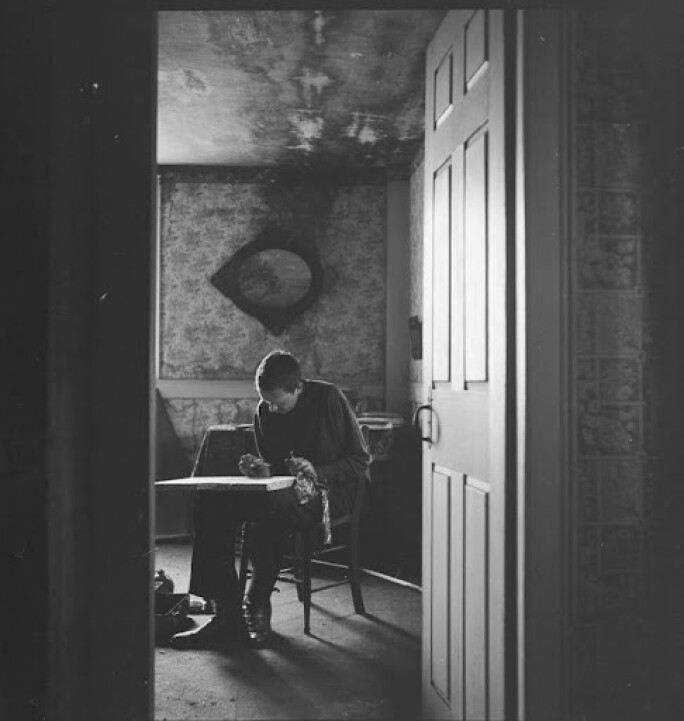
Wyeth’s artistic identity has been closely linked to realism since the onset of his career. His inclusion in Dorothy C. Miller and Alfred H. Barr, Jr.’s exhibition Americans 1943: Realists and Magic-Realists at MoMA further solidified this connection. Dedicated to artists who employed “sharp focus and precise representation, whether the subject has been observed in the outer world – realism, or contributed by the imagination – magic realism,” Wyeth’s involvement in the prominent exhibition further solidified his reputation as a realist and documentarian of everyday life (as quoted in exh. cat. for Americans 1943: Realists and Magic-Realists, p. 5).
“A lot of people say I’ve brought realism back – they try to tie me up with Eakins and Winslow Homer. To my mind, they are mistaken. I would honestly consider myself an abstractionist”

The execution of East Waldoboro demonstrates a realist sensibility, with Wyeth meticulously capturing the atmospheric quality of the misty grey sky, the delicate maneuvers of the tall, coarse grass, and the stoic nature of the farmhouse itself. Considering both his technique and captivation with the state of Maine, correlations arise between Wyeth’s artistic output and that of Winslow Homer, a forefather of American realism. Similarly concerned with documenting his t.mes spent in Prouts Neck, Maine, Homer’s contributions to nineteenth century American art are intrinsically linked to the art historical heritage of Wyeth’s home state. Intently focused on the rugged coastline, vignettes of figures at sea, and architectural motifs, there are striking comparisons between Homer and Wyeth’s artistic outputs. However, to his part, Wyeth insists that his body of work signifies a departure from the realist tradition. “I would honestly consider myself an abstractionist,” he stated in a 1965 interview. This dichotomy between realism and abstraction is central to understanding Wyeth’s artistry, and how his unique approach to painting differentiates itself both from his American predecessors and his post-war contemporaries.

“My aim in painting has always been the most exact transcription possible of my most intimate impressions of nature”
Alongside discussions of how Wyeth aligns with earlier generations of American realists, emerged an association between his artistic style and that of Edward Hopper. Wyeth developed his artistic identity in the wake of Hopper’s distinctly realist approach to the American landscape. Hopper, whom Wyeth first.mes t in New York in 1942, inspired the younger artist amidst a post-war climate that increasingly favored abstraction. “I admire Edward Hopper more than any painter living today,” Wyeth explained, “not only for his work, but because he’s the only man I know who actually feels that America can stand on its own” (Andrew Wyeth, as quoted in Richard Meryman, “Andrew Wyeth: An Interview,” Life, 14 May 1965). Like Hopper, Wyeth’s intrigue into the visual potential of ordinary homes expresses a fondness for his immediate environment. His documentation of the Hoffses house in East Waldoboro speaks to the character and charm of the small Maine town, and exudes a sense of solitude and loneliness that is equally present throughout Hopper’s own watercolors and paintings. Rather than melancholic or sad, as was often associated with Wyeth’s imagery, the artist favored the term “thoughtful” to describe the heightened introspection and complexity of emotion he conveyed in his subject matter (Meryman, ibid).

Right: Edward Hopper, Two Lights Village, 1927. Fitchburg Art Museum. © 2025 Heirs of Josephine N. Hopper / Licensed by Artists Rights Society (ARS), NY
“I know they like to make me the American painter of the American scene, like Hopper. Really, I’ve actually created my own little world – what I want”
Central to understanding Wyeth’s unique visual language is this dichotomy between his perception of realism versus abstraction. To Wyeth, achieving this balance allowed him to seek the true meaning of the subject. With pure abstraction, as was becoming increasingly in favor in America in the 1940s, he believed that artists lost a certain sense of emotion and deeper meaning within a subject. “The abstractionists obliterate the object because it’s one way of escaping perfunctory picturesqueness,” he explained. “Then it’s easier because you don’t have that goddamn thing of subject matter, an object standing in your way. You’ve just got color and mood. But I’d never be satisfied with just that. Why can’t we have reality too, so we can understand it” (Meryman, ibid).
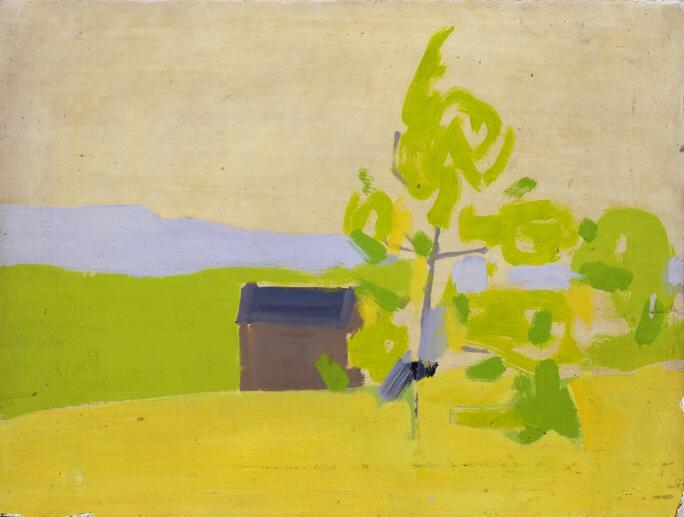
Wyeth appreciated the simplicity and quietude of his life in Maine, and reconciles his feelings of solitude and deep contemplation through isolated homes, untouched fields, and powerful imagery devoid of human life. In East Waldoboro, his application of the tempera medium – which he learned by studying the Renaissance masters at the Philadelphia Museum of Art and training with his brother-in-law Peter Hurd – expresses the subtle nuances of the surrounding landscape as it grows around the deserted farmhouse. Wyeth’s careful layering of pigment across the moody, atmospheric sky and his depth of shadow captured within the windows of the abandoned house contribute to this haunting sense of mystery and absence that is central to East Waldoboro.

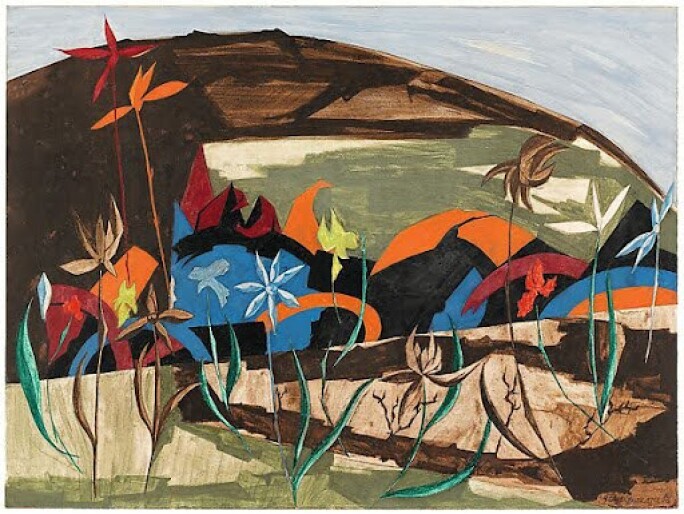
It is noteworthy to consider Wyeth’s mastery of the tempera medium in the mid-twentieth century within the context of his contemporary peers, many of whom adopted tempera much more so from the lens of abstraction. Take Mark Rothko, for example, who once referred to Wyeth’s art as seeking the “pursuit of strangeness,” who approached tempera from a much more reduced (although often vibrant) Color Field palette. Jacob Lawrence, much more figurative in his approach, allowed tempera to guide his investigations into exploring the Black experience in America. In relation to these other titans of twentieth century American painting, Wyeth’s approach to the tempera medium features a deliberately subtle, nuanced palette, with his selection of color often a direct reflection of the shades of nature surrounding him in Maine. The effect that he achieves in East Waldoboro is one that exudes a sense of belonging and familiarity, despite detailing an environment that is otherwise abandoned and empty.
As with many of his illustrations of the Maine landscape, East Waldoboro speaks to the New England spirit that captivated Wyeth for his entire adult life. Through the present work, he breathes new life into a setting that once housed generations of family members, by capturing the essence of the Hoffses home and its surrounding landscape. Through the lens of disappearance and absence, Wyeth creates a sense of purpose. The depth of expressiveness and heightened realism of East Waldoboro draws the viewer in, as is typical of his most dynamic tempera compositions.
The present work has remained in the same private family collects ion since the t.mes of inception, having been acquired by Elizabeth Murton du Pont Carpenter directly from the artist in 1945. An artist in her own right and close acquaintance of the artist, Mrs. Carpenter owned East Waldoboro until her passing in 2006, at which point it continued to descend through her family until present day. Making its first appearance at public auction, East Waldoboro is distinguished by its unbroken provenance, extensive exhibition history in several prominent Wyeth shows, and status as one of the most accomplished temperas – not only from Wyeth’s early years, but across the entirety of his prolific career.

