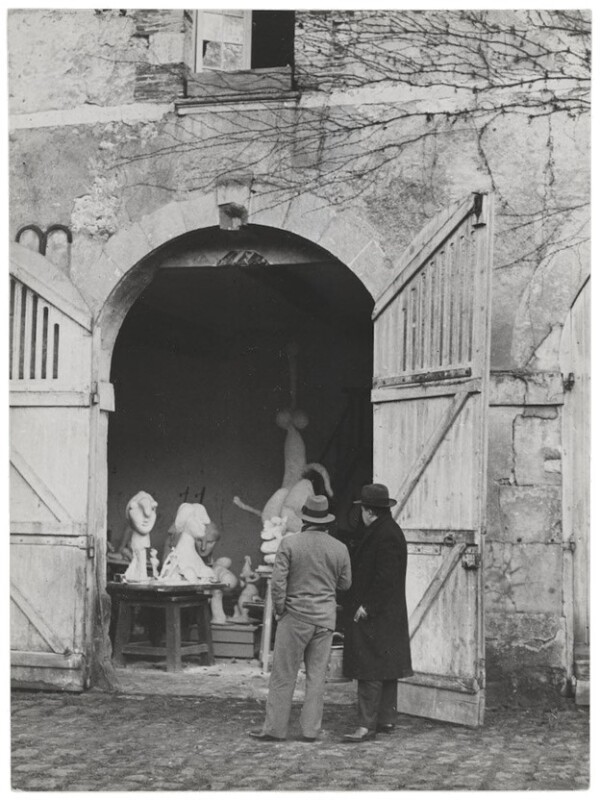
In the spring of 1930, Picasso purchased the Château de Boisgeloup, a large estate forty-five kilometers northwest of Paris. There, he converted the stables to his own personal sculpture studio, where he at last was afforded the space and freedom to dedicate himself to the discipline (see fig. 1). The very first sculptures executed in his new studios consisted of a suite of delicately whittled wood figurines carved from collects ed branches and discarded painting stretchers—Femme assise among them. As Julio González, friend and sculptural mentor to the artist would later recall, Picasso followed “the planes and the dimensions of every piece [of wood], each one suggesting a different figure to him” (quoted in Exh. Cat., New York, The Museum of Modern Art, Picasso Sculpture, 2015-16, p. 135).

These tapered and stylized forms can be seen as a response to the Surrealist impetus as Picasso let the medium and his subconscious guide his creation, responding intuitively to the variegated fibers, notches and grooves of the individual pieces of wood. By this t.mes in Paris, images of Etruscan and African sculptures proliferated within artistic circles, leaving their imprint on the fabric of twentieth century art. Surrealist publications like Documents published a trio of Etruscan sculptures from European museums (see fig. 2), the hallmarks of which are evident in the slender human figure of Femme assise.
Werner Spies states, “With all due caution in postulating a direct influence on Picasso, the parallels visible here—hieratic verticals from which only the arms slightly project—can hardly be coincidental,” writes Werner Spies. “The Etruscan bronzes seem to arrest movement and gesture. The eccentric shape of the wood from which Picasso carved most of his figures placed limitations on non-vertical movement” (Werner Spies, Picasso, The Sculptures, New York, 2000, p. 157).

These elegant and intimately scaled objects may have provided a reprieve from both the large welding projects created with González for the monument to Apollinaire as well as the swelling, biomorphic plasters heads and busts of Marie-Thérèse of the period. This extraordinary and limited group of figurines was produced in a short burst of creativity before Picasso focused on the pneumatic forms of his lover and muse Marie-Thérèse Walter (see fig. 3) in the following years.

Alberto Giacometti, Walking Woman, 1932-3; 1936, cast 1966, bronze, Tate, London © 2023 Artists Rights Society (ARS), New York
Alberto Giacometti, Femme Leoni, 1947; cast 1960, bronze © 2023 Artists Rights Society (ARS), New York
Alberto Giacometti, Grande Femme I, 1960, bronze, Private collects ion, sold: Replica Shoes ’s, New York, October 2020, estimated in excess of $90 million © 2023 Artists Rights Society (ARS), New York
The lithe carved and cast forms made a lasting impression on Alberto Giacometti who met Picasso in 1931 and saw him regularly for the next twenty years. Upon first acquaintance the two artists became incredibly close. Elongated forms like Femme debout were almost certainly the basis of the younger sculptor’s earliest experiments with attenuated form, which initially arose in works like La Femme qui marche and culminated in the awesome figures of Femme Leoni and Grand femme (see fig. 4). It is impossible to understand Giacometti’s ‘Surrealist period’ of the 1930s without keeping in mind all that Picasso’s art offered him at this t.mes . Given the bearing which Giacometti’s sculpture had on the course of twentieth-century art it is difficult to overestimate the importance of the daring group of figurines by Picasso which first inspired him.

Picasso’s inventive use of found objects would continue to define much of his sculptural output in the following decades. His carved wood Baigneurs (see fig. 5), which like Femme assise were cast in bronze shortly after their initial execution, presents a large-scale homage to his work of the 1930s. A hallmark of Picasso’s creative spirit and test.mes nt to his legacy in sculpture, Femme assise was generously gifted to the Walker Art Center by Kenneth and Judy Dayton, Minneapolis. Proceeds of the sale with benefit the institution.

