
"The subjects of this series are young men—fighters and partisans, poets and painters—with whom Baselitz identified. They are heroes, and anti-heroes, existentialist figures from the world of Samuel Beckett, survivors of a world in chaos."
Executed in 1966, Falle [Trap] is a riveting embodiment of the arresting intensity and brilliance of Georg Baselitz's most acclaimed and important series, the seminal corpus of Heroes that cemented his reputation as one of the most provocative and compelling voices of the post-war era. Considered one of the most influential painters of his t.mes , Baselitz has assiduously challenged the realities of history and art history in order to deliver a searing analysis of the human condition in the years following the Second World War. Replete with the iconography of Baselitz's unique artistic lexicon, in Falle [Trap] his ‘Hero’ sits within a desolate landscape, and crimson drops that both seep from the tree branches and frame the figure drip upon his wounded body. In 1965 and 1966, Georg Baselitz produced Heroes and New Types, a body of work presently regarded as one of the most significant examples of German art from the 1960s. During this fervent period of explosive productivity, Baselitz created this series of monumental figures, dichotomously ambiguous and incisive, vulnerable and defiant; the ‘Heroes’ examine the fallibility of the human condition. Just as Berlin and the Wall became concrete metaphors for the global stand-off of the Cold War, so Baselitz's ‘Hero’ paintings today stand as icons of a history that informs our existence in the Twenty-First Century.


Right: The present work installed in Georg Baselitz: The Heroes at Moderna Museet, Stockholm, 2016-2017. Photo © Courtesy of Moderna Musset, Stockholm. All Art © Georg Baselitz 2022

Startlingly captivating in impact, Falle [Trap] is a superlative example of this groundbreaking series and is part of a smaller suite of paintings that portray full-figured Heroes in their composition. This series was executed following Baselitz returned from Florence to West Berlin. The importance of Falle [Trap] is further attested to by its storied exhibition history, having been displayed in numerous retrospectives of the artist's work across the globe, including the 1995 to 1996 traveling exhibition at the Solomon R. Guggenheim, New York, the Los Angeles County Museum of Art, the Hirshhorn Museum and Sculpture Garden, Washington D.C., and the National Galerie, Berlin; the 2007 retrospective at the Royal Academy of Arts in London; as well as the major Heroes survey at the Städel Museum in Frankfurt in 2016 and at the Moderna Museet in Stokholm in 2016-2017. One of a limited suite within the 60 paintings and 130 drawings that comprise Hero Paintings or New Types that incorporate Baselitz's signature trees and the complete figure, Falle [Trap] is a masterpiece that epitomizes the best of the artist's career. The term Held (Hero) for this series was coined in the early 1970s and further defined in an 1973 essay on this body of work by Günther Gercken in the catalogue Hamburg, Galerie Neuendorf.
Georg Baselitz' Hero Paintings in Institutional and Private collects ions


Born in 1938 in a small village not far from Dresden, Georg Baselitz was seven at the end of the Second World War. As a child, Baselitz was profoundly affected by his experiences of the war, including his proximity to the heavily bombed city of Dresden, the refugees and his life in post-war Eastern Germany which came under soviet control and in poverty. Devastated by the Second World War, the German nation was immersed in further anguish when it was carved up and divided into East and West. The West ‘Federal Republic’ and East ‘Democratic Republic’ forged a fractured arena in which the diaMetricas lly opposed ideologies of Western Capitalism and Soviet Communism met head-to-head. The Heroes series, depicting lone figures battered and wounded in disheveled and torn uniforms, evoke a deep sorrow; they appear both grand and as deteriorated as their surrounding landscapes. In Falle [Trap], it appears as if the landscape weeps the blood and tears of the war and devastated environment. Baselitz's trees are reminiscent of the early 19th-century painter Louis Ferdinand von Rayski, a motif Baselitz would continue to return to throughout his career. The tragic character and isolation of the figure in Falle [Trap] testify to the strong effect of German Romanticism on Baselitz’s output at this t.mes . The roaming youthful figure is reminiscent of a specifically Romantic phenomenon. Yet his ruined corporeality and impoverished countenance belie any such reading of Romantic intrepidness.


Through the Heroes, Baselitz explores his history and memory, both personal and cultural, challenging the collects ive German psyche and post-war experience. Then 27 years old, Baselitz dismissed any salient political or artistic categorization; instead, he examined his unique ideology and artistic lexicon. As Baselitz explains, "What I could never escape was Germany, and being German." Baselitz examines what it.mes ans to be German, the legacy of history and Nationality in the Post-War context. Caught in the midst of perverse destruction, Baselitz's avatar - the ‘Hero’- gazes directly forward, undistracted by the violence of the scorched earth that surrounds him. His crux is the struggle of the common people, the existential angst of the period. Noticeably, "the subjects of this series are young men—fighters and partisans, poets and painters—with whom Baselitz identified. They are heroes, and anti-heroes, existentialist figures from the world of Samuel Beckett, survivors of a world in chaos." (Ex. Cat., New York, The Solomon R. Guggenheim Museum, Georg Baselitz, New York, 1995, p. 37) Saturated with post-war tension, Baselitz's Hero wears a muted, nondescript and distressed uniform, a subversion of the nationalism and membership to an organization associated with adorning them, Baselitz's figure is far from idealized and isolated.


In 1966, Baselitz saw post-war Germany in a state of destruction when politics, ideologies and artistic styles were all being questioned and examined. In the present work, titled Falle, which translates to Trap, the Hero is seated with only a small miniature fire at his feet for warmth; he is bleeding from one arm and crimson drops of blood drip onto his head as if he caught his arm on the bark of the trees that frame his figure or as if the trees mimic his wounds. The Hero simultaneously appears to be a personification of the land, at one with his ruinous surroundings and entrapped within the trees vulnerably awaiting his fate. In Falle [Trap], the figures tattered appearance and longing gaze evince resignation - Baselitz questions masculine heroism in the years following the war, illustrating these Heroes as contradictory - the figure's gigantic, bulky frame paradoxical to his apparent state of frailty. By challenging the traditions of classical art history through the lens of a culture scared by modern warfare, the present work bears witness to Baselitz development of a new painterly idiom in the quest to re-access German values. Falle [Trap] is an exceptional example of this groundbreaking series and distinctly embodies the daring innovation and audacious self-reflection that characterize Georg Baselitz's most acclaimed body of work.
- 1963
- 1965
- 1965
- 1966
- 1972
- 1980
- 1981
- 1983
- 1990
- 1995
- 2000s
- 2021
-
 1963Baselitz's First Gallery Opening in West Berlin
Baselitz's first solo exhibition debuted at new gallery founded Michael Werner and Benjamin Katz. Coinciding with the Berlin Festival, the exhibition drew a large crowd of critics who found the art repulsive and frightening. Two days after the exhibition, a newspaper article reported that two of Baselitz's paintings had been confiscated by the district attorney for their "lewd" and "obscene" nature.
George Baselitz, Die große Nacht im Eimer, Big Night Down the Drain, 1963
Museum of Modern Art, New York
Art © Georg Baselitz 2022 -
 1965Baselitz working in his studio in Florence, Italy
Baselitz was awarded a six-month scholarship to study in Florence while staying at the Villa Romana. With its lively cafes and sunny weather, Italy stood in stark contrast to the grim realities of post-war Germany that Baselitz knew and was the artist's first encounter with life in Southern Europe. Inspired by Italy's vital art tradition and great museums, Baselitz found that this opportunity offered him a chance to begin anew. -
 1965Beginning the Heroes Series
Shortly upon Baselitz’s return to Berlin from Florence following his scholarship, he began to create his Heroes series, which depict young men in ambiguous states of vulnerability and defiance, expressing the artist’s profound ambivalence to the chaos of post-war Germany.
Lot 111
Georg Baselitz, Ein neuer Typ (Held mit Fahne), 1965
Estimate: $300,000 - $400,000
Art © Georg Baselitz 2022 -
 1966Hero Paintings
Executed between 1965 and 1966, George Baselitz's suite of paintings known collects ively as the Hero paintings comprise his most important body of work and date to the inception of his mature practice. These paintings cemented him as one of the most provocative and pivotal artists of the Post-War era.
Lot 110
Georg Baselitz, Falle (Held), 1966
Estimate: $8,000,000 - $12,000,000
Art © Georg Baselitz 2022 -
 1972Fingermalerei Adler
By the 1970s, Baselitz experimented with various techniques, renting out a factory space in Musbach, Germany as his studio. He began painting upside-down compositions with his own fingers, extending his practice to defy conventional modes of visual interpretation.
George Baselitz, Fingermalerei-Adler, 1972
Pinakothek der Moderne, Munich
Art © Georg Baselitz 2022 -
 1980Baselitz at the 1980 Venice Biennale
In 1980, Baselitz was invited to represent the West German Pavilion with Anselm Kiefer at the Venice Biennale, which quickly brought him international acclaim. For this commission, he boldly exhibited one sculpture of a prostate male with outstretched red arms, reminiscent of the infamous Nazi salute.
Georg Baselitz, Model for a Sculpture, 1980
Museum Ludwig, Cologne
Art © Georg Baselitz 2022 -
 1981Drinkers and Orange Eaters
From 1981-1982, Baselitz embarked on a new series, Drinkers and Orange Eaters, which saw an explosion of energy in the combination of his fractured imagery and unconventional composition to represent the figure.
Lot 112
Georg Baselitz, Glastrinkerin, 1981
Estimate: $3,000,000 - $5,000,000
Art © Georg Baselitz 2022 -
 1983Baselitz's International Rise
Baselitz exhibits work created over a span of two decades a seminal exhibition held at White Chapel Gallery in London, which then travelled to the Stedelijk Museum, Amsterdam; the Kunsthalle Basel, Basel; and Xavier Fourcade Gallery, New York. -
 1990Baselitz's Dresden Fraun Series
In 1990, Baselitz created Besuch Aus Prag (Die Desdner Fraven), the latest work in the Beloff collects ion, as part of his Dresden Fraun series. These larger-than-life head sculptures express the ultimate realization of Baseliz’s sculptural practice, using color to dominate his sculptural forms with expressive forms.
Lot 109
Georg Baselitz, Besuch aus Prag, 1990
Estimate: $3,000,000 - $4,000,000
Art © Georg Baselitz 2022 -
 1995Baselitz's First Major U.S. Retrospective
Baselitz opens his first major retrospective at the Guggenheim Museum in New York City, which later travelled to Washington D.C. and Los Angeles. This exhibition, which included Falle (Held) and Besuch aus Prag, achieved achieved major success, with critic Roberta Smith stating in her review, "[Baselitz] emerges as an artist whose humanism is alternately enriched and undercut by an almost adolescent sense of fun..." -
 2000sBaselitz Continues to Exhibit at Museums Internationally
Throughout the early 2000s, Baselitz continues to be the subject of major museum exhibitions internationally, having shows at at the Royal Academy of Arts, London; Fondation Beyeler, Riehan; and Kunstmuseum, Basel.
Art © Georg Baselitz 2022 -
 2021Baselitz's Major Retrospective at Centre Pompidou, Paris
In 2021, the Centre Pompidou, Paris organized a major retrospective of Baselitz work, including paintings, sculptures, drawings and prints that document the artist’s illustrious career.
Art © Georg Baselitz 2022


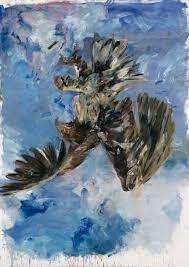


Having garnered the highest degree of commendation, many of the Heroes series are now housed in institutional collects ions worldwide. On March 7th 2022, a major retrospective showcasing six decades of Georg Baselitz’s artwork closed at the Centre Pompidou, garnering increased international attention for an artist already considered one of the most influential of the 20th century. Falle [Trap] has remained in the esteemed private collects ion of Hardie Beloff for over three decades.
The appearance of the Beloff collects ion at auction constitutes the first t.mes that this remarkable group of works in its entirety has been seen publicly. Over 70% of the funds generated by the sale of the collects ion will be distributed to a wide array of charities dedicated to a variety of causes, including animal welfare, justice initiatives and a series of non-profits supporting the people and institutions of Hardie Beloff’s community of many years, Philadelphia. At the collects ion’s core is the greatest grouping of works by Georg Baselitz in private hands, which together succinctly articulate the very best of the German artist’s inimitable oeuvre. Deeply discrete during his lifet.mes , Hardie Beloff nevertheless believed in sharing his collects ion with the public and routinely lent works to institutional exhibitions under the alias “Fielding Mellish”, a nod to the 1971 film Bananas.


