
“It was the block of the body itself, that is to say the trunk and part of the thighs that fascinated me… Only the body is alive, all-powerful, and non-thinking.”
Mesmerizing in its beauty yet dense in its conceptual gravitas, Anthropométrie Sans Titre (ANT 27) exemplifies the spectacular innovation of Yves Klein’s Anthropométries and represents a distillation of the central tenets of his visionary oeuvre. Synthesizing aspects of figuration, abstraction, and performance, the Anthropométries emerged from the artist’s desire to access the spiritual, visceral, and vital nature of the human body, and reveal it on the surface of his paintings. With their highly painterly traces created by the imprint of a painted model’s body, these works provided a new series of powerful and enduring gestural signs of human interaction with the mystic immaterial void. Executed in 1960, the present work is a rare example that the artist has signed on the front, and further bears a singular provenance, having previously been held in the celebrated collects ion of the Durand-Ruel family. Demonstrating exquisite vibrancy and movement, Anthropométrie Sans Titre (ANT 27) deftly flits between the ephemeral and everlasting, presenting a t.mes less relic of performance in Klein’s signature International Klein Blue (IKB) pigment.

Yves Klein’s Anthropométrie in Prominent Institutional collects ions


“Painting is no longer for me a function of the eye. My paintings are the ashes of my art”
The adventure began in the spring of 1958 with an informal performance during a dinner party organized in the flat of Klein’s friend Robert Godet on Paris’ Ile-Saint-Louis. The next important development came a full two years later, inspired by the various "anthropometric" experiments which occupied the artist during this period; this research reached a pinnacle with one particularly significant performance, the "Anthropométrie de l'époque bleue", organized at the Galerie Internationale d'Art Contemporain in Paris on March 9th, 1960. Among the guests were the nude models who worked in collaboration with the artist to mark the canvas with their bodies which had been coated with IKB. An orchestra composed of cellists, violinists and choir members accompanied the performance in a monotone symphony – a twenty-minute concert of one note- while an audience of elegantly dressed spectators, as well as the artist himself who donned a dinner jacket for the occasion, looked on.
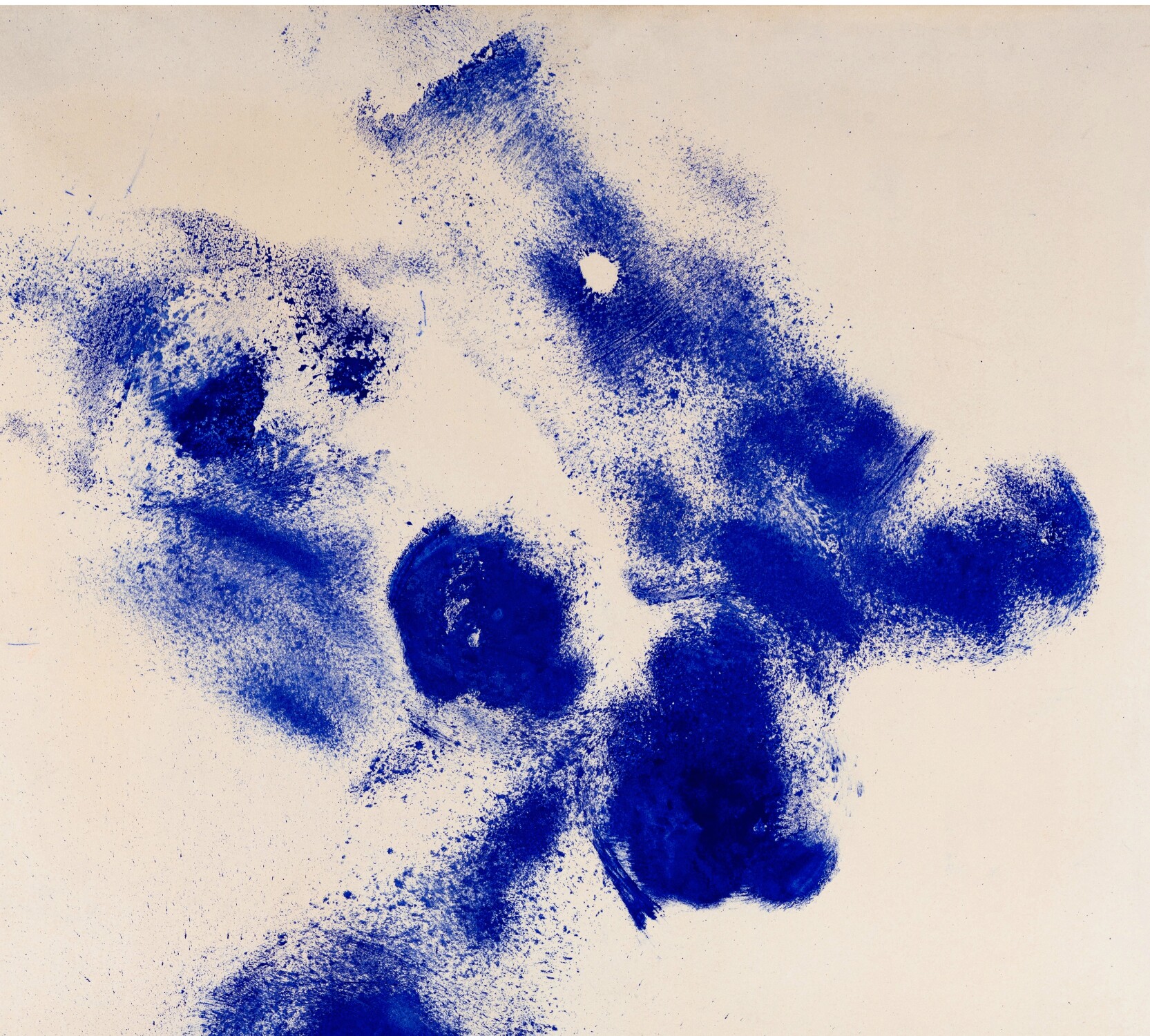

At a t.mes when Abstract Expressionism and Tachisme reigned supreme, Klein marked a daring reintroduction of the human figure with his Anthropométries. Contrary to those artistic movements based on the fetishism of an individual artist’s personal and emotive gesture, Klein chose an opposite approach, completely removing his own hand from the creation of a painting through use of his "human brushes." Moreover, by imprinting the human body directly upon the canvas, he created a sublimely paired figural and abstract work, as subject, medium, and application became one and the same. In these paintings, Klein appropriates the trope of the nude – a subject which for centuries had been treated with idealized sensuality – splashes it with blue pigment and pushes it up against the picture plane with brazen immediacy and radical intimacy. Defying a historical convention in which the nude had offered a test of painterly skill and draftsmanship, Klein here achieves it without lifting a finger. In this regard, a comparable can be drawn between Klein's innovative art historical approach with Henri Matisse's seminal series of Blue Nude paper cutouts, which similarly offer radically new representations of the female corporeality through simple yet effective compositions of paper cutouts, also in the color blue. In his Anthropométries, Klein deliberately references tradition only to challenge it, transform it, and reintroduce it as uniquely his own.
"My models were my brushes. I made them smear themselves with colour and imprint themselves on canvas."

Anthropométrie Sans Titre (ANT 27) represents the figure with pressure points of paint solidly packed amongst focused splatters, swipes, and smears. The primordial, arched female form echoes shamanic fertility figures, while its truncated torso recalls the often-fragmented artifacts of classical Greek sculpture. In his own words: “It was the block of the body itself, that is to say the trunk and part of the thighs that fascinated me… Only the body is alive, all-powerful, and non-thinking.” (Yves Klein quoted in “Yves the Monochrome 1960: Truth Becomes Reality”, Yves KIein, trans. Klaus Ottman, Overcoming the Problematics of Art: The Writings of Yves Klein, New York 2007, p. 185) The form bears an uncanny similarity to Winged Victory of Samothrace, a recurring inspiration for Klein; both exude confidence in their elaborate presentation of the female body and emphasize the skin as an essential contact point. Meanwhile, Klein's fascination with the blue pigment recalls his Matisse's seminal series of Blue Nude paper cutouts
An exemplar from Klein’s oeuvre, Anthropométrie Sans Titre (ANT 27) is sublime in its presence, charged with intellectual significance, and rich with reference. Inimitably capturing the physical traces of movement and the energy of life itself in this intensely blue imprint, Klein here encapsulates his desire to channel the essence of life and universe through art. Through its conceptual and performative genesis, Anthropométrie Sans Titre (ANT 27) connects a real, living moment of the flesh to the spiritual universe. The mark of a moment is eternally emblazoned in vivid blue, evoking and commemorating the full scope of Klein’s bold and magical vision.

