"The raster is for me a system, a principle, a method, structure. It decomposes, distributes, orders, and equalizes everything. I like the way that the dots in a magnified picture swim and move about. The way that the subject changes from recognizable to unrecognizable, the undecided, ambiguous situation, the way it remains open”
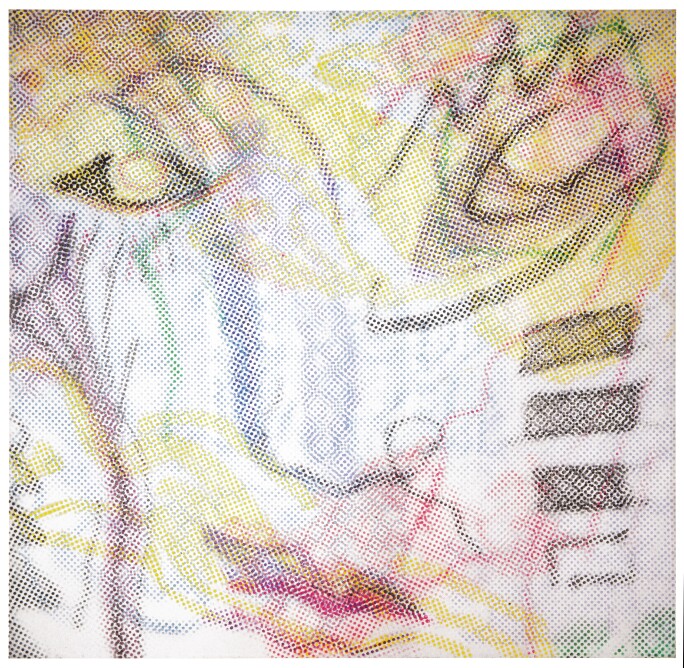
At once weightlessly ethereal and arrestingly hypnotic, Untitled stands at the apex of Sigmar Polke’s career-long flirtation with the powers of abstraction. In the present work, countless layers of colour jostle to the surface, where they are met with a ribbon of pale grey pigment that appears like a plume of smoke, drifting across the composition. Rich purple, pastel blue and ochre ripple across the surface of the work forming an intricate and dizzying lattice that appears to undulate and glisten before our eyes. At once graphic and organic, the undulating colour palette of this shimmering matrix appears uniquely delicate, all the while maintaining a vivid psychedelic undertone. In a thrilling marriage of mark-making, use of colour and mastery of materials, the present work creates a sense of serene chaos – constituted by layer upon layer of alternating technicolour and pastel tones that is compositionally sophisticated and complex. Indeed, Untitled radiates with a sense of joyous adventure, a quality that runs throughout the many diverse outcomes of Polke’s insatiable drive for radical artistic experimentation.
Artwork: © The Estate of Sigmar Polke, Cologne / DACS 2020

In Untitled the artist plunges into the realm of absolute abstraction, stripping the work of a pictorial base, and elevating his infamous raster dot takes on the ephemeral quality of a glimmering lace veil. Through decades of his practice, Polke mobilised the raster dot to challenge and subvert the apparent truth and authority of the printed image and its role as a tool of communication. Where in his early works Polke’s delved into the representational to suggest the abstract, here, the artist’s iconic raster dot is liberated from its representational origins, shedding it’s pictorial roots to become a vehicle for pure abstraction. Indeed, in Untitled, Polke pushes the machinations of image-making beyond representation, whereby the raster dot assumes a new subverted role, providing the somewhat dizzying structure for this technicoloured kaleidoscopic composition. No longer does the artist teeter between abstraction and representation with this radical innovation. “The raster is for me a system, a principle, a method, structure. It decomposes, distributes, orders, and equalizes everything. I like the way that the dots in a magnified picture swim and move about. The way that the subject changes from recognizable to unrecognizable, the undecided, ambiguous situation, the way it remains open” (Sigmar Polke quoted in Dieter Hülsmanns, ‘The Culture of the Raster A conversation with the painter Sigmar Polke in his studio’, in Rheinische Post, May 1966.)
After his hiatus from painting in the 1970s, Polke returned to the medium with renewed energy in the 1980s and 1990s, manipulating his layered pictorial language to it’s most extreme form in his abstract works of the late 1990s. Untitled, in all it’s technicoloured glory, stands at the culmination of decades of the artist’s relentless confrontation of the material and technical possibilities in painting, whereby the mechanisms of image making, namely the raster dot, dominates the composition so comprehensively that all pictorial form dissolves and retreats in the face of this onslaught of abstraction. In Untitled, Polke offers the mechanics of image making devoid of any image itself, laid bare to be absorbed for it’s primarily aesthetic sensibilities.

Polke produced work of astonishing diversity and versatility throughout his career, forging a painterly language that was utterly unique in its embrace of innovative artistic forms and ideas. Sean Rainbird deftly explains Polke's practice as "elusive as he is himself. [Polke] has constructed a persona that plays with the concepts of inspiration and originality. Within this cult of creativity, he is an elfin presence, a shrouded mystic, a magician projecting illusions." (Exh. Cat., Liverpool, Tate Gallery, Sigmar Polke: Join the Dots, 1995, p. 9). Untitled stands as the superb conclusion of Polke’s decades of pictorial and technical innovations, as well as his insistent distrust and deconstruction of the processes of image making in the modern age.