
Cy + Relics, Rome, 1952
Art © 2021 Robert Rauschenberg Foundation / Licensed by VAGA at Arists Rights Society (ARS), NY
“I have always thought 'Twombly' ought to be (if it isn’t already) a verb, as in twombly: (vt): to hover thoughtfully over a surface, tracing glyphs and graphs of mischievous suggestiveness, periodically touching down amidst discharges of passionate intensity. Or then again, perhaps a noun, as in twombly (n.): A line with a mind of its own."
A breathtaking union of inspired visual lyricism and explosive gestural force, Untitled (Rome) is amongst the most magnificent examples of Cy Twombly’s extraordinary abstract lexicon. Executed in 1970, at the chronological apex of the artist’s celebrated ‘Blackboard' paintings, the present work is amongst the most gesturally expressive invocations of the urgent, interrogatory mark-marking which distinguishes the very best examples of this revered series. Even within that rarified group, the present work rises to the fore: unlike those Blackboards restrained to neat rows of tightly coiled reverberations, or those which dissolve into complete frenetic abandon, the present work sees Twombly express the exact, thrilling boundary between control and anarchy, order and chaos, intention and accident. As it surges, leaps, and whirls across the canvas, Twombly’s line sears with the raw energy of a stripped wire; against the elegant sobriety of the slate-gray backdrop, the looping scrawls of Untitled (Rome) teeter on the threshold of legibility in a masterful interrogation of sign, symbol, and mark. Held in the same esteemed private collects ion for almost three decades, Untitled (Rome) emerges as a spectacularly realized example of the ever-present tension between legibility and abstraction, gesture and expression, signifier and signified that lies at the very heart of Twombly’s extraordinary artistic practice.

Alrbight-Knox Art Gallery, Buffalo
Art © 2021 Frank Stella / Artists Rights Society (ARS), New York
Right: BRASSAÏ, 1933
Graffiti, série II 'Langage du mur'
Art © Estate Brassaï-RMN
In Untitled (Rome), formal restraint does battle with sensuous, hedonistic mark-making as lines swell, peak, and resolve themselves with visceral urgency across canvas. Twombly’s cylindrical forms seemingly reverberate within their own echo chamber, refracting into seeming infinity whilst elegantly restrained within the parameters of the canvas. Increasing in volume and expressive abandon as they progress, the four feverish bands of lassoed lines appear to slowly cede any sense of regularity and control, resulting in thrillingly increased drips, smears, and spatters toward the bottom of the picture; against the subdued elegance of the grey ground, the oval scrawls emerge from and recede into one another in dense relief, teetering on the threshold of legibility. As eloquently described by Pierre Restany, Twombly’s abstraction is “poetry and reporting, furtive gesture and écriture automatique, sexual catharsis and both affirmation and negation of the self. As full of ambiguity as life itself...Twombly's 'writing' has neither syntax nor logic, but quivers with life, its murmuring penetrating to the very depths of things. The marks are elusive since they instinctively make for the essential." (Pierre Restany, The Revolution of the Sign, 1961, in: Nicola Del Roscio, ed., Writings on Cy Twombly, , Munich 2002, p. 47) Here, we see the painter leave behind any didactic meaning to his invention, abandoning the safe haven of mythological symbols in favor of a more primal usage of line as a potent transmitter of space, duration, and motion.

Digital Credit © University of Pennsylvania Archives
Untitled (Rome) serves as eloquent test.mes nt to the profound and enduring inspiration Twombly drew from the cultural, historic, and aesthetic specificities of Rome over the course of his extraordinary career. Upon his first visit to Rome in the early 1950s, Twombly was immediately taken by ancient forms of graffiti that he saw scrawled on the exteriors of historical Roman ruins; echoed with newfound ferocity in the graffiti-like strokes of the present work, the artist notes the profound influence the iconographic legacy of classical antiquity enacted upon his practice: "Generally speaking my art has evolved out of the interest in symbols abstracted, but never the less humanistic; formal as most arts are in their archaic and classic stages, and a deeply aesthetic sense of eroded or ancient surfaces of t.mes .” (the artist cited in: Nicola del Roscio, ed., Writings on Cy Twombly, p. 199) It was in Rome, a city saturated in the talismanic presence of myth and archaic legacy, the artist first conceived of the sparse iconography of his Blackboards.

Digital Image © San Francisco Museum of Modern Art
Art © 2021 Robert Rauschenberg Foundation / Licensed by VAGA at Arists Rights Society (ARS), NY
CY TWOMBLY BLACKBOARDS IN IMPORTANT PUBLIC AND PRIVATE collects IONS


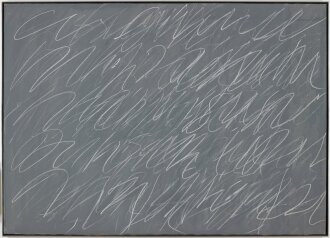


Begun in 1966, The Blackboard works marked Twombly's abrupt abandonment of the richly colorful and expressive compositions from the first half of the 1960s known as Baroque Paintings, giving rise to works that would employ a visual language of pure austerity and sublimity. Renouncing the richer figuration and coloration of that earlier work, Twombly shifted his focus back to the restrained monochrome works that he first embarked upon in the 1950s. However, unlike the static, semi-figurative black and white paintings of Twombly's formative years, the inimitable gray works of the 1960s saw the centrifugal energy and erotic charge of Twombly's Baroque-inspired early 1960s paintings transferred into a rhythmic discourse of mood and movement. Within the Blackboards, “Twombly tries to shatter form as well as its concomitant intellectual and narrative history in a kind of relativism, reducing it to a rationality of 'black and white' that is at the same t.mes the structural sum of all movement." (Heiner Bastian, ed., Cy Twombly: Catalogue Raisonné of the Paintings, Volume III 1966-1971, Munich 1994, p. 23) Here, the scrawled spirals invoke a sort of proto-handwriting: a primitive form of expression that strives toward resolution and legibility but is suspended in a perpetual territory of formal symbolism, akin to our contemporary reading of classical mark-making.


Although Twombly’s mark-making teeters on the exhilarating border between control and pure, hedonistic abandon, the feverish line of Untitled (Rome) never bursts free from the cylindrical reverberations which contain it. Unlike Twombly’s earlier canvases, in which episodes of personal expression are scattered across the canvas, the artist here constricts his activity to a gestural framework—nevertheless, the lassoed bands give way to expressive subjectivity in their vigorously imprecise execution. The pattern of voluminous loops recalls the forced repetition of the Palmer handwriting method, in which the simple gesture of pencil to paper becomes an internalized bodily discipline.

Private collects ion. Art © 2021 Gerhard Richter
Right:Giacomo Balla, Car+Speed+Light, 1913
Image © Museo del Novecento, Milan, Italy / Mondadori Portfolio / Art Resource, NY
Art © 2018 Artists Rights Society (ARS), New York / SIAE, Rome
Twombly was himself taught to write through the Palmer method, an infamously strict.mes thod that requires pupils to repetitively practice rote drills keeping their fingers and wrists rigid while only moving their arms. Within Untitled (Rome), Twombly seemingly invokes yet denounces these punishing typological drills; far from ceding to methodical repetition, the charged strokes of the artist’s hand leap across the page with furious intensity, their rhythmic cadence and raw, kinetic energy unhampered by methodical restraint or canonical impetus. As described by scholar Robert-Pincus Witten, “Handwriting has become for Twombly the means of beginning again, of erasing the Baroque culmination of the painting of the early 1960s… it has been drowned in a schoolmaster’s blackboard. It has been reduced to rudimentary exercises… With it, Twombly casts down all that was grandiose in his mature style, rejecting a lush manner for simple and stringent exercises.” (Pincus-Witten cited in: Nicola del Roscio, op. cit., p. 216) Indeed, the experience of the present work – begun in the upper left, and coursing across the canvas again, and again, and again – is one of increasing abandon, surging towards a fever pitch that is never completely realized. As they progress, Twombly’s loops grow in scale, density, and anarchic force, as if to reach a final point of definitive expression. Yet ultimately, as flawlessly summarized by the artist himself: “Each line now is the actual experience with its own innate history. It does not illustrate - it is the sensation of its own realization.” (The artist cited in: Exh. Cat, New York, The Museum of Modern Art, Cy Twombly: A Retrospective, 1994, p.27)

