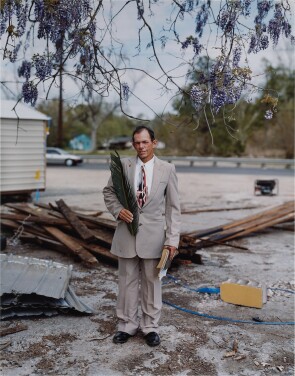
Since the publication of Alec Soth’s seminal monograph in 2004, Sleeping by the Mississippi, and the inclusion of his works in the Whitney and São Paulo Biennials that same year, he has established himself as one of the leading photographers working today. Channeling his wanderlust spirit into the camera, Soth’s images portray powerful poetic and melancholic vignettes of often overlooked people and places.
In 1999, Soth embarked on a journey down the Mississippi River from his hometown in Minneapolis to Louisiana, capturing arresting portraits, still lives, and landscapes, usually with a large-format 8 by 10 inch field camera. The forty seven photographs comprising Sleeping by the Mississippi present a collects ive portrait of middle America that resonate both in their familiarity and peculiarity. He strives to capture the sent.mes nt of poetry as opposed to the narratives of novels through his lyrical approach to documentary photography.
'I don’t claim to be making an accurate document of a place. I’m just making my little melancholy poems.'

In Charles, Vasa, MN a bearded man in paint-splattered coveralls, redolent of a military aviation suit, holds two model airplanes. He is standing on what appears to be a partially-constructed roof covered in snow. With a face almost completely obscured by his beard, glasses, and balaclava, a sense of childlike glee is palpable in the pride he displays showing off the airplanes.
Sustained looking also makes palpable an underlying sense of loneliness, which provokes an exchange of empathy between the viewer and subject. Instead of emphasizing the oddity of the grown man with model airplanes, Soth approached the subject with respect. The tender portrayal calls to mind the longstanding art historical tradition of frontal portraiture with subjects holding objects of devotion, treasure or status.
Alec Soth happened upon Charles early in his journey down the Mississippi. While driving in Minnesota, he noticed an unusual room with glass walls on the top floor of a house and thought that an interesting person might reside there. Inside the house, he met Charles, who referred to the glass space, decorated with pictures of planes, as his cockpit. Soth describes Charles as a “solitary dreamer” and saw his yearn for flight as a metaphor for his dream world. The photographer felt a connection to his subject’s loneliness and fascination with the small creative acts that ordinary people perform to bring beauty into their lives. The context typifies Soth’s practice–with shrewd observation, he seeks the metaphoric and poetic in the ordinary and the lonely.
'Like his predecessors, and with much the same eye, Soth comes to praise his neighbors for their strange religiosity and diverse forms of alienation, discovering in the heartland, yet again, a world of funky places and forgotten dreamers, one generation following the next.'
Soth’s work is rooted in the American itinerant documentary tradition of now-canonical artists including Robert Frank, and Robert Adams. Soth also continues the lineage of color photography pioneers William Eggleston, Stephen Shore, and his former professor, Joel Sternfeld. While drawing upon historical precedents, Soth also maintains a unique voice fueled by his distinct ability to capture the poetry in the banal and endow subjects with a tender dignity.
Prints of this image are in institutional and private collects ions, including The Museum of Modern Art, New York; Brooklyn Museum, New York; National Gallery of Art, Washington, D. C.; Walker Art Center, Minneapolis; San Francisco Museum of Art; and the Traina collects ion, San Francisco.
Alec Soth Sleeping by the Mississippi