Imperial Patronage under Empress Wu
Regina Krahl
These graceful Buddhist deities date from arguably the greatest period of Chinese sculpture, when a fully Chinese sculptural style had been developed and corporal beauty had become an important aspect of figurative representation. The two sculptures are rendered with distinctly feminine facial features and an idealised, youthful physique. They are remarkable for their overly large heads, beautiful, fleshy faces with serene, benevolent features, very faintly smiling, voluminous coiffure carefully tied up in a bun, with some strands falling over the shoulders, bodies displayed in a graceful swaying pose, compact, exposed torsos pleasantly rounded and adorned with jewellery and scarves, and elegantly draped, thin flowing skirts, conveying an inkling of shapely legs underneath.
The carving of Buddhist stone sculptures on a grand scale under court patronage was initiated by the Northern Wei (386-534) imperial family and continued into the Tang (618-907). The monumental cave temples, created by the greatest sculptors of the day, provided an artistic language that dominated the sculptural art in China and inspired also the production of free-standing figures and stelae. As sculptors originally had concentrated on rendering the solemn spiritual message, Buddhist images were often rather formal and stylised and appeared imposing but distant. In the early Tang we begin to see a much more naturalistic approach in Buddhist sculpture, which let deities appear benign and approachable.
The present Bodhisattva figures are classic examples of China’s Buddhist stone carving from the absolute peak of the craft in the early eighth century. They reflect the move towards a more gracious, human form of representation, which initiated the greatest flowering of China’s plastic arts. They bear the characteristics of the period when the powerful Wu Zetian exerted major influence not only on the country’s politics, but also on her arts. They are carved in the metropolitan style patronised by the court at the capital Chang’an, modern Xi’an in Shaanxi province, during Wu’s reign as Empress.
Wu Zetian (624-705), erstwhile concubine of Emperor Tang Taizong (r. 626-649), wife of Emperor Gaozong (r. 649-683), power behind the throne for some of his reign as well as those of her two sons, when officially Empress Dowager (683-690), and eventually self-proclaimed Empress (r. 690-704), defined China’s fate for about half a century and even changed the name of the dynasty from Tang to Zhou. She was a fervent patron of Buddhist causes, who used Buddhism as legitimisation of her rule, to which she had no proper claim. She called herself the incarnation of the Maitreya, the Buddha of the Future, and as such justified her seizure of the imperial throne as the only female Emperor of China.
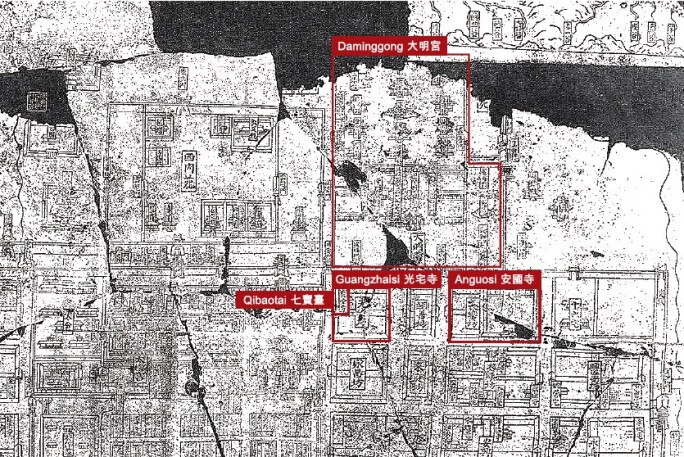
An old map of Tang dynasty Chang'an city by Lu Dafang, Song dynasty After: An Atlas of Ancient Maps in China. From the Warring States Period to the Yuan dynasty (476 BC-AD 1368), Beijing, 1990.
圖一 宋 呂大防《長安城圖》殘拓 出處:《中國古代地圖
Even prior to her tenure, Buddhism was strongly supported by the imperial court, who subsidised major building projects and encouraged monks to travel abroad and bring back sacred scriptures. Empress Wu sponsored the translation and dissemination of Buddhist sutra texts, invited Buddhist patriarchs and teachers to the palace and encouraged the teaching of the Buddhist doctrine. In the name of Emperor Gaozong and on her own she commissioned many building projects of temples in the capital and cave temples with Buddhist sculptures, most notably at the Longmen Caves outside Luoyang in Henan. The monumental central Buddha Vairocana at Fengxiansi, the most important Longmen Temple, was conceived to be represented in her likeness. If in Buddhist sculpture Bodhisattvas until then had been depicted as either male or else genderless, they were now rendered with a distinctive feminine beauty – a transformation clearly due to her intervention. This started the full transformation towards a ravishingly beautiful, sensuous naturalism in Buddhist imagery, where the religious message was delivered through a very accessible form of human beauty, which marks the fully matured style of Buddhist stone sculpture.

A limestone 'Buddhist triad' stele, Tang dynasty, dated 704, from the Guangzhai Temple in Xi’an, Shaanxi, Gift of Hosokawa Moritatsu, Important Cultural Property, Tokyo National Museum (no. TC-718)
© Image : TNM Image Archives
圖二
唐長安四年 姚元景造石灰岩雕一佛二菩薩龕 正面 「長安四年九月十八日姚元景造」銘 陝西省光宅寺 細川護立氏寄贈 重要文化財 東京國立博物館(編號TC-718)
© Image : TNM Image Archives
One of the temples the Empress had built in Chang’an was the Guangzhaisi (fig. 1). It was erected in 677 at a site where some Buddhist relics had been found, and towards the end of her reign in the first years of the 8th century, she commissioned the addition of a pagoda to the temple, Qibaotai, the Tower of Seven Jewels. The temple no longer exists, but some thirty stone stelae carved in high relief are preserved from the interior of the pagoda, which are executed in a style very similar to the present sculptures. They are illustrated and discussed in Yan Juanying, Jinghua shuiyue. Zhongguo gudai meishu kaogu yu fojiao yishu de tantao/Visualizing the Miraculous World, Taipei, 2016, pp. 83-112; some of them are also published in Osvald Sirén, Chinese Sculpture from the Fifth to the Fourteenth Century, London, 1925 (reprint Bangkok, 1998), pls 391-397. The stelae are partly preserved in the Baoqing Temple in Xi’an, partly in the Tokyo National Museum, and two are in the Freer Gallery of Art, Washington, D.C. They are variously dated in accordance with 703 or 704, and either come in the form of triads of the Buddha flanked by Bodhisattvas very similar in style and pose to our pair, or they depict single eleven-headed Bodhisattvas enclosed in a niche, depicted in a less relaxed pose than our figures, but otherwise also very closely related; compare, for example, a triad stele in the Tokyo National Museum, illustrated in Angela Falco Howard et al., Chinese Sculpture, New Haven & London, 2006, fig. 3.112 (fig. 2); and one of the Freer Bodhisattvas in particular [https://asia.si.edu/object/F1914.55/] (fig. 3).

A fragment of Guanyin of eleven heads, Tang dynasty, dated 703, from the Guangzhai Temple in Xi’an, Shaanxi, Gift of Charles Lang Freer, Freer Gallery of Art, Washington DC (no. F1914.55)
圖三
唐長安三年 十一面觀世音菩薩龕殘件 陝西省光宅寺 Charles Lang Freer 餽贈 華盛頓弗利爾美術館 (編號:F1914.55) NeilGreentree
The Guangzhaisi triads probably also show the original poses of the present Bodhisattvas, with one arm raised. Unlike most of these temple sculptures, they were conceived and carved fully in the round and meant to be free-standing. Since such sculptures are obviously prone to breakage, only few are preserved from this period, and it is extremely rare to find a pair. While the two figures are differently attired, they are clearly complementary and not only contemporary, but must have been sculpted in the same workshop, for the same patron and for the same location. Given their similarity with imperial commissions under Empress Wu, they are most likely to have been executed by sculptors working for the court at that t.mes .
The close connection to imperial workshops is further underlined by the stylistic similarity with the various grand white marble sculptures executed around this t.mes or shortly afterwards for imperial temples. A head of an eleven-headed Guanyin with very similar features, excavated from Leshan Nunnery in Xi’an and attributed to Empress Wu’s patronage was included in the exhibition Buddhist Sculpture from China: Selections from the Xi’an Beilin Museum. Fifth through Ninth Centuries, China Institute Gallery, New York, 2007, cat. no. 55. The development of the Wu Zetian style to an even more flamboyant form shortly afterwards is documented in a seated Bodhisattva figure from the Anguo Temple, an important place of worship of the zhenyan (‘true word’) school of Esoteric Buddhism, constructed in 710 next to the imperial palace complex Daminggong in the capital, and a large torso excavated from the Daminggong palace site itself, both illustrated ibid. cat. nos 57 and 54.
Chang’an at the t.mes was an international metropolis, the largest city on the globe, which naturally attracted the best craft.mes n. This metropolitan sculptural style is believed to have been transported to the Longmen Caves through the imperially funded construction work there. Longmen Bodhisattvas sculpted under Empress Wu are equally rendered as graceful beings, standing in relaxed poses, with a slight swerve to the body and performing naturalistic gestures, in a style not unlike that seen on the present figures; compare, for example, related Bodhisattvas in the Jinan Cave at Longmen, illustrated in Zhongguo meishu quanji: Diaosu bian [Complete series on Chinese art: Sculpture section], vol. 11, Shanghai, 1988, pls 173 and 174, or from the Leigutai Caves, also known as Dawanwufo Caves, ibid., pl. 183 and in Ryūmon sekkutsu/Longmen Caves, The Miho Museum, n.p. (Koka-shi), 2001, p. 62.
A figure of a monk, originally from the same figure group as our Bodhisattvas and also from the Grenville L. Winthrop collects
ion, is illustrated in Sirén, op.cit., pl. 371.
女相慈容:武則天敕造佛教造像
康蕊君
菩薩立像成對,展現中國雕塑藝術史上的輝煌盛世,時風格圓熟,強調體態柔美,雅姿悅目,彰顯聖明。觀兩尊菩薩,娉婷娜嬝,散發青春少艾的獨特婉柔。頭部略大,慈容靜穆,面圓頰豐,眉清目秀,嫣然淺笑。束髮為髻,卻巧留數撮輕垂肩上。採微曲立姿,閒適自在,軀體飽滿柔潤,配飾瓔珞,薄紗掛臂,下著長裙透體輕盈,隱約展現修長雙腿,嫵媚卻不失優雅。
北魏(386-534年)宮廷弘揚佛教,大興石雕造像,後朝皇室延承此習,及至李唐(618-907年),續放異彩。這些佛教洞窟,恢宏壯觀,佐證當朝雕塑巨匠的鬼斧神工,所展藝韻,風靡全國,影響無遠弗屆,不只寺窟造像,圓雕立像及浮雕石碑均溢此風。早期造像集中展現佛教諸神的莊嚴,形姿傾向拘謹生硬,聖明可畏,卻略顯疏離,難以親近。及至唐初,佛教造像漸改前風,姿態趨向自然,神衹更顯平易可親。
八世紀初,中國佛教石雕造像藝術登峰造極,神衹軀體更趨寫實,豐盈優雅,如此兩尊菩薩立像,誠佳作典範,渙溢武后時期長安造像氣韻,殊為珍罕。唐代初年,武則天權傾朝野,除參與政事,還大興文藝之事。當時首府長安,即今陝西西安,文化薈萃,且受益於宮廷扶助,藝展異風,綻放華彩。
武則天(624-705年)左右中國朝政共半世紀,原為唐太宗(626-649年間在位)才人,至唐高宗(649-683年間在位)時,初復昭儀,再封皇后,並始臨朝聽政。二子先後登基,武氏尊為皇太后(683-690年),未幾改唐為周,稱帝掌政(690-704年間在位),成為中國史上唯一的女性皇帝。武后篤信佛教,大弘法事,更自謂彌勒未來佛轉世,藉此宣稱皇位正統。
武周以前,唐室已廣推佛事,捐修寺院,鼓勵僧人出國取經。武后又供養佛僧,敕譯經文,促揚佛法,並邀請高僧留住宮中,大興佛學。嘗以高宗與自己的名義,在長安修築寺院,且御令開鑿洞窟、雕造佛像,包括河南洛陽市郊龍門石窟。龍門重地奉先寺之大盧舍那像龕,巨佛面相乃依武后慈容而造,端莊秀麗。其菩薩石雕,顯然受武后影響,一改傳統之男相或中性形象,溢散女性獨有的婉雅。此後佛教石雕藝術逐趨成熟,造像更形寫實生動、豐腴婀娜,藉寬容柔姿,弘揚佛法聖靈。
唐儀鳳二年(677年)建成的長安光宅寺,正屬武后修築的佛寺之一。該址發現佛舍利,因此八世紀初大周末年,武后命添七寶臺供奉(圖一)。如今該寺早不復存,但七寶臺約三十餘石得以保存,傳流後世。觀傳世七寶臺造像,採高浮雕作成,風格與這對菩薩極為相近,如欲參考圖片及相關討論,請見顏娟瑛,《鏡花水月 : 中國古代美術考古與佛教藝術的探討》,台北,2016年,頁83-112;當中數例,又收錄於喜龍仁,《Chinese Sculpture from the Fifth to the Fourteenth Century》,倫敦,1925年(再版,曼谷,1998年),圖版391-397。此組佛教雕像,部分仍存西安寶慶寺,也有歸入東京國立博物館之例,另有兩尊,現藏華盛頓弗利爾美術館,均製於長安三至四年(703-704年),多採一佛二菩薩之式,菩薩雕風與姿態與此對尤為接近。當中也有十一面菩薩龕,整體風格與此亦近,惟形姿略顯拘謹。對比東京國立博物館藏佛龕,中央雕如來佛,旁立二菩薩,形姿與此極似,收錄在 Angela Falco Howard 等,《Chinese Sculpture》,紐黑文及倫敦,2006年,圖3.112(圖二);另可參考弗利爾美術館藏其中一尊菩薩像 [https://asia.si.edu/object/F1914.55/](圖三)。
據光宅寺佛龕,可悉此對菩薩原來姿態,應是一手高舉、一臂輕垂,但有別於寺中大部分雕塑,兩尊菩薩均非依牆雕鑿,卻採圓雕而成,秀立獨佇,更見靈動。然而如此巧製之圓雕佛像,保存有艱,傷損難免,從唐代能傳流至今之像,碩果僅存,如此仍能成雙共對者,更罕。兩尊菩薩縱然袍服有別,顯然相輔相乘,不只同屬唐初造像,且應由某一作坊為相同供養人奉於一寺所造。觀此對菩薩,與武后敕令所造佛像風格相近,推想當出唐代宮廷雕匠之手。
有年代相若或略晚、為奉於朝廷敕命修建佛寺而製之大理白石佛教造像,碩大宏偉,論藝風,與二菩薩有相類之處,佐證衪們與宮廷作坊的關聯。西安樂善尼寺遺址出土十一面觀世音菩薩頭像,或為武后命製供奉,其輪廓分明,月眉垂目,慈容與此兩尊極近,見《西安碑林佛教造像》展覽圖錄,華美協進社中國美術館,紐約,2007年,編號55。武周時期爾後未幾,佛教造像風格更趨華麗。景龍四年(710年)建成之安國寺,位處長安,毗鄰唐代宮城大明宮,乃真言密教重要寺院。遺址發掘的一尊菩薩坐像,以及大明宮故城出土殘像,頭首雖缺,尺寸碩大,堪作參考,兩例出處均同上,編號57及54。
李唐初年,長安堪稱國際都會,盛極一時,舉世無雙,英才雲集,不乏巧匠,聚首在此文化交匯的樞紐,成就妙韻華風。遠至洛陽龍門石窟,或因宮廷大興其事,造像渙散長安藝風。武周年間所造龍門菩薩石雕,婀娜豐腴,軀體微曲,舒暢自然,風格近此二菩薩,例見龍門極南洞內菩薩,圖載於《中國美術全集.雕塑編》,卷11,上海,1988年,圖版173及174,或擂鼓臺(又稱大萬五佛洞)雕像,出處同上,圖版183,又見於《龍門石窟》,美秀美術館,出版地不詳(甲賀市),2001年,頁62。
Grenville L. Winthrop 舊藏中,且有一僧人造像,與此二菩薩類同,收錄在喜龍仁,前述出處,圖版371。

