
“Tiles, plants, puzzles, bings o games, couches…all these very specific memories, they’ve become something more broad. I’m not just thinking of [my grandmother]. It’s become more mine: a presence of me.”
A cacophony of saturated hues and complex textures, Surf and Turf embodies the vivid spirit of Angel Otero’s powerful process-based work, merging painting with collage and sculpture to transcend the traditional boundaries of the medium and create a singular art form. Drawing from his personal memories of growing up in Puerto Rico and the gestural mark-making of artists whose work he first discovered in books as a child––Picasso, de Kooning, Pollock––Otero’s paintings evoke the captivating and peculiar ways in which quotidian objects become personified through the lens of memory. Angel Otero is represented by Hauser & Wirth and recently participated in his first major solo exhibition with the gallery, Angel Otero: Swimming Where t.mes Was, on view from November until December 2022. Test.mes nt to the impact and growing acclaim of his work, Otero’s paintings reside in the permanent collects ion of esteemed institutions including the Solomon R. Guggenheim Museum, New York; Bronx Museum of the Arts, New York; Kemper Museum of Contemporary Art, Kansas City; Margulies collects ion, Miami; North Carolina Museum of Art, Raleigh; Virginia Museum of Replica Handbags s, Richmond; and Istanbul Modern, among others.

"By using oil paint, you give a big hint about the history of painting—oil paint has been used by so many artists over so many centuries. At the same t.mes , it’s such a challenged medium today. And it has so many references to the body, in terms of the brushstroke and so on. So, for me, it’s very important to use that specific medium."
In Surf and Turf, the dining room of Otero’s grandmother’s house is transformed into a brilliant kaleidoscope of color and hazy form. Blazing flurries of scarlet, orange, emerald, yellow, and cobalt blue churn together, coalescing into familiar domestic forms that anchor the painting–a dining table, ceramic floor tiles, blue wooden chairs–and then shattering into vivid abstraction. The saturated structures blur the line between gesture and allusion, recalling spaces loosely based on personal recollects ion with a layered and fractured effect that seems to speak to memory’s inherent blurriness and distortion. A dreamlike setting emerges out of the material, imbibed with surrealist charm and a sense of magical realism not unlike “a Gabriel García Márquez book where you see something that is not fictitious, but it doesn’t necessarily mean that it’s real, either” (Angel Otero quoted in: Kristen Tauer, “Studio Visit with Angel Otero”, WWD, 20 November 2022, online)


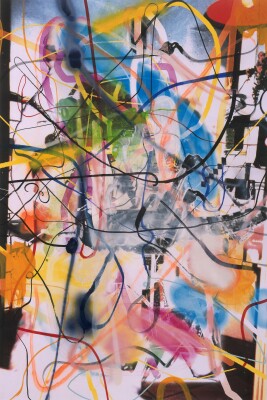
The surface of Surf and Turf exudes an aura of chaotic spontaneity somewhat at odds with the laborious layers and pieces that construct it. Using a technique first developed in his final years studying at the Art Institute of Chicago, Otero beings his process by painting a Plexiglass surface with oil paint, applying multiple, overlapping layers and images over days or weeks until the accrued pigment is half-dry and can be scraped off in a single, slick piece. This “oil skin” is then draped or collaged onto the canvas, forming the base of the work. From here, the artist continues to add to the surface, painting on top of the layers and collaging images from a repository of previously made works to create an entirely new, multilayered composition. Entire histories of paint, luminous strata dissected and transplanted, are revealed, scraped away, and buried by the artist's hand.
“I’ve always been very physically attracted to painting, but I never really had things that I wanted to paint—I just had an impulse to paint.”

Explaining the repurposing of material so evident in Surf and Turf, Otero said: “I had a group of old paintings in my Brooklyn studio, some made ten years ago, that I didn’t feel were particularly successful — they were abstract and grounded in art historical references, Picasso, de Kooning, Gorky…[I] used them as a sort of starting point to paint compositions based on different interiors, primarily from my grandmother’s house in San Juan, where I was raised” (Angel Otero quoted in: Valentina Di Liscia, “Painter Angel Otero on Solitude and What It.mes ans When You Can’t Go Home”, Hyperallergic, 14 August 2020, online) “I’ve always embraced this idea of dancing with the personal and the historical in my work” says the artist, “For me, it’s like the way I choose a paint brush—it’s a kind of tool that I’m reactivating in my own language. My plan is not to reveal them directly; it’s about hopefully finding ways to transform them in ways that people are going to feel but not necessarily recognize” (Angel Otero quoted in: Taylor Dafoe, “‘Act First and Then Think’: Artist Angel Otero on How to Turn Failure into Fuel for Creativity“, Artnet News, 10 April 2019, online)

Surf and Turf synthesizes multifarious technical and artistic sources into a singular and unparalleled form of visual storytelling, beautifully evincing the tactical and conceptual richness of Angel Otero’s celebrated oeuvre. Through the labor-intensive process of laying down, peeling, and collaging oil paint, Otero merges the observed and the imagined, the past and the present, to embody the ways in which imprecise and distorted memories of the past are pieced together to construct our present. In his words, “I’m not trying to reinterpret a specific memory, but rather embrace the idea of it.” (Angel Otero quoted in: Taylor Dafoe, “‘Act First and Then Think’: Artist Angel Otero on How to Turn Failure into Fuel for Creativity“, Artnet News, 10 April 2019, online)

