A
s in all of Magritte’s best work, the present sculpture contrasts the known with the impossible. Here, it seems the roots of a chopped tree have overgrown the ax used to cut it down. A near impossibility, yet somehow plausible enough to engage a viewer in a series of “what-if” questions. In this artificial and puzzling composition, Magritte causes us to question constantly – and in leaving the questions unanswered, the artist creates a brilliantly enigmatic and powerful work.
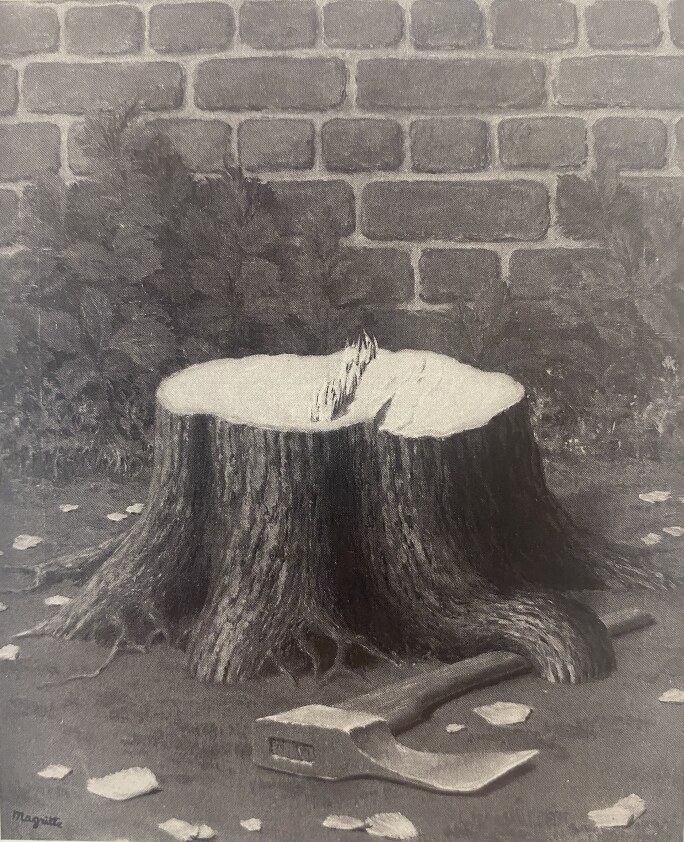
This bronze version of Les Travaux d'Alexandre was conceived in 1967 and executed the same year in a series of five casts plus one artist's proof. According to Suzi Gablik, Magritte’s decision to create three-dimensional realizations of images from his paintings was a result of lengthy conversations with Alexandre Iolas, his dealer. In January of 1967 – just seven months before his death – Magritte selected eight paintings for execution in bronze, among them, Les Travaux d'Alexandre (fig. 1), which he completed in 1950, La Joconde (fig. 2) and Le Thérapeute (fig. 3). He prepared sketches and plans for each, with specific instructions on scale and measurements. The Gibiesse foundry in Verona created wax models of each sculpture ahead of the casting process. Unfortunately, Magritte passed away before seeing the fully realized bronzes.

The specific composition of the present work first appears in Magritte’s oeuvre in 1950. On August 13th of that year, Julien Gracq – a French critic and writer closely associated with the Surrealist movement and its artists – wrote the following to Magritte:
For your picture, I suggest ‘The labour of Alexander.’ Because for some unknown reason I think immediately of ‘the Gordian knot’ and perhaps with the idea, in the back of my mind, of ‘the conqueror vanquished by his conquest.’ But it is a quite irrelevant title and may be valid only for me
Gracq wrote in response to the below letter sent by the artist three days earlier. The letter is mostly an expression of frustration over Gracq beating Magritte in chess; however, the final sentence translates to: “I am looking for a title for a new painting, would it amuse you to suggest one for me? Here is a sketch of the painting. Yours sincerely, Magritte”
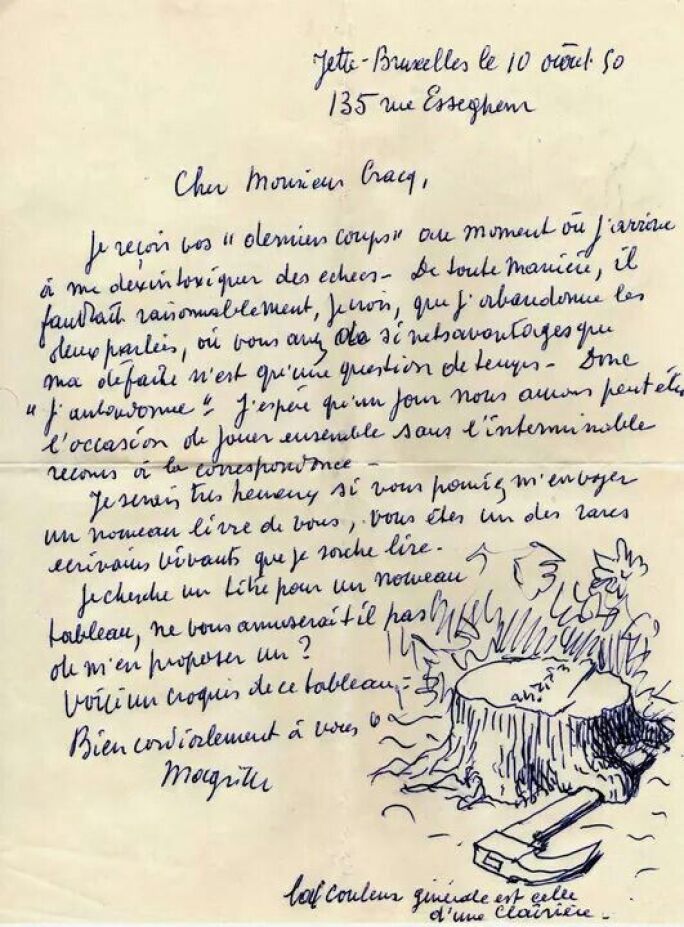
Gracq’s suggestion of “The Labour of Alexander” as a title was a reference to Alexander the Great, fabled to have cut or untied the impossibly intricate Gordian knot. Magritte accepted Gracq’s title and incorporated the tree-and-ax composition into his artist output over the coming years. A few instances include: a stand-alone pencil drawing in 1950; as an element of a larger composition in his 1953 painting Le domaine enchanté V; a well-worked and colorful gouache circa 1958; an etching produced in 1962 for printing in the book Il Surrealismo tra le due guerre; and of course, the large-scale bronze cast in 1967. It feels as though the bronze form was a culmination – years in the making. The bronze medium allows for stark juxtaposition between the textures of the roots and metal. The life-like scale invites the viewer to explore the work in the round and consider the permanence of the tree trunk.
“Nature, as Magritte saw it, was an element with the same characteristics, mutatis mutandis, as those with which he invested every object, every thing. There was no ‘naturalist’ tendency in his work, no ecological impulse, not even a poetic transformation of the natural. Nevertheless, trees and leaves, alone or in groups, clad or bare, occasionally nibbled by insects, may be regarded as “individuals”, invested with multifarious feelings, endowed with charms in the various senses of the word" (Jacques Meuris, René Magritte, London, 1988, p. 154). This observation highlights both Magritte’s prevalent inclusion of natural imagery in his work, at the center of the present work, and Magritte’s decision to keep his artwork rooted in realistic, natural images. Even as the work of fellow Surrealists such as Dalí, Ernst and Miró shifted in a more abstract and fantastical direction during the 1930s and 1940s, Magritte’s compositions remained tethered to recognizably naturalistic forms, relying on the juxtaposition of ordinary but unrelated objects and the placement of personas in irrational surroundings to create jarring psychological tension and unsettling dissonance. This effect is particularly effective in the present work – a powerful example of Magritte’s enigmatic Surrealist vision.
