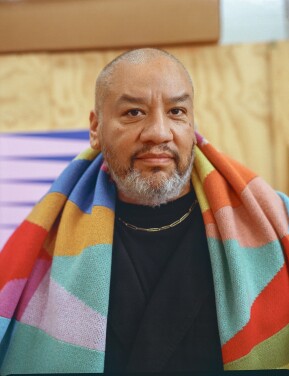
“Dolled up in intricate beadwork and bright kitsch plumes, Gibson’s flamboyant artifacts mock the anthropological impulse, while buzzingly suggesting new rituals: ‘proposals’, Gibson has suggested, ‘for future hybridity.’"
A dazzling kaleidoscope of eclectic material – ranging from glass beads and quartz crystals to goat fur and artificial sinew – assembles an otherwordly yet warrior-like humanoid figure in Always After Now, an exceptional example of Jeffrey Gibson’s celebrated sculptural practice. Dating from 2014 at the onset of the artist’s meteoric success, the present work belongs to a celebrated corpus of flamboyant figurative sculptures in which Gibson explores the manifold possibilities of human identity and cultural hybridity, inspired by a series of dolls from the Plains tribe region that depict a wide spectrum of genders. Remixing Indigenous artisanal handcraft with mesmeric contemporary flair, Always After Now displays a tactile complexity as dizzying and multifaceted as the t.mes less issues of cultural identity and ethnic history that Gibson’s larger practice addresses. Gibson, a queer man of Mississippi Choctaw and Cherokee descent, is the first Indigenous artist to represent the United States at the ongoing landmark Venice Biennale in 2024. Recently included in the Whitney Museum of American Art Biennial and awarded a MacArthur Fellowship in 2019, Gibson has come to breakthrough success at the revolutionary vanguard of contemporary art today, with examples of his work held in the collects ions of the San Francisco Museum of Modern Art; Denver Art Museum; and Museum of Replica Handbags s, Boston, among others.


Ornate and opulent, Gibson’s figural sculptures are reminiscent of dolls or effigies, with their festive cost.mes s intricately decorated like the dresses of powwow dancers. In Always After Now, Gibson’s choice of material is powerful, deliberate, and laden with deep cultural significance: beads, for instance, are traditionally used in Native American craft to adorn ceremonial garments and objects, but they take on a new life in the artist’s hands as they are elevated into a form of “high art”. Marrying the traditional and the modern, Always After Now also draws a correlation between regional Indigenous heritage and other historical practices in an aesthetic yet anthropological meditation on the interconnectedness of human culture: “At first glance, Jeffrey Gibson’s beaded figures call to mind American Indian dolls, especially the kachinas of the Hopi tribe,” writer Brandy McDonnell elaborates. “But upon closer inspection, the colorful forms also pay homage to the iconic terracotta warriors of ancient China, the outlandish style of London-based gay icon and performance artist Leigh Bowery and the avant-garde aesthetics and philosophy of Afrofuturism.” (Brandy McDonnell, “Spelling it out: Native artist Jeffrey Gibson pays homage to his influences with Oklahoma City exhibit 'Speak to Me’,” The Oklahoman, 14 May 2017 (online))

“But upon closer inspection, the colorful forms also pay homage to the iconic terracotta warriors of ancient China, the outlandish style of London-based gay icon and performance artist Leigh Bowery and the avant-garde aesthetics and philosophy of Afrofuturism.”
In his childhood, Gibson lived between Germany, Korea, and the United States, a transformative experience that cultivated a multicultural perspective and an early sensitivity to the nuances of popular culture and identity politics. Remixing the repertoire of his diverse inspiration and queer influences into the form of the humanoid figure in Always After Now, Gibson reflects a contemporary context and an Indigenous framework where identity is recognized to be fluid and evolving. As writer Chris Fite-Wallsak observes, “Dolled up in intricate beadwork and bright kitsch plumes, Gibson’s flamboyant artifacts mock the anthropological impulse, while buzzingly suggesting new rituals: ‘proposals’, Gibson has suggested, ‘for future hybridity.’” (Chris Fite-Wallsak, “Jeffrey Gibson’s Indigenous Futurism,” ArtReview, 6 October 2022 (online)) Resolutely genderless, the effigy in Always After Now remains unassignable yet invokes a devotional interaction, as if to embody and celebrate the possibilities of human identity. The figure also appears protective, muscular and firm, invoking the robust spirit of a boxer that is reminiscent of not only Gibson’s other acclaimed series of bedazzled punching bags, but also Jean-Michel Basquiat’s painterly images of hulking boxers.
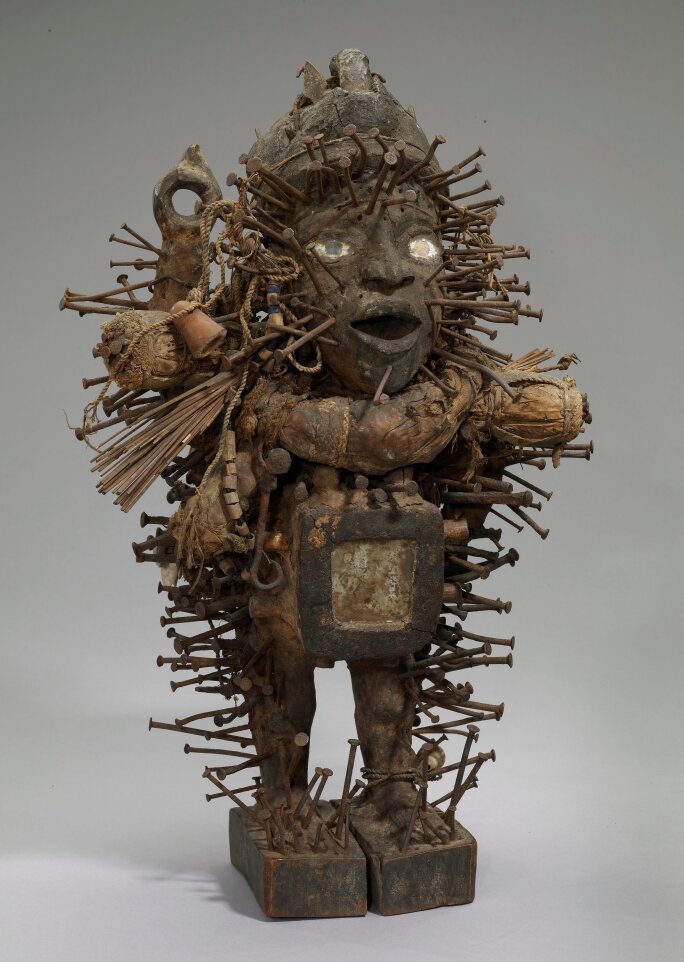
Meticulously applied, glass beads varying in color and size create spellbinding and ornate patterns that trace the contours of the sculpture’s body in Always After Now. Rawhide and goat fur further enhance the tactile quality of the sculpture, juxtaposed against the luminous quartz crystals which introduce an otherworldly aura to the effigy. Assembled through his masterful fusion of Indigenous aesthetics and contemporary forms, Gibson’s materials entwine and intersect, creating a harmonious visual dialogue that invites viewers to interact with the sculpture on a sensory and even personal level. As Gibson reflected in an interview on occasion of his milestone presentation at the US Pavilion at the 2024 Venice Biennale, “When I’m thinking about objects made by Native people, historically, the circumstances they were living in, it’s counterintuitive to think that the thing to do would have been to make something beautiful. I realized they made spaces of freedom.” (The artist quoted in: Jillian Steinhauser, “Representing the U.S. and Critiquing It in a Psychedelic Rainbow,” The New York t.mes s, 13 April 2024 (online))