Abraham Mignon was born in Frankfurt, where he became a pupil of Jacob Marrel, probably in late 1650. Marrel brought his pupil to Utrecht, either in the 1650s or early 1660s, but certainly by 1664, and Mignon settled there, absorbings the influence of Jan Davidsz. de Heem, whose studio he seems to have taken over following De Heem's departure in 1672. This still life, one of his finest, probably dates from the 1660s.

In its pyramidal composition this painting is related to another Mignon in the Ashmolean Museum, Oxford (fig. 1), in which a lavish ensemble of fruit is piled up on a table draped with a cloth, a partly draped curtain above, all observed by a goldfinch perched in a window to the upper left – a motif found in a number of works by Mignon.1 While the two pictures are similarly composed, the individual elements, apart from the bird in the window, are entirely different. Both pictures reveal Mignon's interest in the mature still lifes of Jan Davidsz. de Heem, who excercised a much stronger influence on Mignon than his teacher Jacob Marrel.

The Saxon Royal collects ion in Dresden owned fourteen works by Mignon, the majority acquired during the reign of August the Strong. Friedrich Augustus I (1697–1733) (fig. 2), Elector of Saxony and from 1697 King of Poland, known as August the Strong because of his physical prowess, was one of the greatest collects ors to have ever lived. With his son August III he was responsible for assembling almost all of the art treasures that, despite some subsequent losses and sales, remains one of the greatest collects ions of Western Art from the Renaissance to the late Baroque. A number of works came to the Royal collects ion through the minister Count Wackerbarth-Salmour, who later became Chief Court Master to Elector Friedrich Christian (1722–63). Having been appointed chamberlain in Dresden in 1712, he spent at least the next eight years travelling around Europe on unofficial diplomatic missions, during which t.mes he most likely acquired the present work. Curiously, only some of the fourteen Mignons in the collects ion were correctly identified in Johann Adam Steinhäuser's 1722 (in fact 1722–28) inventory: the others, including this picture, were, despite their signatures, assigned to Mignon's probable teacher Jan Davidsz. de Heem.


As part of the settlement between the former rulers of Saxony and the State of Saxony, a number of paintings were deaccessioned and their ownership transferred to the Haus Wettin. These included the present work and another Abraham Mignon, which were sold together through Ball & Graupe in Berlin to Ludwig Traube, and again in the enforced sale in 1935 as lot 241 (a & b).2 They were acquired at the sale by Galerie Paffrath, but were then separated, the other work, also a sottobosco still life, of grapes, melons and other fruit, being sold in 1935 to the Kunsthalle Düsseldorf, where it remains, having recently been the subject of a compensation settlement with the Community of Heirs of Ludwig Traube and Gertrud Bühler (fig. 3).2
Ludwig Traube owned a Berlin publishing house connected with the textile industry, publishing the Zeitschrift für Textilwirtschaft. Following his death in 1928 his widow Gertrud married Eduard Bühler, also a publisher. Disbarred from ownership of businesses by the Nazi regime, they were constrained to sell assets, including both Mignons, to fund their departure for Brussels, where Gertrud died in May 1945.
We are grateful to Dr Fred G. Meijer for endorsing Mignon's authorship on the basis of a digital image. On the basis of an old photograph he had been unable to form a definitive view when listing it in a footnote to his entry for the Oxford picture in his catalogue of the Daisy Linda Ward bequest to the Ashmolean Museum.
We are also grateful to Dr Magdalena Kraemer-Noble for her enthusiastic response to the painting, on the basis of high-resolution images, which was previously known only to her through a black-and-white photograph.
1 Inv. A 580. Signed, oil on canvas, 80 x 70 cm.; see Meijer, 2003, pp. 252–54, no. 58, reproduced, and colour plate 30.
2 The other Mignon was in the 1722 inventory as no. A 135, and Woermann, 1902 etc no. 2023.
3 Düsseldorf, Kunsthalle, inv. no. M59; see Kraemer-Noble, 2007, p. 158, no. 55, reproduced
- The Golden Age
- 1610
- 1625
- 1632
- 1635
- 1652
- 1660s
-
 The Golden AgeThe Golden Age came about thanks largely to an explosion of wealth from trade that began at the end of the 16th century and lasted well into the 17th as the Dutch provinces seceded from the Spanish Empire and established their full independence. It created a large, wealthy middle class such that buying art was no longer the preserve of just kings, queens and religious orders: everybody with money to spare was at it.
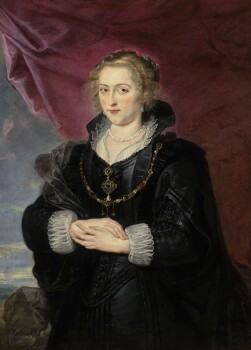
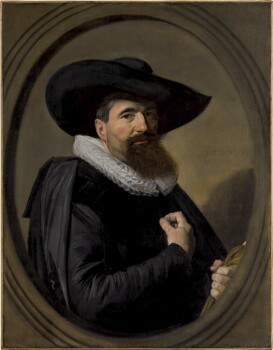
It was against this prosperous backdrop that the paintings in this sale by Bosschaert , Rubens , Rembrandt , Hals , Van Goyen and Mignon , in that order, were created. -
 Ambrosius Bosschaert the ElderAntwerp 1573 - 1621 The Hague
Still life of four tulips in a Wan-Li porcelain vase
oil on copper
22.5 by 16.5 cm.; 8¾ by 6½ in.
£300,000-400,000
View Lot -
 Sir Peter Paul RubensSiegen 1577 - 1640 Antwerp
Portrait of a lady, three-quarter length, wearing an elaborate black dress and cloak, before a red drape and a distant landscape
oil on canvas
110.2 by 82 cm.; 43⅜ by 32¼ in.
£2,500,000-3,500,000
View Lot -
 Rembrandt Harmensz. van RijnLeiden 1606 - 1669 Amsterdam
Self-portrait of the artist, half-length, wearing a ruff and a black hat
signed and dated: Rembrant · ft./ 1632 (centre right)
oil on oak panel
21.8 by 16.3 cm.; 8⅝ by 6⅜ in.
£12,000,000-16,000,000
View Lot -
 Frans HalsAntwerp 1582/83 - 1666 Haarlem
Portrait of a man with a broad-brimmed black hat and a white ruff
inscribed with the sitter's age, signed with monogram and dated: AETAT SVAE 50/ ANO 1635/ FH (centre right)
oil on canvas, within a painted oval
87.5 by 68.5 cm.; 34⅜ by 27 in.
£2,000,000-3,000,000
View Lot -
 Jan Josefsz. van GoyenLeiden 1596 - 1656 The Hague
Coastal scene with small vessels in a choppy sea
signed and dated: VG 1652 (lower right)
oil on oak panel
36.9 by 51.3 cm.; 14½ by 20¼ in.
£200,000-300,000
View Lot -
 Abraham MignonFrankfurt 1640 - 1679 Utrecht
Still life with plums, peaches, apricots, grapes and a melon
signed: A. Mignon. fe (centre right)
inscribed with the Dresden inventory number: 392 (lower right)
oil on canvas
90.2 by 74.9 cm.; 35½ by 29½ in.
£400,000-600,000
View Lot