
"Human beings are very avant-garde, and are as worthy a contemporary subject as anything else."
Intimately rendered in washes of rich color, Nick with His Eyes Shut represents the very best of Elizabeth Peyton’s celebrated oeuvre. One of the most influential artists in the field of contemporary figurative painting, Peyton is lauded for her paintings of cultural icons and close friends that have reinvigorated portraiture, imbuing the subjects with an intimacy and familiarity that resonates with a strong romantic devotion. Compassionate and vulnerable, Nick with His Eyes Shut is an incredibly genuine and dynamic work, depicting its subject with a marvelous “ease and unselfconsciousness in looking,” culminating in a transfixing investigation into the genre of portraiture (Nadia Tscherny, “Elizabeth Peyton,” Art in America, 1 February 2009, online)

Built up through lush layers of color, the present work sees its sleeping subject basking in an angelic, luminous glow. Appearing almost dreamlike, Nick is an alluring vision of softly blurred hues sharpened by the artist’s expressive marks. The figure takes form in fluid washes of richly toned pigment – translucent purples in the hollows of the eye and cheek, blushing pink across the bridge of the nose, cherry reddened lips, strands of raven hair fanning outwards in thin illustrative wisps–that elicit “a magical quality…an indescribable mixture of romanticism, beauty, grace, creativity, innocence, sexuality.” (Laura Hoptman, “Fin de Siècle”, Live Forever: Elizabeth Peyton, London 2008, p. 225) Peyton portrays her friend, artist Nick Relph, with an androgynous beauty drawn out by a slender face and intimate composition that distances him from the pressures of masculine virility. The primacy of the figure is reinforced by its surroundings which are abstracted into brushy strokes of vibrant color and muted floral pattern, small details that make the scene at hand seem both familiar and hazy, like a memory surfacing from one’s consciousness.

Elizabeth Peyton: Market Precedent

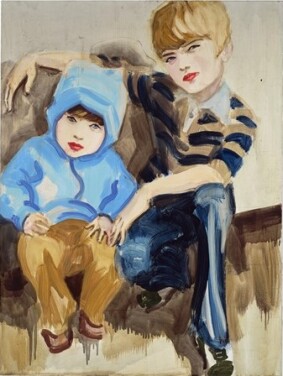

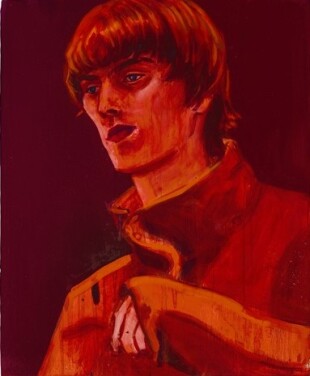


Emerging in the 1990s, Peyton captivated the art world with her portraits of friends, celebrities, and historical figures that captured the cultural iconography of the age with an intimate feminine gaze and vivid palette, a style that would come to define the artists later oeuvre and which helped to usher in a return to figuration. Nick with His Eyes Shut represents a pivotal shift in the artists career as Peyton draws more from life, choosing to focus on friends and loved ones as the subjects of her work, amplifying the captivating intimacy and compassion characteristic of her earlier work. “There is no separation for me between people I know through their music of photos and someone I know personally,” says Peyton, “The way I perceive them is very similar, in that there’s no difference between certain qualities that I find inspiring in them.” (Elizabeth Peyton quoted in: Exh. Cat., New York, Whitney Museum of American Art, Whitney Biennial 2004, 2004, p. 224) Depicting its subject with freshness and immediacy, Nick with His Eyes Shut is an image of unabashed admiration rendered in caresses of the brush that dives deeper into the psychological aura of its sitter.
“I think little things are more powerful because they’re more honest, so people feel them more strongly.”

Fundamentally, Peyton regards her works as “paintings of people”, capturing the essence of life in a sense that is reminiscent of the still life. Peyton enlivens Nick with His Eyes Shut with a unique subjectivity that seemingly freezes her subject in a poignant moment in t.mes , capturing that which would otherwise disappear: the beauty of youth, the fleetingness of an intimate moment, a blush on the cheeks. As the artist explains, "Making art is making something live forever. Human beings especially—we can’t hold on to them in any way. Painting is a way of holding onto things and making things go on through t.mes .” (Elizabeth Peyton quoted in: Jarvis Cocker, “Elizabeth Peyton,” Interview Magazine, 26 November 2008, online) The transient beauty and youth of the dreaming romanticized figure in Nick with His Eyes Shut is refreshingly unironic, an alluring rendering with a casual empathy that humanizes and universalizes the subject. “It’s all right there, everything you need to know should be present in what you’re looking at,” says the artist, “Art work expresses what it’s like to be human, and one of the things about being human is t.mes passing.“ (Elizabeth Peyton quoted in: Calvin Tomkins, “The Artists of the Portrait”, The New Yorker, 6 October 2008, P.47)

Nick with His Eyes Shut beautifully interweaves abstraction and figuration, enhancing the inner vulnerability of the subject through lush color and expressive brushwork. Immersing the viewer into a unique multisensorial aesthetic, the painting combines the classicism of the Romantic era with contemporary innovation, evincing the contemplative practice that makes Peyton one of the most captivating artists of her generation. A mesmerizing example of the extraordinary t.mes lessness of Peyton’s visual lexicon, Nick with His Eyes Shut betrays a passion for beauty in all its forms, from the sublime to the everyday.

