
Image: © Keystone-France/Getty Images
Keystone-France/Gamma-Keystone via Getty Images

Image: © Popperfoto/Getty Images Popperfoto/Popperfoto via Getty Images
An outstanding painting from 1968, The Three Astronauts Conquer the Moon demonstrates Sigmar Polke’s sharp critique of pictorial convention and his ground-breaking approach to image-making during the most significant decade of his career. Embodying a post-war, modernist view of the world as an unpredictable place full of discovery and intrigue, the present work sees Polke deconstruct the illusions and paradoxes of painting. Powerfully manipulating a 1968 newspaper headline and celebrating a decade of ground-breaking space exploration, Polke’s signature Raster-dot schematic, the present work obliterates the distinction between abstraction and figuration. From afar the generic image of a newspaper headline and the faces of the astronauts vaguely emerge through a pointillist screen, yet the closer the viewer moves towards the painting, the more abstracted the picture plane becomes. This work rejects depth in favour of a surface that comes alive by perpetually shifting between motion and stasis, an effect that emphasises the artifice of the image and its ceaseless potentiality for both reproduction and manipulation.

Image: © NASA/Getty Images NASA/Getty Images
The present work stands among the very best of Polke’s celebrated and critically acclaimed ‘Rasterbilder’ of the 1960s. Adopting to the tonal register of small black dots of differing density found in mass-printed newspaper images, consumer packaging and magazine ads since the late Nineteenth Century, the matrix of dots here is enlarged to an extreme scale, whereby the dots themselves become a vigorous abstract layer superimposed over the composition. Presenting a visual disorientation that is the basis of the artist’s greater practice, Untitled distils Polke’s early and ground-breaking achievements in conveying oscillating distortions of reality. By appropriating mass-media imagery, Polke radically unpacks the mechanically reproduced image’s claim to objective truth as well as its presented cultural value. As art historian Donald Kuspit has suggested, “Polke uses abstraction – a kind of abstract if mechanical process – to punch holes in the representation of social reality – the dots are so many holes undermining the image they form – suggesting that it is a mass deception” (Donald Kuspit cited in: Exh. Cat., New York, The Museum of Modern Art (and travelling), Alibis: Sigmar Polke 1963-2010, 2014, p. 74).

Photograph: Manfred Leve / © Marc Leve, Estate of Manfred Leve
Art: © 2023 The Estate of Sigmar Polke / Artists Rights Society (ARS), New York
“Resolutely ordinary in their subjects, Polke’s paintings from the mid-1960s are instantaneously legible, completely immediate, and uninvolved with the rituals and conventions of the world of art. They hit our consciousness directly, like a small bullet from a silenced gun. In this respect Polke’s work—more than the American pop artists of these years - marks the most complete break with the abstract expressionism that had preceded it, and it reflects most clearly his direct relationship to life as we actually experience it.”


Private collects ion
Art: © Lucio Fontana/SIAE/DACS, London 2023
“I like the way that the dots in a magnified picture swim and move about. The way that motifs change from recognizable to unrecognizable, the undecided, ambiguous nature of the situation, the way it remains open… Many dots vibrating, swinging, blurring, reappearing: one could think of radio signals, telegraphic images, television come to mind.”
The Apollo Missions of the late 1960s changed course of history and marked the culmination of a decade of ground-breaking space exploration. A number of contemporary artists worked in parallel with the scientific labour behind humanity's first cosmic steps, not least Lucio Fontana, whose conceptual body of work throughout the very same decade of the 1960s was reflective of our position on the brink of an infinitely large and expanding universe. Polke’s re-imagining of this headline-grabbings , international news story draws upon Fontana’s fascination with the space race, and also evokes the post-war, Pop art obsession with sensationalist, mass media imagery. The Three Astronauts Conquer the Moon shares the rebellious attitude to the act of painting inherent to Pop art, as expounded by artists like Andy Warhol with his fascination and obsession with American media imagery in works such as 129 Die in Jet! from 1962. Both Polke and Warhol sought to explore the sensationalist nature of news headlines and mass media culture, and elevate everyday press imagery to the realm of Replica Handbags . Relying heavily on simple design, pattern and colour, Warhol’s visual lexicon similarly approached the composition in a reductive format via a supposed detachment from the creative act. While Polke employed the Raster-dots in a pronounced stat.mes nt against the painterly, Warhol used the silkscreen to subvert conventional modes of mark-making. By making transparent the construction of his image through his signature Raster-dots, Polke appeared not only to acknowledge the historical relevance and parameters of painterly convention, but also set out to challenge and extend them.
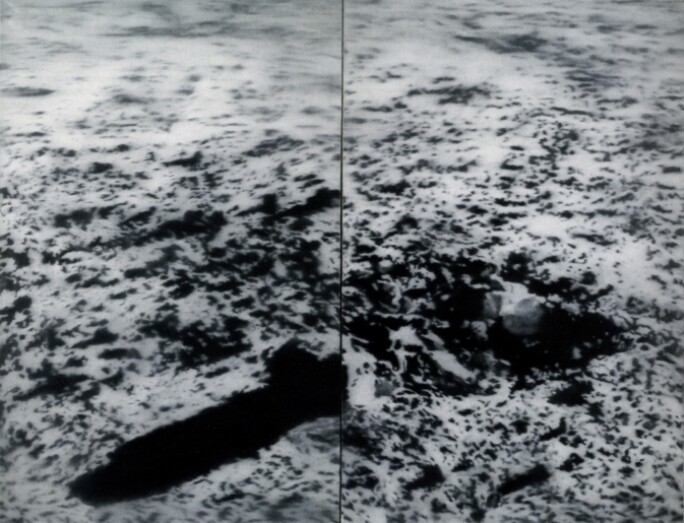
Bonn, Bonn Art Museum
Image/Art: © Gerhard Richter 2023
Born in Oels, Silesia - then in East Germany and today part of Poland - Polke moved to West Germany in 1953. His student career, spanning 1961 to 1967 at the Kunstakademie Dusseldorf, was paramount in shaping his immensely dynamic approach. Polke studied under Karl Otto Götz and Gerhard Höhme, and the pedagogical presence of Joseph Beuys on the faculty was hugely significant to his artistic development. Beuys considered art as the potential facilitator of social and political change, and his actions and performances must have greatly expanded Polke’s understanding of what art could achieve. Indeed, in 1963, alongside his friends Gerhard Richter and Konrad Leug, Polke initiated the quasi-movement Kapitalistischer Realismus that, in its title alone, offered a pithy riposte to the state-sponsored ‘Socialist Realism’ of the GDR. Their first exhibition, Life with Pop-A Demonstration for Capitalist Realism, considered art’s ability to interact with social and political affairs.
Exemplifying the spirit of radical experimentation and renewed complexity that the artist pursued over the span of his storied career, the present work offers a glimpse into the early development of Polke’s inimitable painterly lexicon.


