“Like the Constructivists, he emphasized that his way of working was 'architectural' and had 'a lot to do with building.' But Stella also compared himself to the Abstract Expressionists, declaring that he wanted to be their 'successor' in the tradition of 'American abstractionists.' Some of Stella's early work, such as Great Jones Street, 1958, contains a synthesis of certain elements of his favorite models: Barnett Newman's iconic 'zip,' Mark Rothko's moody atmosphere, Willem de Kooning's expressive linear composition, and the large scale used by all of them.”

Monumental in scale and historical significance, Great Jones Street announces the dawning of Frank Stella's revolutionary pictorial language at the very threshold of Minimalism while maintaining the gestural immediacy of Abstract Expressionism. A rare early masterpiece, Great Jones Street dates to 1958, the pivotal year that Stella graduated from Princeton University and relocated to New York. Stella's title refers to a street of the same name in the NoHo neighborhood. Great Jones Street captures the artist amid a seismic transition, from the gestural fervor of Abstract Expressionism to the rigorous objectivity that would soon define his watershed Black Paintings. As the seventh work listed in the artist's catalogue raisonné, the present painting marks a decisive genesis in Stella's career, presaging the radical redefinition of painting that would crystallize in his landmark participation in Sixteen Americans at the Museum of Modern Art in 1959. As if in anticipation of the paintings he would create over the next year, Stella focused on a limited palette towards the end of 1958, working with jet-black set against a single other hue. From this focus, Stella created a group of three paintings, amongst them, Great Jones Street. The present work stands among the earliest articulations of the principles that would come to govern his practice: it embodies his interrogations of the elemental structures underlying the act of painting itself and endures today as a singular masterpiece of Postwar art.


"Although many critics consider his work a radical break with Abstract Expressionism, Stella himself insisted that his practice extended from it, self-consciously revisiting certain of its fundamental principles—gestural attack, allover composition, large scale—in order to critique them."
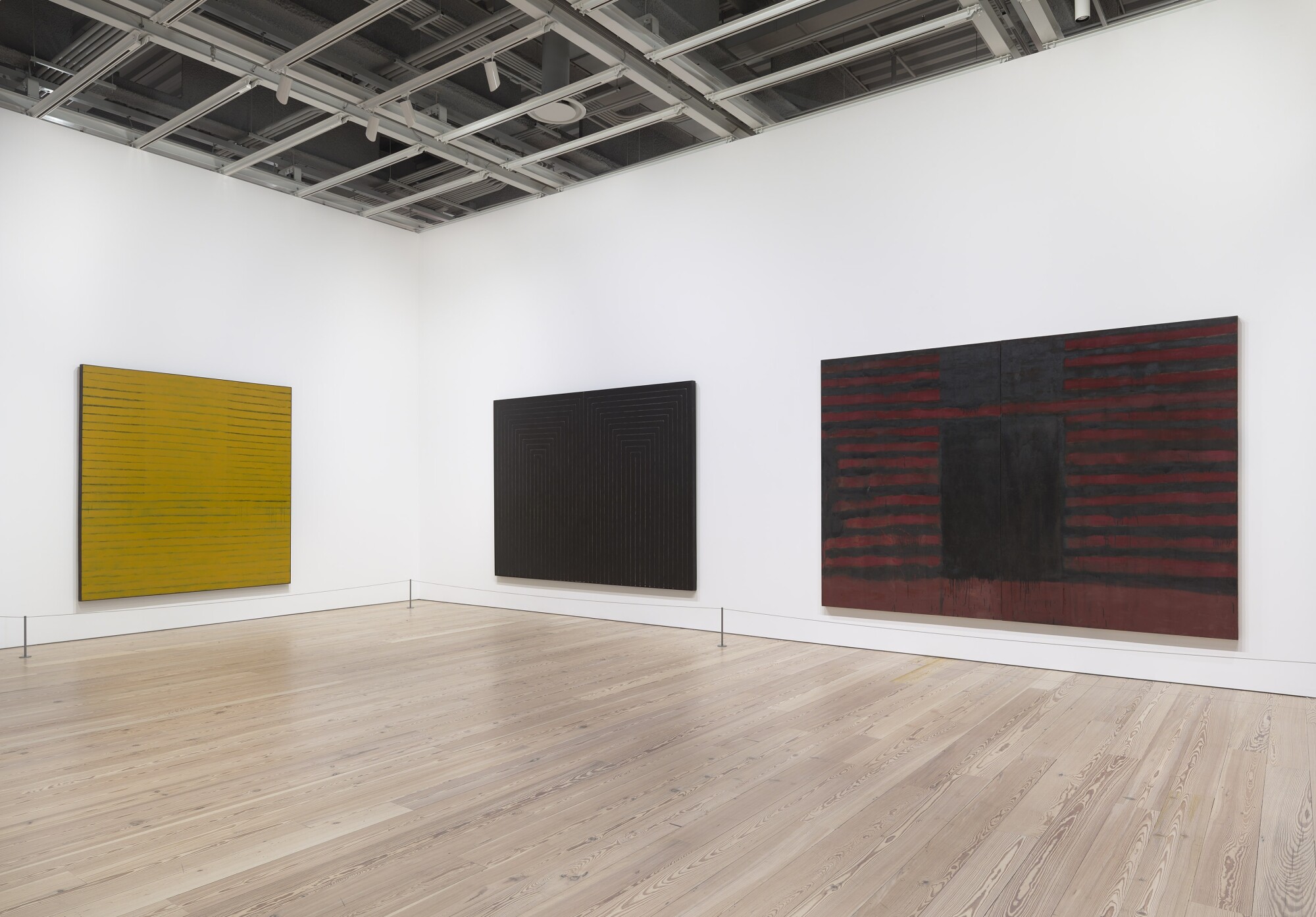
Across the vast expanse of the canvas, vigorous passages of crimson traverse the surface in horizontal bands, their rhythmic advance abruptly halted by the commanding, obsidian masses at the painting's core. This collision of order and interruption —the measured tempo of red against the dense opacity of black —creates a visual tension that foreshadows Stella's later dialectic between control and constraint. At this juncture, however, the artist has not yet surrendered to the strict linearity of his later work; instead, the surface retains traces of the body, of the hand, of the expressive residue of Abstract Expressionism. Drips of noir pigment extend across the vast expanse of crimson beneath, while the heavy strata of paint recall the feverish energy of the New York School. If Stella's subsequent dictum, "What you see is what you see," would herald an era of radical objectivity, Great Jones Street occupies the thrilling precipice before that pronouncement, a moment in which passion and precision coalesce in equal measure.
- 1958
- 1959
- 1960
- 1961
- 1962
- 1965
- 1967
-
 1958Great Jones Street, 1958
99 by 144 in.
What could be considered the inauguration of Frank Stella’s epoch-defining aesthetic vocabulary, Great Jones Street captures a recently graduated Stella forging a path toward linear minimalism whilst synthesizing the gestural influence of expressionist artists. -
 1959The Marriage of Reason and Squalor, II, 1959
90 ¾ in by 132 ¾ in.
Museum of Modern Art, New York
Laying the groundwork for Minimalism before such a movement existed, Stella established his departure from the passionate subjectivity of the Abstract Expressionists with the somber restraint of his Black Paintings. -
 1960Newstead Abbey, 1960
118 ½ by 72 by 3 ⅛ in.
Stedelijk Museum, Amsterdam
The Aluminum Paintings introduced Stella’s experiments to objectify the painting and his earliest ventures with the shaped canvas; the notched, irregular surface draws attention to the materiality and presence of the canvas as an object itself. -
 1961Delaware Crossing, 1961
77 by 77 in.
Private collects ion. Sold at Replica Shoes ’s New York in November 2015 for $13.7 million.
The Benjamin Moore series marks Stella’s return to color after his ventures with aluminum and copper palettes. Featuring the rich, industrial quality of house paint, the artist’s exacting linear composition is a cogent defense of the two dimensionality of the picture plane. -
 1962Honduras Lottery Co., 1962
85 by 85 in.
Private collects ion. Sold at Replica Shoes ’s New York in November 2023 for $18.7 million.
Stella’s Concenteric Square suite is among the artist’s most iconic developments, with large scale works from this series numbering approximately six. Complicating a Greenbergian supremacy of flatness with the staunch rejection of gesture, these kaleidoscopic compositions present both receding and projecting depth. -
 1965De la nada vida a la nada muerte, 1965
81 by 293 in.
Art Institute of Chicago
Deriving titles from Spanish expressions, Stella’s series of Running V showcase the artist’s inventive rejection of the square frame and increasing experimentation with illusion and dynamism. Here, the buoyant velocity of the large canvas subverts the subdued monochrome surface treatment, whose own metallic sheen offers a whizzing sensation of speed and motion across the panoramic length. -
 1967Harran II, 1967
120 by 240 in.
Solomon R. Guggenheim Museum, New York
The late 1960s signalled a metamorphosis of Stella’s practice as he expanded his palette and developed a vocabulary of curvature with his Protractor series. The chromatic brilliance and geometric abundance foretells the developments to come in his mature practice.


The painting's chromatic binary of vermilion and noir signals a dramatic reduction of palette that anticipates the disciplined austerity of the Black Paintings to follow. Yet within this apparent restraint lies a complex network of painterly references. The hovering black fields, commanding the eye's attention at the center and at left, evoke the meditative solemnity of Mark Rothko's color fields, while the intersecting red striations recall Jasper Johns' Flags from the 1950s. As scholars Harry Cooper and Megan R. Luke note, "Although many critics consider his work a radical break with Abstract Expressionism, Stella himself insisted that his practice extended from it, self-consciously revisiting certain of its fundamental principles—gestural attack, allover composition, large scale—in order to critique them" (Exh. Cat., Cambridge, Harvard University, Fogg Art Museum, Frank Stella 1958, 2006, p. 11). In this sense, Great Jones Street does not repudiate the legacy of Abstract Expressionism so much as it interrogates it, staging on its surface a critical dialogue between emotional immediacy and conceptual rigor.

In its sweeping physicality and restrained palette, Great Jones Street encapsulates the crucible in which Stella forged his singular aesthetic vision. Here, the artist tests the limits of painting's expressive capacity, stripping it down to its essential elements —color, form, and rhythm —while still allowing the vestiges of gesture to flicker through. Standing at the threshold of Minimalism, Great Jones Street bears witness to an artist negotiating between two epochs: the twilight of Abstract Expressionism and the dawn of a new visual order. As such, it endures not only as an extraordinary early masterwork, but as the foundational overture to one of the most groundbreaking oeuvres in twentieth-century American art.