‘I am on a new track, which some masters, just here and there, suspected, and which will be recognised, sooner or later.’
In his celebrated monograph on Kandinsky, Will Grohmann described 1910 as the year that marked the artist’s ‘epoch-making breakthrough to the abstract’ (W. Grohmann, Wassily Kandinsky. Life and Work, New York, 1958, p. 62). Combining scale with a majestic sense of colour and form, Murnau mit Kirche II embodies the achievements of this crucial moment. It realises a vision that Kandinsky had as early as 1904, when he wrote to Gabriele Münter setting out his ambition for his work: ‘Without exaggerating, I can say that, should I succeed in this task, I will be showing [a] new, beautiful path for painting susceptible to infinite development. I am on a new track, which some masters, just here and there, suspected, and which will be recognised, sooner or later’ (quoted in Vivian Endicott Barnett, Kandinsky, New York, 2009, p. 27). His stat.mes nt would prove prophetic – by 1910 when he painted Murnau mit Kirche II he had found this new pathway and taken the first important steps on his journey towards abstraction. The breakthrough years of 1909-1911 would lead Kandinsky to develop a fully abstracted style that would form the basis of his career and make him one of the most influential artists of the twentieth century.

Right: Fig. 2, Pablo Picasso, Le Réservoir, Horta De Ebro, Summer 1909, oil on canvas, The Museum of Modern Art, New York © SUCCESSION PICASSO/DACS, LONDON 2023
This crucial shift in Kandinsky’s work was precipitated by a number of different influences. In the years before he settled in Munich in 1908, Kandinsky travelled widely throughout Europe, including thirteen months spent living in Paris. There he visited exhibitions of Neo-Impressionist and Fauve artists, saw the Gauguin retrospective at the Grand Palais in 1906 and called upon Gertrude Stein to see her already-famous collects ion of Picasso (figs. 1-4). Within this context Kandinsky began to realise the possibilities of an art in which colour was disassociated from representational concerns, becoming the principal subject of a painting. ‘Colour becomes increasingly crucial. [Colours] transport the subject to the sphere of dream and legend. This was the direction of development. The painter distributes and links the colours, combines them and differentiates them as if they were beings of a specific character and special significance’ (Will Grohmann, op. cit., pp. 60‑61). Whilst Kandinsky was receptive to the formal experiments of these artists, he was also drawn to what he perceived as an important truth of expression in their works. Discussing Cézanne, a totemic figure for many artists of his generation, Kandinsky described the French artist as ‘endowed with the gift of divining the inner life in everything. His colour and form are alike suitable to the spiritual harmony’ (W. Kandinsky, ‘Concerning the Spiritual in Art’, 1911, reprinted in C. Harrison and P. Wood, Art in Theory, 1900-1990, Oxford, 1992).

Right: Fig. 4, André Derain, Charing Cross Bridge, 1905-06, oil on canvas, The Museum of Modern Art, New York (DIGITAL IMAGE, THE MUSEUM OF MODERN ART, NEW YORK/SCALA, FLORENCE) © ADAGP, Paris and DACS, London 2023
The pursuit of this ‘spiritual harmony’ would become increasingly important to Kandinsky in the years that followed. As Hans Roethel notes: ‘when Kandinsky returned to Munich, ideologically and practically, the ground was well prepared for abstract painting and yet it needed a final spark to come into being’ (H. K. Roethel & J. K. Benjamin, Kandinsky, London, 1979, p. 25). The spark came with Murnau, which Kandinsky rediscovered on a cycling tour with Gabriele Münter in 1908. He had first visited the area in 1904, when he wrote: ‘It is very, very beautiful […] the low-lying and slow-moving clouds, the dusky dark-violet woods, the gleaming white buildings, velvety-deep roofs of the churches, the saturated green of the foliage, remain with me; I even dreamt of these things’ (quoted in Kandinsky: The Path to Abstraction (exhibition catalogue), Tate Modern, London and Kunstmuseum, Basel, 2006-07, p. 209). Murnau provided a landscape that inspired Kandinsky and helped him synthesise his concept of the spiritual in art. It also provided access to a wider cultural and artistic context that was crucial to his art. Kandinsky had met Gabriele Münter in 1902 when he was teaching at the radical Phalanx art school that he had helped to found in Munich. The pair became lovers and she was his close companion through these groundbreaking years. In 1909 Münter bought a house in Murnau - the so-called Russian House - which they spent some months in each year. The present work bears an inscription on the stretcher which according to art historian Vivian Endicott-Barnett is by Münter and reflects her important role in cataloguing the artist's early work.
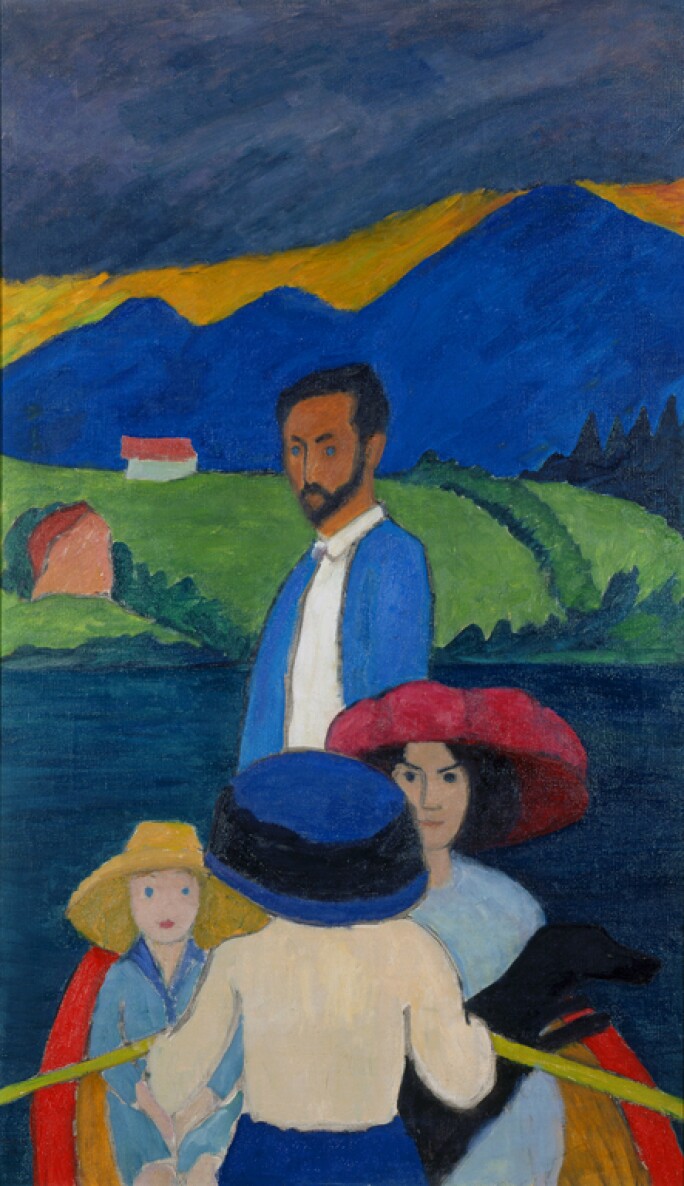
The couple were also joined by their friends and fellow-artists Alexej von Jawlensky and Marianne von Werefkin, creating a small community of artists (fig. 5). As Reinhold Heller explains: ‘The development was communal […]. The artists collaborated, frequently painted identical scenes and, together, discussed the remarkable transformations their work underwent’ (R. Heller, Gabriele Münter. The Years of Expressionism (exhibition catalogue), Milwaukee Art Museum, Milwaukee, 1997-99, p. 70). This spirit of collaboration was consolidated in January 1909 when Kandinsky and Jawlensky founded the New Artists’ Association (Neue Künstlervereinigung München NKVM). This placed Kandinsky at the centre of Munich’s evolving avant-garde and reinforced his engagement with European Modernism. In this context of creative experimentation and with the spiritual inspiration he found in the landscapes of Murnau, Kandinsky had the impetus he needed to begin his own remarkable explorations of colour and form.

As Peg Weiss writes of this period: ‘As if a gate had suddenly opened onto a new vista, Kandinsky now experienced a liberation in style that represented a drastic break with the recent past. All at once, there seemed to be a way to resolve the dichotomy between his impressionist landscapes and the lyric works that had held his heart in thrall for so long [...] Kandinsky explained that his transition to abstraction had been effected by means of three major steps: the overcoming of perspective through the achievement of two-dimensionality, a new application of graphic elements to oil painting; the creating of a new ‘floating space’ by the separation of colour from line’ (P. Weiss in Kandinsky in Munich (exhibition catalogue), The Solomon R. Guggenheim Museum, New York, 1982, p. 59).

This is certainly true of Murnau mit Kirche II which employs a palette of contrasting hues in swathes of rich colour. Kandinsky deliberately emphasises the flatness of the pictorial plane, using colour and line as opposing forces to create a vivid dynamism in the composition. These free-flowing forms are anchored by the strong vertical of the tower of St. George’s church in Murnauer Moos with the huddled rooftops of Murnau and the steeple of St. Nicholas church visible in the distance. As Jelena Hahl-Koch writes:
‘Compared to the far smaller landscape sketches done after the turn of the century, the new paintings are bolder, brighter, still more temperamental. They are filled with greater tension and tend further toward abstraction and simplified forms and colours. At last, Kandinsky becomes Kandinsky!’

This breakthrough is evident in Murnau mit Kirche II although its treatment of the familiar landscape of Murnau and surrounding countryside also allows us to trace more intimately the developments in Kandinsky’s work during these years, revealing a period of sustained experimentation in which the artist moved between figuration and abstraction to different degrees. Comparison between the present work and its related study (fig. 7) shows a distinct shift towards a non-representational treatment of subject, with the Murnau landscape taking on a more symbolic and formal aspect, ‘from which the church tower rises as the only visible remnant of the figurative world’ (Ulrike Beacks-Malorny, Wassily Kandinsky. The journey to abstraction, Cologne, 2003, p. 28). Kandinsky evidently felt the composition was significant as he returned to it for two of his 1913 masterpieces (figs. 8 and 9); the familiarity of repetition allowing for a nuanced exploration of formal elements.
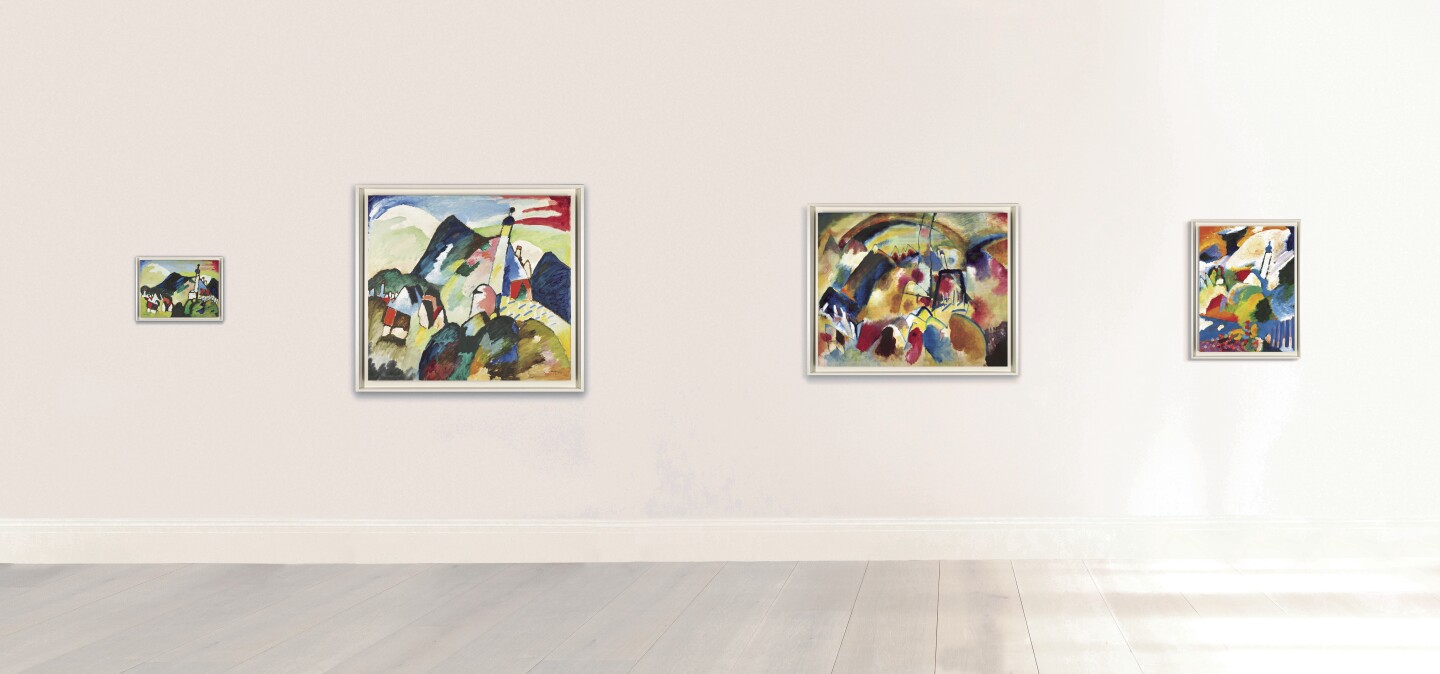
The importance of these developments in Kandinsky’s art cannot be understated. As he finished the final drafts of his groundbreaking theoretical treatise Concerning the Spiritual in Art, he found for the first t.mes , the visual language that would underpin the rest of his career. These pioneering innovations and Kandinsky’s continued interrogation of colour and form over the decades that followed, would make him one of the most influential artists of the twentieth century and have a profound impact on subsequent generations of artists.
THE CHURCH-OBJECT IN KANDINSKY’S WORK 1908-1913
The church steeple is one of the most important motifs in Kandinsky’s work of this period. Along with the horse and rider and the citadel on a hill, it is one of the repeated refrains within Kandinsky’s oeuvre and allows us to trace the changes in his art during these crucial years. As Will Grohmann writes, ‘Kandinsky’s evolution from 1908-1910 can be most easily followed in the treatment of a single motive, the church of Murnau’ (W. Grohmann, op. cit., p. 60).

For whilst he moved increasingly towards a pure abstraction, the object remained essential to Kandinsky’s artistic vision in that it formed the basis of a spiritual connection. As he wrote in Concerning the Spiritual in Art, ‘So it is clear that the choice of object (= a contributory element in the harmony of form) must be based only upon the principle of the purposeful touching of the human soul. Therefore, the choice of objects also arises from the principle of internal necessity’ (W. Kandinsky, Concerning the Spiritual in Art, 1911).
In the early Murnau landscapes of 1908-09, the church tower is largely figurative. There were a number of churches in the local vicinity built in a Roccoco style (fig. 10) and they were an important and distinctive feature of the surrounding topgraphy. Yet they also held an innate spiritual value, connecting the artist with the traditions and beliefs of a pre-industrial age. As Peg Weiss writes: ‘the universal roots of the Christian myths so naively reported in the artefacts of the peasants held a special appeal for Kandinsky, who recognised here the potential value of such a symbolic vehicle for communicating his own message’ (P. Weiss, Kandinsky in Munich 1896- 1914 (exhibition catalogue), The Solomon R. Guggenheim Museum, New York, 1982, p. 65). Just as he was drawn to explore biblical iconography in his depictions of Saint George or the Final Judgement, so he used the churches’ external architecture as a means of conveying human presence – something ‘touching the human soul’ in his landscapes.

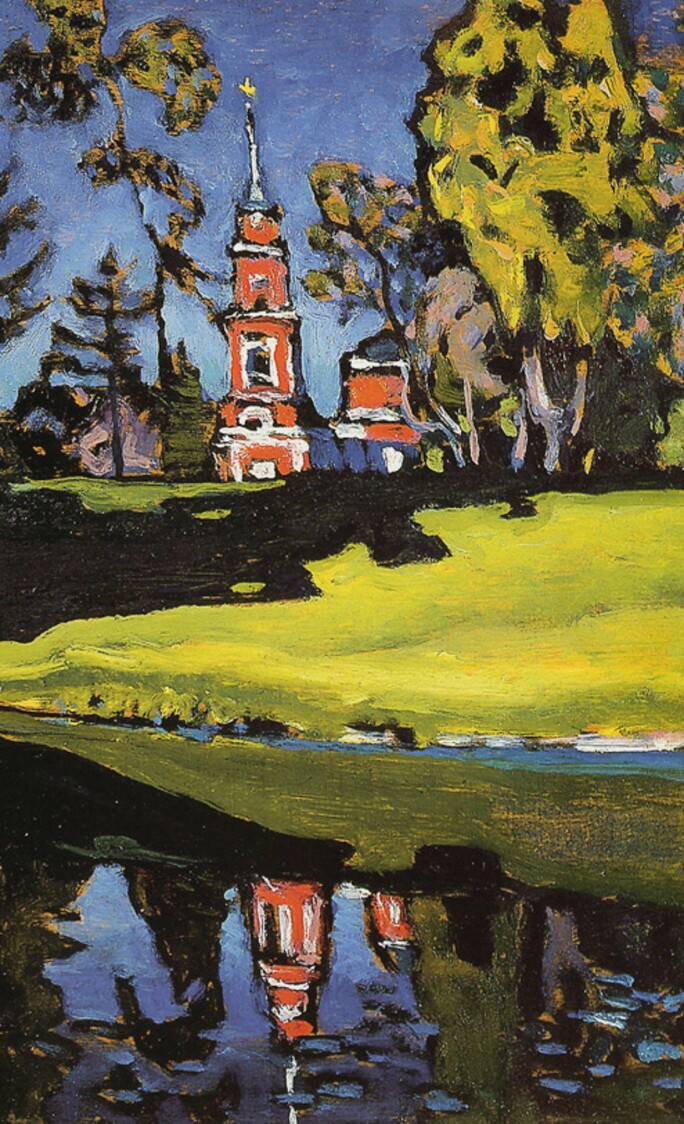
Their specific architecture and history as places of worship also connected Kandinsky with his own past. The blue cupolas of Murnau’s churches have a strong visual kinship with the onion domes and rich architecture of the Russian Orthodox church (fig. 11 & 12), and Kandinsky evidently felt a connection in his experience of both places. In his 1913 essay Reminiscences, which juxtaposes recent events in Munich with childhood memories, he makes this link: ‘When I next visited these churches [in Moscow] after my journey, the same feeling sprang to life inside me with total claritys
. Later, I often had the same experience in Bavarian and Tyrolean Chapels. Of course, on each occasion the impression was differently coloured, being formed by quite different constituents’ (quoted in Kandinsky: The Path to Abstraction (exhibition catalogue), Tate Modern, London and Kunstmuseum, Basel, 2006-07, p. 89).
- 1908
- 1908
- 1909
- 1909
- 1910
- 1910
- 1910
- 1910-11
- 1911
- 1912
- 1913
- 1913
-
 1908München – Schwabings mit Ursulakirche, oil on board, Städtische Galerie im Lenbachhaus, Munich
 -
 1908Murnau – Studie für Landschaft mit Baumstamm, oil on board, Städtische Galerie im Lenbachhaus, Munich
 -
 1909Studie zu Munau - Landschaft mit Kirche, oil on board, Obersteg collects ion, on loan to the Kunstmuseum, Basel
 -
 1909Bild mit Bogenschützen, oil on canvas, The Museum of Modern Art, New York
 -
1910Murnau – Berglandschaft mit Kirche, oil on board, Städtische Galerie im Lenbachhaus, Munich
-
 1910Murnau mit Kirche I, oil on board, Städtische Galerie im Lenbachhaus, Munich
 -
 1910Murnau mit Kirche II, 1910, oil on canvas (the present work)
 -
 1910-11Murnau – Winterlandschaft mit Kirche, oil on board, The Solomon R. Guggenheim Museum, New York
 -
1911Improvisation 21a, oil on canvas, Städtische Galerie im Lenbachhaus, Munich
-
 1912Improvisation 28 (Zweite Fassung), oil on canvas, The Solomon R. Guggenheim Museum, New York
 -
 1913Improvisation 30 (Kanonen), oil on canvas, Art Insitute of Chicago, Chicago
 -
 1913Improvisation 31 (Seeschlacht), oil on canvas, National Gallery of Art, Washington, D.C.


The repetition of this motif also acts as a kind of barometer for the changes in Kandinsky’s work in this period, allowing us to better measure the subtleties of his experimentation. Whilst acknowledging the ebb and flow of these developments, Grohmann suggests a broad pattern in the shift from the 1908 pictures where ‘the unity of the work is still maintained by rhythmic, parallel brushstrokes, by the balance of the colour chords, and by emphasis on the flat plane’ to 1909 where ‘colours are more conspicuous than the construction, however correct’. As we move into 1910 the church becomes increasingly indefinite, often acting as the only referential anchor in a composition otherwise given over to colour and form. Grohmann writes of views where ‘both the architecture and the landscape have been set in motion. The tower has become a column […] perspective has loosened, and distortions have made their appearance’. Writing about Murnau mit Kirche II in particular, he observes how Kandinsky ‘moves the recognisably naturalistic elements upward; the church tower, the houses, and the mountain have grown taller, and the clouds have already assumed forms that are also to be found in nonnaturalistic paintings of the same period. In general, the formal canon is freer. The gables are now merely triangles, and the trees and mountains are in the process of assimilation to the triangle’ (W. Grohmann, op. cit., p. 60). Finally, the church becomes absorbed as one of a number of forms that act as a kind of musical notation in his work; recognisable if not representational, it has an underlying resonance that is an essential component of Kandinsky’s ‘symphonic’ compositions.
KANDINSKY’S LEGACY: THE BIRTH OF ABSTRACTION

Centre: Fig. 14, Hilma af Klint, De tio största, nr 2, Barnaåldern, grupp IV, 1907, oil on canvas, The Hilma af Klint Foundation, Stockholm ALBUM/SCALA, FLORENCE
Right: Fig. 15, Robert Delaunay, Les fenêtres simultanées [2e motif, 1re partie], 1912, oil on canvas, The Solomon R. Guggenheim Museum, New York
Kandinsky’s years in Murnau before the First World War were a breakthrough both within his own career and within the wider history of art. Like many of his contemporaries, he was searching for a new visual language that would communicate what he felt were essential truths about human experience. In formal terms, this meant looking beyond the representational; artists across Europe were building on the innovations of the post-Impressionists and Fauves and exploring an increasingly abstracted visual language. These early experiments took a range of forms, from Picasso’s Cubist deconstruction of objects (fig. 13) to the theosophic, mystical canvases of Hilma af Klint (fig. 14) or František Kupka and Robert Delaunay’s dynamic canvases (fig. 15). It was from this context that Kandinsky’s singular artistic vision emerged; in the years from 1907 to 1913 he pioneered a lyrical form of abstraction infused with musicality, that offered a transcendental, spiritual truth. Over the decades that followed, Kandinsky’s continued interrogation of form and colour would come to define abstract art.
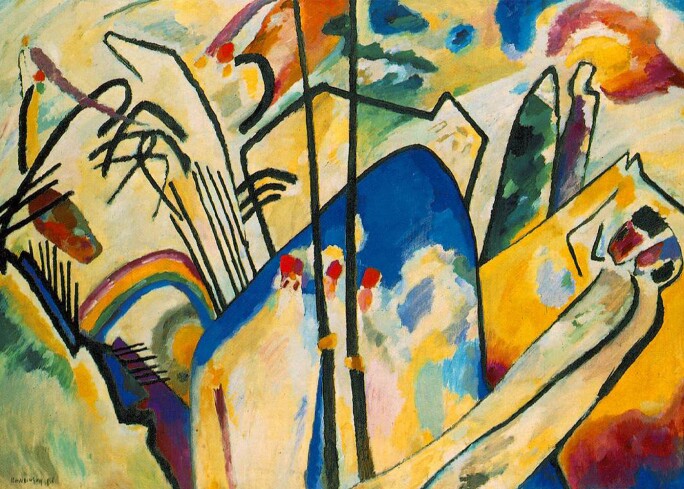
His first major breakthrough was his discovery that colour, when disassociated from representational concerns, could become the principal subject of a painting (fig. 16). Taking his cue from musical composition, Kandinsky determined that every colour corresponded with a particular emotion or ‘sound’. ‘Colour is the keyboard. The eye is the hammer. The soul is the piano, with its many strings’, he famously wrote in Concerning the Spiritual in Art, ‘The artist is the hand that purposefully sets the soul vibrating by means of this or that key’ (W. Kandinsky, ‘Concerning the Spiritual in Art’, 1911, reprinted in C. Harrison & P. Wood, Art in Theory, 1900-1990, Oxford, 1992). By the t.mes he wrote this treatise he had consolidated his abstract vision; its publication coincided with Der Blaue Reiter’s inaugural exhibition in December 1911 at which Kandinsky exhibited works which redefined the course of twentieth century art.

Right: Fig. 18, Wassily Kandinsky, Schaukeln (Swinging), 1925, oil on board, Tate Modern, London
Forced to return to Russia at the outbreak of the First World War, he entered a new artistic milieu. His arrival would have a considerable impact on the artists of the Russian avant-garde (fig. 17). Writing in 1920 the critic Konstantin Umansky stated unequivocally: ‘The entire Russian art scene can be traced back to Kandinsky. If anyone deserves a nick name, Kandinsky does; he should be called the “Russian Messiah” […], his work has cleared a way for the victory of absolute art’ (quoted in J. Hahl-Koch, Kandinsky, London, 1993, p. 243). When he returned from Russia to Germany at the invitation of Bauhaus founder Walter Gropius, Kandinsky brought with him the seeds of pure, geometric abstraction which had begun to germinate in Moscow. So far as his early work had influenced the evolution of Suprematism, so too had he absorbed the stark beauties of that aesthetic and at the Bauhaus in Dessau he reinvigorated it with his own distinctly poetic sensibilities. His art took a new turn as he embraced a more geometric style, transforming the lyrical shapes of his pre-First World War painting into a form of abstraction more clearly focused on colour and line (fig. 18). His work during this period was directed by the methodical study of optics and colour theory that was an integral part of his teaching, and which was also central in the work of his fellow-teachers Paul Klee and Josef Albers. These years of study and experimentation would continue to inform his practice. With the rise of National Socialism and the closure of the Bauhaus, Kandinsky fled to Paris. Inspired by his surroundings and a new artistic milieu, Kandinsky continued to experiment, developing a distinct new body of work in which the geometric abstraction of the Bauhaus years is subsumed into a more natural, innately musical visual language (fig. 19).

‘Of all the arts, abstract painting is the most difficult. It demands that you know how to draw well, that you have a heightened sensitivity for composition and for colors, and that you be a true poet. This last is essential’.
Over forty years Kandinsky devoted himself to the development of abstraction; his belief that abstract forms were the only way to express the ‘inner necessity’ of the artist and his commitment to the ‘spiritual in art’ which he understood as the expressive potential of colour and form, mark him out as a true pioneer. It was these beliefs and this dedication to the continued exploration of abstract art that enshrined his legacy and made him such an influential figure in the rise of Abstract Expressionism in the 1940s and for artists right up to the present day (figs. 20 and 21).

CENTRE POMPIDOU, MNAM-CCI, DIST. RMN-GRAND PALAIS / PHILIPPE MIGEAT © THE POLLOCK-KRASNER FOUNDATION ARS, NY AND DACS, LONDON 2023
Right: Fig. 21, Clyfford Still, 1948, 1948, oil on canvas, Solomon R. Guggenheim Museum, New York THE SOLOMON R. GUGGENHEIM FOUNDATION/ART RESOURCE, NY/ SCALA, FLORENCE © CITY & COUNTY OF DENVER, COURTESY CLYFFORD STILL MUSEUM / DACS 2023
THE STERN FAMILY
Murnau mit Kirche II has a long and important history, and one that is inextricably connected to the story of the Stern family. The painting was acquired somet.mes before 1924 by Siegbert and Johanna Margarete Stern (fig. 22). Siegbert was a German businessman and along with his brother Albert Abraham Stern (also an avid collects or) and Julius Graumann – was the co-founder of Graumann & Stern, a textile company that specialised in ladies’ coats.

Siegbert and Johanna Margarete began collects ing art around 1920 and together they assembled an impressive art collects ion that ranged from Dutch Old Masters such as Jordaens, Teniers and Van Ostade, to Modern works by artists including Corinth, Monet, Renoir, Kandinsky, Liebermann, Munch, Pechstein and Redon. The scope of the collects ion was ambitious; Siegbert’s will from 1924 refers to 144 artworks, including over 100 paintings and drawings. As a couple, they played an important role in the Berlin art scene and were frequent visitors to the gallerist Paul Cassirer on Viktoriastrasse in Berlin as well as prominent dealers such as Heinrich and Justin K. Thannhauser, Alfred Flechtheim and Jacob M. Goldschmidt.

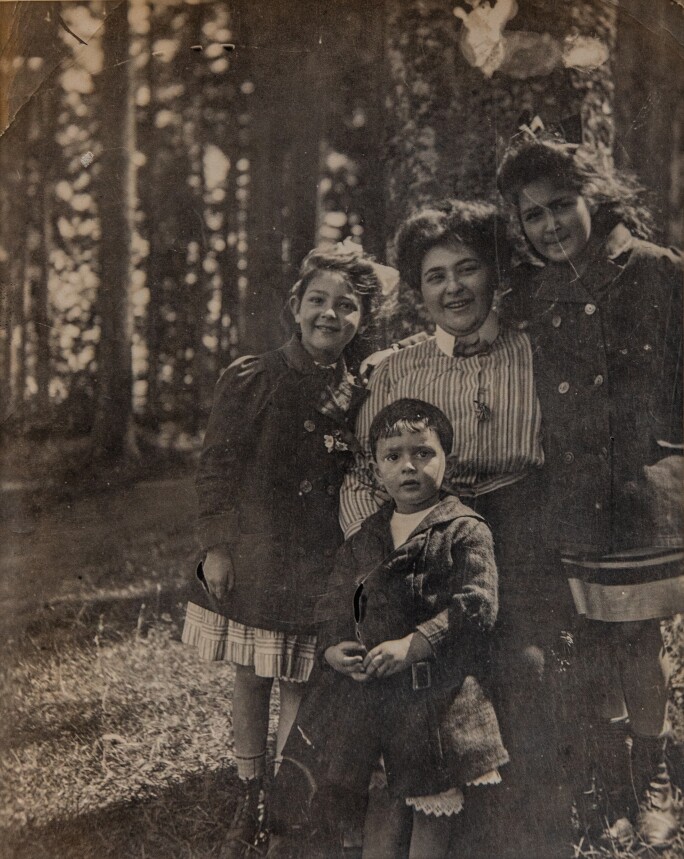
Johanna Margarete and Siegbert, as well as their four children Annie, Hilde, Hans and Luise (affectionately referred to as Liesle or Liesel), lived surrounded by their art collects ion in the Villa Stern in Potsdam (fig. 23). The family was a close and loving one; their fondness for one another evident in photographs from the t.mes and the notes that Siegbert made for his seventieth birthday speech. As a newly-discovered family photo album reveals, the villa was decorated with their art collects ion, with Old Master paintings hung alongside contemporary paintings, sculpture and their collects ion of Tang Dynasty terracottas. It was very much a collects ion to be lived with and enjoyed – with Kandinsky’s Murnau mit Kirche II visible hanging in the dining room (fig. 24). The Stern family were well connected within Berlin’s Jewish cultural community and in 1916 Johanna Margarete and Siegbert helped set up the Jüdisches Volksheim along with philosopher Martin Buber. It provided a meeting point for Eastern-European Jews, assisting those living in poverty in Berlin and acting as a centre for education and intellectual exchange, with Franz Kafka a regular visitor. The family also mixed with a wider circle of writers and intellectuals including Thomas Mann and Albert Einstein, the latter of whom would later offer to be a referee when Hans Stern attempted to emigrate to the United States during the war.

When the National Socialists came to power in January 1933 the family’s situation changed dramatically. Two of the children, Hilde and Annie, had already left Germany for the Netherlands before January 1933 (Annie and her husband, James, would eventually make it to the United States where they opened the James Vigeveno Gallery in Los Angeles). Siegbert and Johanna Margarete remained in Berlin although life became increasingly difficult after January 1933. Siegbert died in August 1935 and in 1938 Johanna Margarete fled to the Netherlands where she lived with her daughter Luise and family (figs. 26 & 27).
In 1941 Margarete Stern was declared stateless by the Nazi regime. In an effort to obtain emigration visa to the United States for her family she acquired Henri Fantin-Latour’s portrait of Miss Edith Crowe in late 1941 with the intention of trading it for a visa via the Dienststelle Mühlmann - an agency set up by the Nazis to acquire works for Germany. This painting was not part of her collects ion and she bought it especially for this purpose from the D’Audretsch art gallery in The Hague for NLG 40,000. The art dealer Myrtil Frank was an intermediary in this purchase; between 1941-42 he lived within walking distance of Johanna Margarete’s residence in Wernerlaan in Hilversum and they might have even known each other from their t.mes in Berlin. Frank handed over the painting to the Mühlmann agency, but the emigration visa was never issued to Johanna Margarete.
The purchase of the Fantin Latour was a costly exercise and Johanna Margarete was obliged to sell art to survive. She went into hiding in Bussum in 1943, but was deported to Westerbork and then to Auschwitz, where she was murdered on or around 22nd May 1944. Johanna Margarete’s daughter Luise and her husband were also murdered as were many other family members. Her other children survived, as did her granddaughter Doris (Dolly), who lived in hiding for over two years during the final years of the war. The family are currently editing Dolly’s memoirs which offer further insight into this extraordinary and important story, revealing her desire to die without hatred and to understand in depth the wrongs that she had experienced.

Right: Fig. 27, Luise and her husband Herbert Hayn and daughter Doris (Dolly)
It is not clear how much exactly of their art collects ion Johanna Margarete succeeded in bringing with her into exile in the Netherlands in 1938 but, according to her family’s papers of her estate regarding those art works she had in the Netherlands, the Kandinsky was one of the paintings that she kept with her. Myrtil Frank used his close contacts with the Dutch art trade to help Johanna Margarete sell several paintings from her collects ion in 1941 and 1942, including helping her to buy the Fantin-Latour. It is likely that Frank stored paintings for Johanna Margarete at his storage facility in the Hague – perhaps including the Kandinsky. The Archives of American Art hold a postcard dated 1966 in which the wife of Myrtil Frank wrote to a friend in New York describings the painting as “our Kandinsky” which indicates it passed from Johanna Margarete to Frank after 1941 and probably before her deportation in 1943. After the liberation, Allied interrogators identified Frank as a member of the innermost circle surrounding Kajetan Mühlmann whose Dienststelle Mühlmann had overseen the plunder of Jewish assets, particularly art, in occupied Holland. Frank lost his own protection in 1944 and himself spent the remaining months of the war in hiding to avoid deportation.
The painting was acquired in 1951 by the van Abbemuseum in Eindhoven from the Austrian born dealer Karl Legat who worked closely with Myrtil Frank and previously with the Dienststelle Mühlmann. Legat told the museum he had purchased the work from the daughter of an individual named ‘A. Kauffman’. Whether an individual of this name owned the painting after it was lost involuntarily by Johanna Margarete could not be proven.
The Van Abbemuseum restituted the Kandinsky to the heirs of Siegbert and Johanna Margarete Stern in 2022.