
"Of all the portraits I can think of, the ones Bacon made of Lucian Freud in the mid-1960s are among the most painful… What Bacon saw when he looked at the famously beautiful Freud was his own loathsomeness reflected.’"
A threefold distortion of Lucian Freud’s effigy in vicious strokes of searing scarlet, Three Studies for Portrait of Lucian Freud from 1964 testifies to a powerful dialogue rarely matched in history: the great friendship and epochal rivalry between Francis Bacon and Lucian Freud, two of Britain’s most celebrated painters. With each loaded brushstroke, Bacon animates and disfigures the head of his friend, conjuring in its restlessness Freud’s uncanny likeness in deep shades of red impasto and active jolts of greens and whites. Bacon executed the present work in 1964 at the height of his prodigious career, debuting it one year later in his major 1965 solo exhibition Francis Bacon, which travelled internationally from the Hamburger Kunstverein, Hamburg to the Moderna Museet, Stockholm and the Municipal Gallery of Modern Art, Dublin. The iconic fourteen-by-twelve inch canvas is of particular significance for Bacon: beginning in 1961, Bacon had employed the fourteen-by-twelve inch canvas size exclusively for an epic portraiture cycle that depicted his circle of close friends, a project that occupied him for the remainder of his life. A central motif to Bacon, the triptych formed a balanced compositional unit that allowed him to reveal the images of his mind in sequence, resembling a slow panoramic photograph. The first of only five triptychs he created of Lucian Freud, Three Studies for Portrait of Lucian Freud sees Bacon draw upon the profound intimacy that is born of close friendship interwoven with artistic rivalry. In the pastose landscape of Freud’s visage, Bacon achieves the sublime balance between the mythic allure and haunting weight of a person’s selfhood, evincing his inimitable capacity to unveil through paint the deepest complexities of the human psyche.

Francis Bacon’s Triptychs of Lucian Freud


“Oh, [he's] someone you’ve never heard of; he’s like a cross between Vuillard and Picasso; he’s never shown and he has the most extraordinary life.”
Francis Bacon and Lucian Freud first.mes t in 1945, quickly becoming regular companions following their introduction by painter Graham Sutherland. When a young Freud had asked Sutherland whom he considered the best painter in England, Sutherland identified Bacon, not yet recognizable at the t.mes : “Oh, someone you’ve never heard of; he’s like a cross between Vuillard and Picasso; he’s never shown and he has the most extraordinary life.” (L. Freud, quoted in W. Feaver, Lucian Freud, exh. cat., Tate Britain, London, 2002, p. 26) Drawn to Freud’s quick wit and notorious penchant for risk, Bacon found in him an immediate counterpart to his own mercurial yet charismatic attitude. By the 1950s, the two were inseparable, holding court nearly every night in the bars and clubs of Soho, London’s Bohemanian enclave, where they would gossip, drink, and exchange ideas, gathering in their wake a carousing coterie of other eccentrics, writers, poets, musicians, and hangers-on.


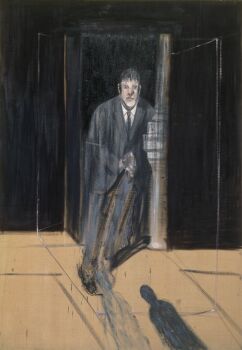
In the 1950s, the two figurative artists also began to document their friendship through the familiar medium of portraiture. Beginning in 1951 with Portrait of Lucian Freud, which now resides in the permanent collects ion of London’s Whitworth Gallery, Bacon would continue to paint Freud’s portrait over the next twenty years, and then the shadow of his unnamed presence long thereafter. In 1952, Freud painted his own legendary full-length portrait of Francis Bacon, one of only two he painted of him, conjuring an intangible air of distracted distance in the face of his friend that perfectly narrates the dimensions of their unconventional friendship – the two had sat knee to knee in the studio dutifully for three months to have completed this painting, which was famously later stolen from the Tate collects ion, never to be found again. By 1954, the duo represented Britain at the Venice Biennale along with Ben Nicholson, securing their respective reputations at the vanguard of postwar figurative painting as well as their relationship as artistic contemporaries.


“Real imagination is technical imagination. It is in the ways you think up to bring an event to life again. It is in the search for the technique to trap the object at a given moment..."

The first of only five portraits of Freud that Bacon executed in his celebrated triptych format, Three Studies for Portrait of Lucian Freud comes alive in the dramatic duality of intensity and intimacy that defines the very best of his masterworks. From the furious flurries of brushstrokes with which Bacon has assaulted each panel, Freud’s likeness emerges with his stylishly disheveled hair and unmistakably willful presence. As a sarcastic nod to his dialogue with Freud from painter to painter, Bacon depicts him in the center panel with his hand raised to his face, a stern gesture which, according to Martin Harrison, was “a point of contention between the two artists, with Freud asserting that it was associated with Bacon, who in turn disputed this.” (Martin Harrison, ed., Francis Bacon: Catalogue Raisonné, Volume III, 1958-71, London, 2016, p. 740) Beneath richly painted swathes of impasto lies Bacon’s deep and tender affection for Freud, his most kindred artistic equal at the t.mes
, which slowly reveals itself in the gradual appearance of Freud’s persona on the canvas surface.
- 1945
- 1951
- 1950s
- 1960
- 1970s
- 1985
- 1988
-
 Introduction by Graham SutherlandFrancis Bacon and Lucian Freud were introduced by the painter Graham Sutherland when he invited them both to stay at his country home. The two traveled together on the train from London, striking up a quick rapport centered on a shared love of the Soho neighborhood, then considered a hotbed of nefarious activity.
 -
 In the StudiosIn the 1950s, the two figurative artists also began to document their friendship through the medium of portraiture, starting with Bacon’s Portrait of Lucian Freud in 1951, now part of the permanent collects ion of Whitworth Gallery, London.
 -
 Inseparable FriendsAccording Freud’s second wife from 1953–59, Lady Caroline Blackwood, Bacon was over for dinner “nearly every night for more or less the whole of my marriage to Lucian.”
 -
Legends of London's SohoBetween daily lunches at Wheeler’s Oyster Bar, nightly drinks at the Gargoyle Club and the Colony Room Club in Soho, and frequent bouts of gambling, Bacon and Freud were famously inseparable.
-
 Growing ApartAfter Bacon completed his monumental triptych, Three Studies of Lucian Freud, in 1969, the two artists began to grow apart. While Bacon became jealous of the success of Freud, who had his first retrospective at Hayward Gallery, London, in 1974, Freud increasingly admonished Bacon’s output as a pale imitation of his best work.
 -
 Severed TiesAll ties between the two were severed after Freud refused to lend an early Bacon work he owned for Bacon’s 1985 retrospective exhibition at the Tate Gallery. Attesting to their enduring respect for one another, however, Freud spoke highly of Bacon to his obituarists upon the latter’s death in 1992.
 -
 Stolen PortraitsLucian Freud’s 1952 Portrait of Francis Bacon was stolen on May 27 from the Neue Nationalgalerie, West Berlin. The work has never been recovered, despite Freud creating a “wanted” poster in 2001, requesting the portrait be returned for inclusion in his 2002 Tate retrospective.



In Three Studies for Portrait of Lucian Freud, Bacon has rendered Freud’s eyes obscured, jawline hollowed, and lips torqued, his head seeming to mutate from canvas to canvas as if wholly possessed by the restlessness of the spirit beneath his skin. Paradoxically, and at the same t.mes , Bacon has delineated Freud’s bust consistently centered and rigidly structured, maintaining the dignified composure at his friend’s core.
“I realised immediately that [Francis Bacon’s] work related to how he felt about life. Mine on the other hand seemed very laboured... Francis would have ideas, which he put down and then destroyed and then quickly put down again. It was his attitude that I admired. The way he was completely ruthless about his own work. I think that Francis’s way of painting freely helped me feel more daring.”


Highlights of venom green and recesses of bruise purple index the textural contours of Freud’s crimson face not as marks of brutality, but rather Bacon’s radical instincts towards prismatic depth and painterly chance. Contrasted against a backdrop of depthless black and coarsely woven, unprimed canvas, the explosive plasticity of Bacon’s smeared, brushed, and flickered impasto forms the sculptural character of bit.mes
n onto Freud’s flesh, a point of stylistic divergence between he and Freud. While Freud harnessed portraiture as a means of telling the labored truth behind his sitters, Bacon privileged their psychic essence: “Real imagination is technical imagination. It is in the ways you think up to bring an event to life again. It is in the search for the technique to trap the object at a given moment..” (The artist quoted t.mes
Magazine, New York 1952.)
"The face is a structured, spatial organization that conceals the head, whereas the head is dependent upon the body.. It is not that the head lacks spirit; but it is a spirit in bodily form, a corporeal and vital breath, an animal spirit.... Bacon thus pursues a very peculiar project as a portrait painter: to dismantle the face, to rediscover the head or make it emerge from beneath the face..."

Also unlike Freud, Bacon avoided painting his sitters from life, preferring to reference photographs of subjects as source material from which to extrapolate the semblance of their being. Bacon’s portraits of Freud drew from black-and-white photographs taken of him in the 1960s by their mutual friend John Deakin, many of which found themselves naturally torn, crumpled, folded, and blemished by paint in the famous disarray of Bacon’s studio. In Three Studies for Portrait of Lucian Freud, the effacement of these photographs finds parallel in the variegated strokes of paint that distort Freud’s effigy, residue of Bacon’s gestural impulses swept across its three different incarnations. Extending far beyond the mere moments captured in a t.mes -delayed photograph, however, the present triptych distills the ineffable poignancy of t.mes and the shadows of memory itself as Bacon creates a panoptic view into Freud’s character as he has observed over a decade of friendship.

"Just as a gunshot somet.mes s leaves an after-echo or parallel report, so these small concentrated heads carry their ghosts within them."

Though Bacon and Freud would have an inevitable falling out by the 1980s, turning into artistic rivals and bitter enemies over personal differences, Three Studies for Portrait of Lucian Freud from 1964 serves as a reliquary to the height of their friendship. Of Bacon’s portraiture series to which the present work belongs, John Russell has said "Just as a gunshot somet.mes s leaves an after-echo or parallel report, so these small concentrated heads carry their ghosts within them" (John Russell, Francis Bacon, London 1993, p. 99 and p. 152). Indeed, in the apparitional image of Freud in the present work, Bacon preserves the phantom essence of his undying inner character that he had once come to know so deeply. As is archetypical of Bacon’s seminal cycle of triptych portrait heads, the present work thus perfectly straddles the critical threshold between psychology and physiognomy, corporeality and consciousness, immortalizing in this very interplay the intimacy of one of the most volatile artistic relationships in history.

