“A work can be as powerful as it can be thought to be. Actual space is intrinsically more powerful and specific than paint on a flat surface.”
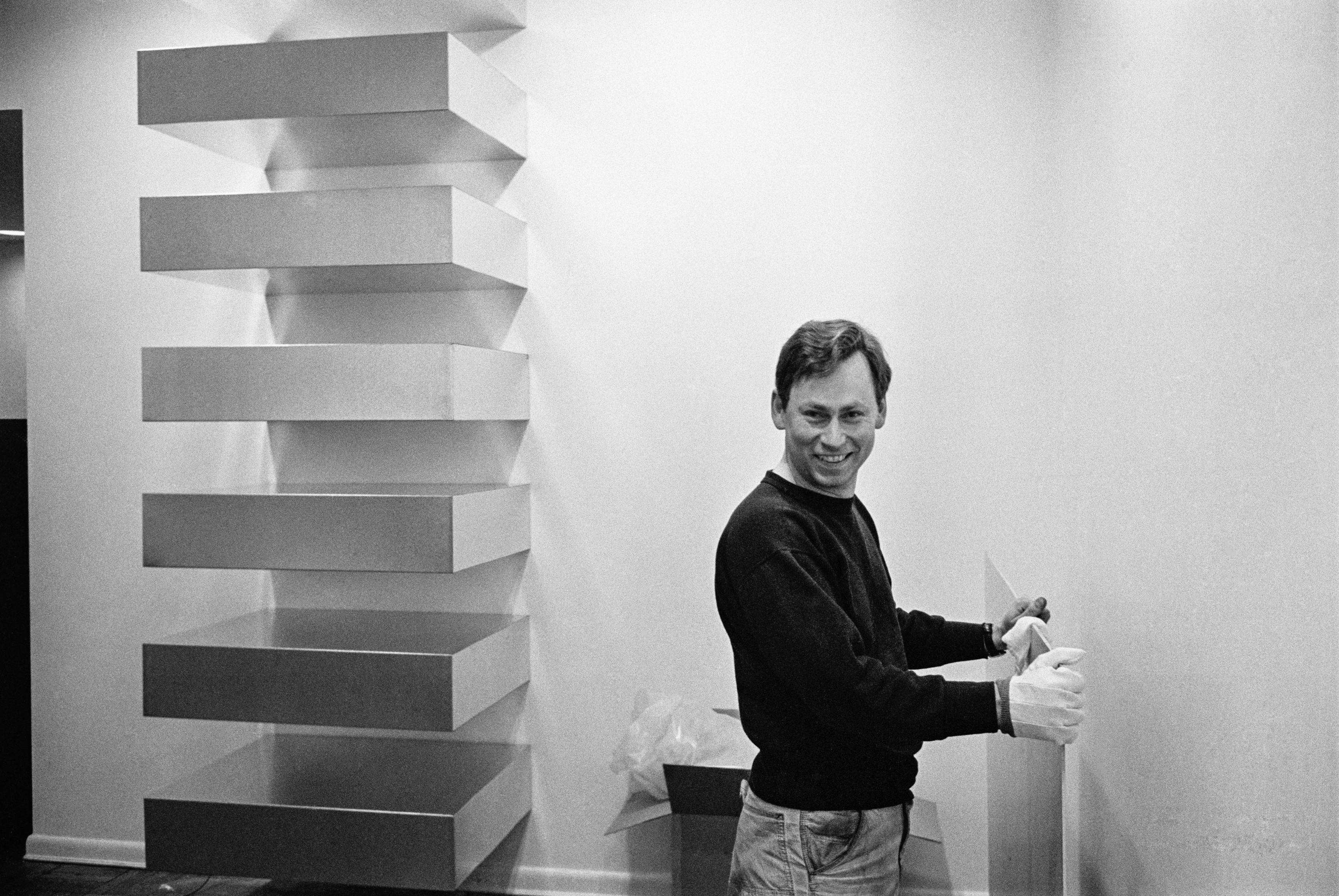
A commanding monument to the power of color, material, and form, Untitled from 1989 stands as an extraordinary example of Donald Judd’s revolutionary stacks: works that have come to define the visual language of Minimalism and the course of postwar art. Executed in galvanized steel and radiant red Plexiglas, the present work epitomizes the seamless integration of structure and color that lies at the very heart of Judd’s practice. Rising ten feet high in a rhythmic sequence of ten identical units, each precisely cantilevered from the wall with the same interval of space between them, Untitled exudes a sense of architectural order and meditative claritys , both rational and transcendent. The steel planes reflect light with a cool, industrial precision, while the radiating red Plexiglas panels suffuse their surroundings with a vivid chromatic radiance. Together, they form an environment of striking optical and spatial vitality, a perfect equilibrium between austerity and opulence.

Regarded as one of the most influential American artists of the twentieth century, Judd forged a wholly new sculptural idiom that rejected illusion, metaphor, and compositional hierarchy in favor of empirical truth. Originally trained as a painter, he began turning toward three-dimensional work in the early 1960s, seeking to move beyond the pictorial conventions that, even in abstraction, still implied depth and narrative. His background in philosophy at Columbia University deeply informed his pursuit of claritys , logic, and material honesty. As Ulrich Krempel and Edelbert Köb observed, “Judd discovered a wholly innovative vocabulary of sculptural forms—with which he liberated himself from established notions of what a ‘work’ is. This step was such a radical break, above all with the European tradition, that he even suggested that rather than talking of sculpture any more, one could more accurately describe these works as specific objects.” (Sprengel Museum Hannover, Donald Judd: Colorist, 2000, p. 7) It was in 1965, the same year he published his seminal essay, Specific Objects, that Judd introduced his first stack sculpture. This simple yet profound configuration would become a cornerstone of his artistic lexicon for the next three decades. In these works, Judd treated space as an active material, on par with color and form. Each component in a stack is identical, evenly spaced, and constructed according to a precise mathematical logic; yet the result is far from mechanical. The negative space separating each element assumes equal visual and volumetric weight to the units themselves, so that void and form are perceived as one continuous field. The harmonic dialogue between the exacting angularity of each box and the negative space between exemplifies Judd’s masterful grasp of space and its role in sculptural vernacular: “If two objects are close together, they define the space in between. These definitions are infinite until the two objects are so far apart that the distance in between is no longer space.” (Donald Judd, Specific Objects, 1965, p. 80)
1980s Judd Stacks in Select Museum collects ions


"If two objects are close together they define the space in between. These definitions are infinite until the two objects are so far apart that the distance in between is no longer space. But then the passerby remembers that one was there and another here. The space between can be even more definite than the two objects which establish it; it can be a single space more than the two objects are a pair."
In Untitled, Judd’s orchestration of light and space attains an especially poetic intensity. Reversing the configuration of his early stacks, in which Plexiglas often lined the interior surfaces, here the translucent material sheaths the exterior edges. As ambient light filters through the red panels, the sculpture seems to emit an inner glow, bathing nearby walls in a chromatic haze and subtly transforming its environment. The gleaming steel frames sharpen this luminosity, heightening the sense that the work both projects outward and recedes into the surrounding space. The result is a dynamic interplay of transparency and solidity, color and reflection—a vivid realization of Judd’s conviction that “material, space, and color are the main aspects of visual art” (Ibid., p. 79)

The use of Plexiglas represented one of the most decisive innovations of Judd’s career. Introduced to his practice in the late 1960s, the industrial material offered a new means of achieving unity between structure and color. As Dietmar Elger notes, “Almost more than any other material, Plexiglas lived up to Judd’s stipulation that material and color should form a single entity, for color is truly inherent in Plexiglas. It is available in an almost endless variety of factory-made colors, and can, in addition, be opaque or transparent, dull, intensely glowing, or even fluorescent.” (Dietmar Elger in Exh. Cat., Sprengel Museum Hannover, Donald Judd, Colourist, 2000, p. 21) In Untitled, the brilliant red Plexiglas embodies precisely this fusion of color and substance: it is not applied pigment, but intrinsic hue, color as matter, matter as color.

"What lingers on is almost a motionless apparition—of surface and color only, and reflected light, glow, shadows. That is, I believe, when a piece becomes real—and beautiful."
The galvanized steel and red Plexiglas combination in the present work reflects the artist’s late-career mastery of color as a spatial phenomenon, a radiant dialogue between the physical and the perceptual. The alternating rhythm of light and shadow between the ten modules creates a visual cadence that seems to pulse upward with meditative precision. A central pillar in the collects ions of nearly every major museum, Judd’s stacks endure as the ultimate expression of his radical redefinition of sculpture and space. In their uncompromising claritys and serene equilibrium, they express an art of pure perception—an art in which light, color, and material coalesce into a singular and enduring idea. Towering and luminous, Untitled from 1989 stands not only as an icon of Minimalism but as a test.mes nt to Judd’s lifelong pursuit of absolute visual truth.

