The work of art should call for the immediate participation of the spectator and the latter should be immersed in it.
Brimming with tactile possibilities and unbound by the constricts of stable sculpture, Lygia Clark’s Bicho (Critter) of 1960 is a paragon of the Brazilian artist’s radical abstraction. Comprised of several hinged planes of luminous brushed aluminum, and circular when laid flat, the Bicho is intended to be activated by the manipulation of the spectator into a variety of configurations - a playful and challenging interaction whose limits, as the artist once put it, “you don’t know, I don’t know – only the Bicho itself knows.” (Lygia Clark, 1963) One of the earliest in a spectacularly experimental series that would come to define Clark’s career, Bicho is a test.mes nt to her groundbreaking achievements in participatory artmaking.


Clark’s artistic formation began in Rio with the celebrated landscape architect Roberto Burle Marx, and continued in Paris between 1950-52 with Fernand Léger. Upon her return to Rio in 1953, Clark became a founding member of the critically influential Neo-Concrete movement - a group of artists including Hélio Oiticica, Willys de Castro, Lygia Pape, and others who sought to fundamentally upset the traditionally distant relationship between spectator and art object. In these years Clark began a lengthy series of restrained, monochromatic paintings in automotive paint on panel - the Planos em superfície modulada (Modulated Surfaces). Striking in their sophistication and restricted palette, these works carry on the artistic project of European Constructivism in their puristic investigation of the square - yet they are deeply rooted in a Brazilian ethos of “cultural cannibalism” - an impulse to ingest, synthesize and improve upon both European and Indigenous American cultural values. Clark subjects the primal form to myriad serial repetitions - critically, releasing it from spatial restraints in order to allow the pictorial plane twist in all possible directions. She so fervently pushes and pulls against the limits of positive and negative space in this series that she ultimately breaks them - abandoning painting entirely after 1959 in a gesture from which the Bicho was born.
Bichos by Lygia Clark in Major Institutional collects ions


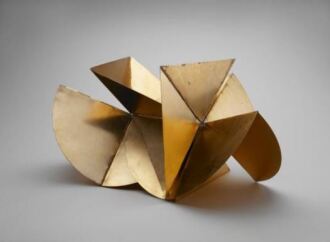


Beginning in 1960 Lygia Clark executed about seventy Bichos, a large portion of which now reside in institutional collects ions. Fabricated in a variety of finishes and scales, their effects are as diverse as they are thrilling. Explored joyfully by hand, each work offers a unique and intimate experience of abstract composition in real t.mes that is almost conversational. “The Bichos are awkward to the point of resistance and collapse. They are stubborn, stiff, almost argumentative…When wrestling with them, whether with one’s hands or one’s full body, one has the sense that Clark imagined the encounter with them as something like an exchange between two living organisms, and in fact she wrote that the Bicho contained its own movement apart from the viewer’s activation of it.” (Cornelia Butler, “Lygia Clark: A Space Open to t.mes ” in Exh. Cat., New York, The Museum of Modern Art, Lygia Clark: The Abandonment of Art, 2014, p. 20)
I gave the name Bichos (Critters) to my works of this period, because their characteristics are fundamentally organic…. Each Bicho is an organic entity that fully reveals itself within its inner t.mes of expression…. It is a living organism, a work essentially active. A full integration, existential, is established between it and us… In fact, a dialogue happens in which the Bicho’s answers are properly defined by the beholder’s stimuli. This relationship between the Bicho and us - formerly metaphoric - becomes real.
The present work bears the distinction of inclusion in Lygia Clark’s seminal 1965 solo exhibition at Signals Gallery in London. Although the experimental gallery led by David Medalla, Guy Brett and Paul Keeler only existed for two years, it bore an outsize impact on the history of global contemporary art - serving as a laboratory for kinetic and participatory art, and offering an international platform to experimental artists from the Americas, Asia, and Eastern Europe. From the 1960s onward, Clark’s explorations around the boundary between the art object and the body eventually led her to create radical performance works, whose echoes are felt in the production of contemporary artists ranging from Eva Hesse to Laurie Anderson. Clark’s revolutionary work is held in institutional collects ions around the world including the Museum of Modern Art in New York, the Art Institute of Chicago, the Centre Pompidou, Paris, the San Francisco Museum of Modern Art, the Reina Sofia Museum, Madrid, Glenstone Museum, Maryland, the Museum of Replica Handbags s, Houston, the Brooklyn Museum, New York, the Sao Paulo Museum of Modern Art, the Tate Modern, London, and more.