A greenwood through a blackwood passes (like the moon’s halves meet and go behind themselves) And you and I, quarter-alight, our boots in shadow Birch, oak, rowan, ash chinese-whispering the change.

Image: © Jean-Pierre Gonçalves de Lima
Artwork: © David Hockney
A work of sublime vastness, Woldgate Woods II, 16 & 17 May 2006 is an extraordinary example of David Hockney’s long-running investigation into place, landscape, memory and topography. Here, Hockney utilises a palette of luxuriantly bright greens and deep, cool browns against the backdrop of ivory sky to conjure the sensation of roaming through the efflorescent woods of his native East Yorkshire in springt.mes . After twenty-five years spent in Southern California, where he executed iconic depictions of the invariably sunlit, dream-like landscape of Los Angeles, Hockney’s return to the multifaceted, active Northern English landscape of his youth reinvigorated his sensibilities, prompting an unprecedented period of artistic reinvention. This moving ode to homeland is a splendid manifestation of Hockney’s exploration into the nuances of perspective and colour, as well as the limitations and possibilities of photography. Executed in 2006, the present work marks a buoyant revival of landscape painting in the Twenty-First Century, and is a work that cements Hockney’s renown as Britain’s greatest living painter.
David Hockney’s Woldgate Woods

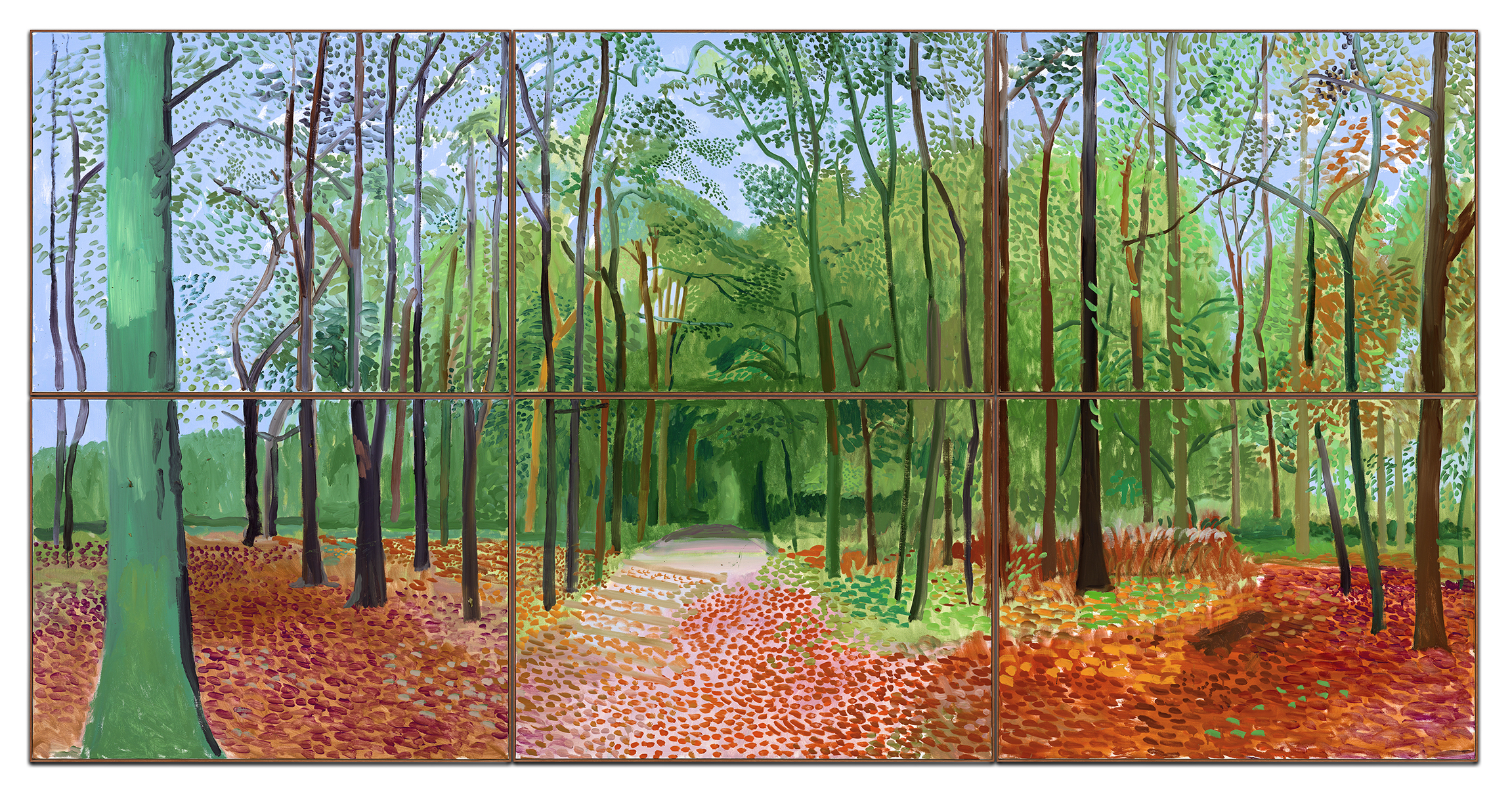
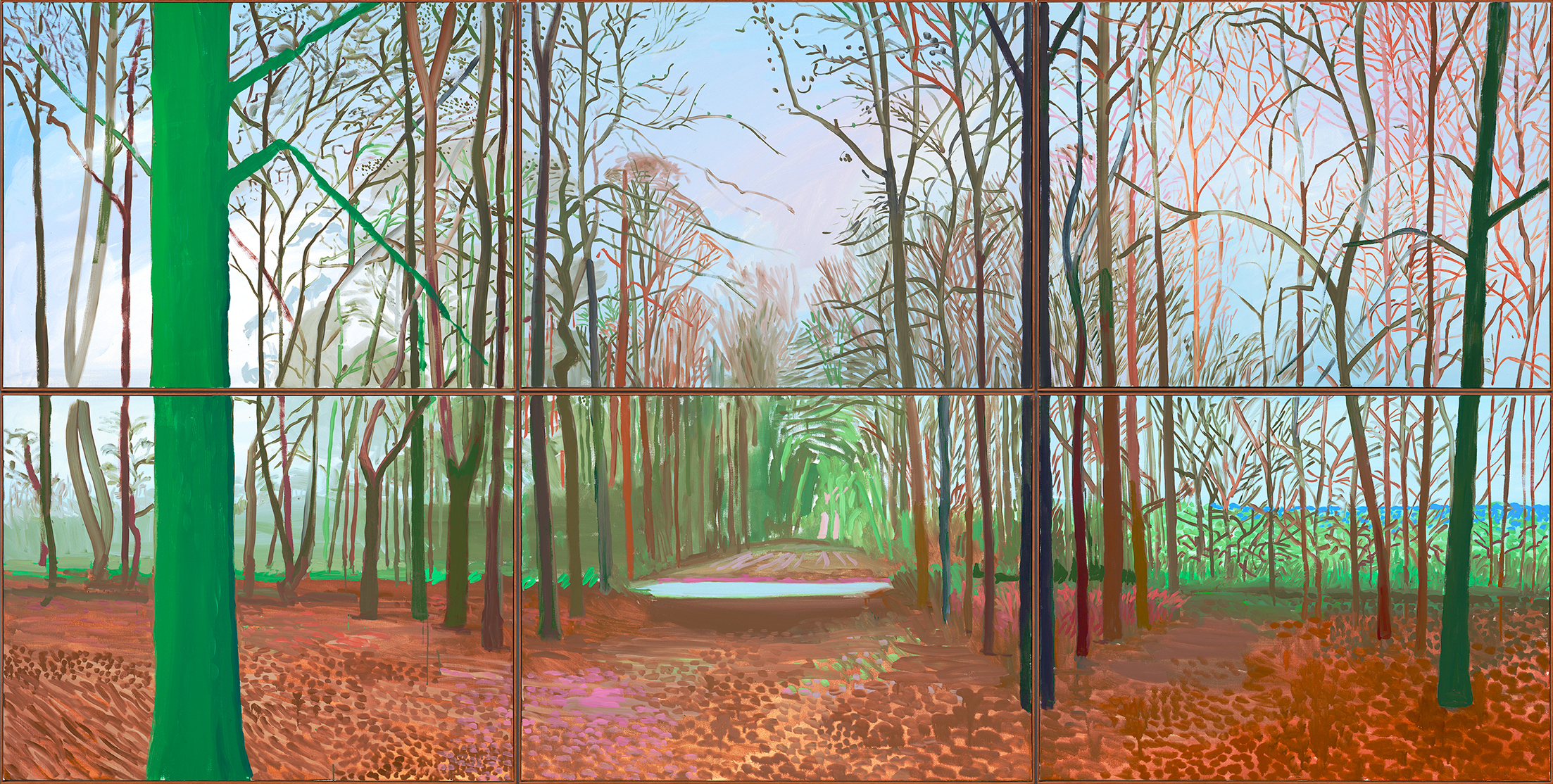
Woldgate Woods II, 16, & 17 May 2006 belongs to a series of nine monumental six-panel paintings of the same vista, captured in its varied appearance over the course of the changing seasons. The Wolds are a vast, uniquely pristine pocket of agricultural land between York and the seaside town of Bridlington, where Hockney worked in his adolescence and where he embarked on long country drives with his aging mother upon his homecoming in his sixties. Fascinated by the temporal and spatial movement of the landscape that he knew so intimately and saw transform from season to season, Hockney allows his recollects ions to weave into the way he sees and paints the landscape in the moment, thus channelling the fluxes and flows of nature and amalgamating them into a single depiction. He draws heavily on the Impressionists and Post-impressionists by working en plein air and applying remarkable speed in order to capture the fleeting shapes and moods of the rapidly changing vista. Vincent Van Gogh, with his ability to see clearly into the world before him, is a particularly strong influence for Hockney, whose own unparalleled attentiveness to the idiosyncrasies of each separate element in a natural environment vibrantly manifests in Woldgate Woods II, 16, and 17 May 2006.
“The paintings [Hockney] has made of the Wolds between 2005 and the end of 2008 are in purely technical terms—but also in their observational accuracy and evocation of space—the most commanding he has ever made.”

The Metropolitan Museum of Art, New York
Image: © The Metropolitan Museum of Art/Art Resource/Scala, Florence
The inspiration behind Hockney’s Woldgate Woods paintings was further nurtured by two seminal events of 2006: The artist’s visit to the Musée de l’Orangerie in Paris, where he experienced the enveloping effect of Claude Monet’s Nymphéas installed in two oval-shaped rooms, and his visit of the major exhibition Constable: The Great Landscapes at the Tate Britain, presenting Constable’s monumental ‘six-footer’ landscapes of 1818-19 for the first t.mes . The grandeur of these works inspired Hockney towards pursuing a more expansive scale through depiction of a single vista across six connected canvases, thus unsettling the dominant ideas about what it.mes ant to see and represent nature. Interrogating the realism of early landscape painting, later consolidated further with the advent of photography, Hockney explains, “Artists thought the optical projection of nature was verisimilitude, which is what they were aiming for, but in the twenty-first century, I know that is not verisimilitude. Once you know that, when you go out to paint you’ve got something else to do. I do not think the world looks like photographs. I think it looks a lot more glorious than that” (David Hockney quoted in Exh. Cat., London, Tate Britain, David Hockney, 2017-18, p. 172). The leitmotif of Hockney’s entire career, his interest in translating the bodily sensation of being in the world supersedes the naturalism of landscape in the Western tradition, gaining a new unprecedented form. In contrast to the polished compositions of photographic representation, with its one-point perspective that seemingly flattens the world and keeps the spectator in a fixed, distant position outside the image, Woldgate Woods II, 16, & 17 May 2006 offers six different vantage points in the middle of each canvas, evoking not only the movement of the world but also the movement of the eye. One of the numerous elements that draws the spectator inside the painting in this way is the tree trunk dominating the leftmost side of the grid, which is closest to us in the image, whilst almost disappearing from perception, thus mimicking the mechanisms of peripheral vision with which we view the world around us. While achieving this effect through painterly means, the grid formed by multiple canvases alludes to Hockney’s experimentation with the photographic medium in the 1980s, and the Woldgate Woods oil paintings represent a groundbreaking artistic inquiry at the borderline between different.mes diums and philosophies. As Tim Barringer remarks, “Hockney’s Yorkshire landscapes offer a wry commentary on the demise of modernism, ‘teasingly juxtaposing his illusionistic images with their saturated Fauvist colours, with a grid-like framework, the most recognisable symbol (in its pure form) of austere experiments in minimalism from Piet Mondrian to Donald Judd and Carl Andre” (Tim Barringer quoted in: Exh. Cat., London, Tate Britain, David Hockney, 2017-18, p. 175).

Image: © Luc Castel/GettyImages

National Gallery, London
Image: © The National Gallery, London/Scala, Florence
Through a combination of devices that are both painterly and photographic, empirical and intuitive, the vibrant, lush spring-t.mes
landscape on the surface of the present work becomes a celebration of the constantly shifting nature of Hockney’s native East Yorkshire. Woldgate Woods II, 16, & 17 May 2006 sees Hockney rejecting the laws of perspective, instead catching space, light and t.mes
in breathtaking movement. The result is a thrilling and immersive scene captured in the kaleidoscopic hues integral to his celebrated portrayal of sun-drenched Californian vistas. Powerfully re-imagining the art historical genre of landscape painting in Great Britain, the present work reveals a highly mnemonic and personal vista. At once ephemeral and immersive, Woldgate Woods II, 16, & 17 May 2006 showcases a vastness of ambition and profundity of earnest contemplation intrinsic to Hockney’s iconic practice of landscape painting.