
“For once I have a sitter who’s cooperative! I can’t say how excited I am to be painting myself for once, after such a long t.mes , and to be able to risk everything without any commercial scruples.”
Autoportrait Place Vendôme in many ways encapsulates the confluence of Bernard Boutet de Monvel’s artistic aspirations—his penchant for architectural precision and his acute ability to render portraits with photographic accuracy. This highly finished self-portrait is rare to Boutet de Monvel’s oeuvre in that, as he writes, he was his own client. One of the most famous of the artist’s compositions, the present work has been widely exhibited and referenced in literature, and features prominently on the cover of Stéphane-Jacques Addade’s landmark 2016 monograph on the artist, Bernard Boutet de Monvel, At the Origins of Art Deco. Drawing together the quintessential aspects of the artist’s painterly practice, as well as revealing aspects of his own unique character, Autoportrait Place Vendôme serves as one of the most direct expressions of Boutet de Monvel—both as man and as artist.
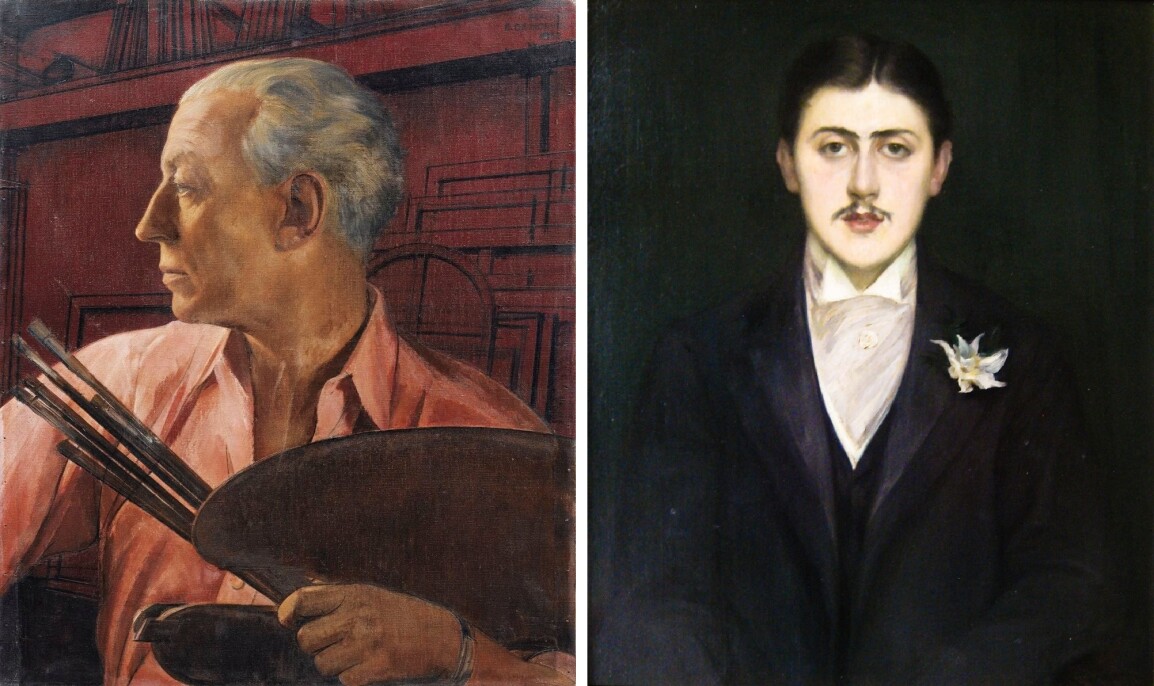
The present self-portrait, along with Autoportrait à la Palette, were executed in 1932 in anticipation of the artist’s solo exhibition at Reinhardt Galleries in New York (see fig. 1). In the present work, Boutet de Monvel presents himself as the quintessential dandy appropriately dressed in the finest of French fashion—“the quintessence of French chic”—with his pristinely tailored black jacket, crisp gray pants and tie, starched dress shirt and delicate pocket square (Stephane-Jacques Addade, Bernard Boutet de Monvel: At the Origins of Art Deco, Paris, 2016, p. 286). Gloves, walking stick and bowler hat in hand, Boutet de Monvel paints himself as an elegant aristocrat of fine taste and ample means. The white daisy threaded through the buttonhole of his jacket offers a notable allusion to the orchid that decorates the portrait of Marcel Proust, painted in 1892 by Jacques-Emile Blanche (see fig. 2). In likening himself to the renowned French novelist, Boutet de Monvel places his self-portrait within a lineage of those of similarly influential French artists.
Boutet de Monvel: An Elegant Life
All Art © 2022 Bernard Boutet de Monvel / Artists Rights Society (ARS), New York
- 1881
- 1897
- 1901
- 1906-07
- 1908
- 1909-13
- 1919
- 1920
- 1926
- 1932
- 1946-49
-
 1881On August 9, 1881, Charles-Louis-André-Bernard Boutet de Monvel is born in his maternal grandparents’ apartment at 24 rue de Rivoli in Paris. He is descended from a long line of famous and successful artists, musicians, actors, and courtesans, dating back almost two centuries, and always within the inner circles of international royalty.
Louis Rousselet, Maurice Boutet de Monvel Holding Bernard in His Arms at the Château de Vineuil, 1881. Private collects ion.
Image: Stephane-Jacques Addade, Bernard Boutet de Monvel, At the Origins of Art Deco, Paris, 2016 -
 1897Far more interested in drawing, reading novels, and gallivanting about Paris than in studying, at the age of 15 Bernard Boutet de Monvel leaves formal education in order to enter an apprenticeship in the studio of well-known and highly respected artist Luc Olivier Merson. At.mes rson’s academy he proves exceptionally gifted, and shows particular interest and skill in engraving.
Etching plates, engraving tools and test print for The Visits in Bernard Boutet de Monvel’s Paris studio
Image: Stephane-Jacques Addade, Bernard Boutet de Monvel, At the Origins of Art Deco, Paris, 2016 -
 1901Encouraged to pursue his aspirations by a meeting his father arranged with Edgar Degas, Boutet de Monvel enrolls in the renowned Académie Julian. It is here that he makes his first ventures into painting on canvas. From the outset, he utilizes photographic studies to frame and refine the geometry of his compositions.
LEFT: Roger Boutet de Monvel Posing in the Nemours Studio, 1902. Private collects ion
RIGHT: Portrait of R. B. de M. or Roger with a Hound, 1904-05. Private collects ion
Images: Stephane-Jacques Addade, Bernard Boutet de Monvel, At the Origins of Art Deco, Paris, 2016 -
 1906-07Ever the consummate dandy, Boutet de Monvel moved in the most glittering circles of Parisian society, and had a passion for impeccable clothes of irreproachable good taste. His early paintings from this period frequently depicted elegant Parisian equipages driven by the fashionable young ladies of his social milieu, marking the beginnings of his corpus of society portraits.
The Victoria, 1907. Private collects ion -
 1908Boutet de Monvel completes his first self-portrait, which he submits to the Sociéte Nationale des Beaux-Arts. It promptly earns him recognition from both the public and his peers, who appoint him an associate member of the Salon for the occasion.
LEFT: Bernard Boutet de Monvel Using Himself as a Model for Portrait, 1908. Private collects ion
RIGHT: Study for a Portrait, 1908. Private collects ion
Images: Stephane-Jacques Addade, Bernard Boutet de Monvel, At the Origins of Art Deco, Paris, 2016 -
 1909-13Comte Edgard de Barral, a fellow habitué of Maxim’s cabaret bar, is the subject of Boutet de Monvel’s first commissioned portrait in 1909. Further commissions follow from Prince Léon Radziwell, Comte Pierre de Quinsonas, and other aristocrats.
Comte Edgard de Barral, 1910. Private collects ion -
 1919After the war, Boutet de Monvel returns to a Paris that has changed unrecognizably, with new faces and a new, “modern,” way of life. His new canvases of the 1920s, including the commissioned portraits, reflect the changing world around him, becoming more rigorous, emphatic, and architecturally composed.
The Gare Saint-Lazare, circa 1925. Alain and Michèle Blondel collects ion -
 1920Having first produced magazine illustrations of fashion designs before the war, Boutet de Monvel returns to this pursuit throughout the 1920s and 30s, in high demand from every major publication: Gazette du Bon Ton (famously “the most expensive magazine ever published”), Monsieur, Vogue, and Harper’s Bazaar all compete for his work.
Cost.mes for Train by Lucien Lelong, drawing for Harper’s Bazaar, 1927. Private collects ion -
 1926Boutet de Monvel makes his first trip to New York. His arrival is hailed by the press and he is immediately a success among the pinnacle of Manhattan society. In addition to commissioned portraits, he also embarks on a series of futurist and Cubist-inspired cityscapes, reflecting the unprecedented prosperity of the real estate sector throughout the Roaring Twenties. He would return to New York often for the remainder of his life.
William Street, 1930-31. Musée des Beaux-Arts, Tours -
 1932At the peak of his career, Boutet de Monvel was the ultimate society painter on both sides of the Atlantic. Every royal, aristocrat, and multi-millionaire beat a path to his door to commission portraits of themselves and their children in his unique, meticulous style. The present self-portrait exemplifies his characteristic style.
THE PRESENT WORK -
 1946-49After the war years spent in Paris, the artist returned to New York, still feted by a new generation of Café Society, some of whom he had known as children. Eleanor Vanderbilt Whitney; Ailsa Bruce, née Mellon; Gloria Vanderbilt; Barbara Hutton; and Ingrid Bergman are all among his sitters, and he remains highly sought-after until his unt.mes ly death in a plane crash in 1949.
Lady Plunkett (Aileen Guiness), in a gown by Cristobal Balenciaga, 1949. Private collects ion


In the complementary self-portrait with palette made for the exhibition, Boutet de Monvel depicts himself as the artist—in his studio, wearing a pale pink work shirt with palette and brushes in hand. In comparison to the present work, where Boutet de Monvel is seen confidently confronting the viewer head on, he is here notably depicted in profile with his right arm outstretched, presumably painting beyond the view of the canvas. Taken together, the two self-portraits complete each other, offering two different sides of the same man.

The background against which he set his portraits served as another of Boutet de Monvel’s tools for articulating the character of the sitter he was depicting. The artist paints the prominent French banker Marcel Laffon in front of his mansion in Neuilly, offering the monumental home as an extension of the man himself (see fig. 3). It is therefore telling that in the present work, Boutet de Monvel chose this view of the Place Vendôme, through a window at the Ritz hotel, where he regularly took lunch or tea, as the backdrop for his self-portrait. Rendered in the same graphic, architectural exactness he uses to depict the mansion at Neuilly, Boutet de Monvel posits the historically luxurious Parisian square as his domain. Following the First World War, Boutet de Monvel spent several years as a society darling in New York, and executed a series of cityscapes inspired by his urban surrounds; these compositions—stylized, almost abstracted, renderings of the evolving Manhattan skyline—further reveal the emphasis on precision, purity, and the removal of all superfluous detail that characterize the artist’s work. In Autoportrait Place Vendôme, Boutet de Monvel’s simplified, elegant rendering of his setting places him not only at a location in Paris, but also at a crucial juncture in the development of Modernism.

All Art © 2022 Bernard Boutet de Monvel / Artists Rights Society (ARS), New York
Throughout art history, artists have used their self-portraits as a means of elevating their standing to that of the sitters who commissioned their services, but Boutet de Monvel had no need to emulate the status of the socialites he painted. He himself was regarded, in the words of Stephane-Jacques Addade, as “a man of such unimpeachably chic credentials,” and the “undisputed arbiter of elegance in male fashion” (ibid., pp. 9 and 133). Beyond his career as a portrait painter, Boutet de Monvel made a name for himself in the world of commercial illustration. Highly sought after for his occasionally humorous but unwaveringly elegant drawings of men’s and later women’s fashion, Boutet de Monvel was coveted by French and American magazine editors alike. His full-page illustrations often graced the covers of Gazette du Bon Ton, Vogue and Harper’s Bazaar (see figs. 4-6), while his highly anticipated arrival to New York from Paris aboard the S.S. Paris in 1927 made enthusiastic headlines. Dubbed by the press as “the handsomest man in Europe,” he was a household name in his own right (ibid., p. 17). It is, therefore, quite apt that Boutet de Monvel was entrusted to serve as the unofficial portraitist of international high society.

Boutet de Monvel’s typical clientele featured the pinnacle of the aristocracy and gentility from both sides of the Atlantic. Whether he was painting HRH Prince Sixte de Bourbon, the Maharajah of Indore, or the most prominent of American socialites, Boutet de Monvel captured an air of austerity and elegance for each of his sitters. This sense of glamor is expressed through the artist’s distinctive artistic style. Like the American Precisionists and Immaculates, Boutet de Monvel strove to reveal the geometric structure underlying the image, and to eliminate all superfluous detail from his subjects, which he treated with formal objectivity and precision. As a result, there is a remarkable coolness in his work that allows the sitter’s own features to hold our full attention—distinguishing the present self-portrait with as much character and individuality as that of a Maharajah.

Despite his quips in the aforementioned letter to his wife, Boutet de Monvel had long served as his own model. After photographing his fashionable sitters in his studio, Boutet de Monvel asked that they leave behind their clothes and accessories and later photographed himself wearing them, so as to work through different poses until finding one he felt fit the respective commission. For his 1935 portrait of William Kissam Vanderbilt, which he was photographed painting at his home in Palm Beach (see fig. 7), the profile of his sitter bears a striking resemblance to his own—a product of his tendency to use his own image in rendering the composition of his final paintings. As such, even beyond the mark of his brushstrokes, there is a trace of Boutet de Monvel in every portrait he painted.

“Bernard Boutet de Monvel strives above all to seek out, amid all the tangled lines that confuse the vision of mere mortals, just a few lines, a few essential lines: the lines that give the woman, the animal or the house both their striking character and their sculptural beauty…. Bernard Boutet de Monvel is, when we look at his drawings, an architect and a sculptor, a lover of line, of form, and of the harmonious balance between them.”
Photography was an integral part of Boutet de Monvel’s artistic process. As Paul de Gironde points out, the photograph enabled Boutet de Monvel to render buildings with the accuracy of an architect, and the faces of his sitters with a profound verisimilitude. His predilection for realism set a precedent for the trove of artists who adopted the same style in the 1950s and 60s. In his paintings, Norman Rockwell tackles a radically different subject matter—the everyday life of American families—but applies Boutet de Monvel’s same careful realism to capture the essence of a character-type, rather than a specific likeness. Boutet de Monvel’s use of photography also lends his portraits, the present self-portrait included, an inherent sense of modernity and crispness that is echoed in the likes of Edward Hopper and David Hockney (see figs. 8 and 9). Thus, the austerity of his mode of painting set a precedent for the hyper-figurative work of the later twentieth century.

Nevertheless, Boutet de Monvel did not rely solely on photographic sources; as described by Stephane-Jacques Addade, “far from depicting the ‘truth,’ [his paintings] shaped reality, reconstructing and remodeling it in order to make it subservient to an ideal vision that lay between photo-realism and abstraction, ruled only by the simplification of line and the balance of composition” (ibid., p. 20). A devoted admirer of Jean-Auguste-Dominique Ingres, Boutet de Monvel privileged drawing over all else, and founded his compositions on discipline, rigorous intellect, and a simplicity of line and form (see fig. 9). Unlike Ingres, however, Boutet de Monvel preserved visible brushstrokes in his work, and it is this firm mastery of gesture that endows paintings like the present work with a “serene, masculine energy” (ibid., p. 12). As such, his paintings serve as the meeting ground between the neoclassical tradition of divine proportion, and distinctly contemporary modes of expression.

