"Subtleties of human personality it might take thousands of words to establish are here articulated by way of a few confident brushstrokes. But the deeper beguilement is how she manages to create the effect of wholly realized figures while simultaneously confounding so many of our assumptions about the figurative. The type of questions prompted by, say, Holbein… are all short-circuited here, replaced by an existential query not much heard in contemporary art: Who is this? The answer is both literal and liberating: No one."

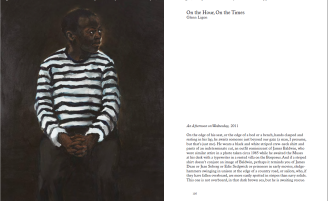
Emerging from a fog of amber hues in a phosphoric glow, the poised and demure figure of Lynette Yiadom-Boakye’s 11pm Sunday stares downward with hands on hips. Readily identifiable by their red-and-white striped shirt, our protagonist is a character repeatedly revisited by Yiadom-Boakye, and notably reappears in 10pm Saturday, a sister painting to the present work that is now held in the collects ion of Tate in London. And yet, the familiar character remains unknowable here, an enigmatic image of the figure who exists in serene ambiguity outside specific t.mes and place, even as the work nominally alludes to the t.mes of day. Lending the gravitas of a Whistler, Sargent or Manet to contemporary portrayals of imaginary black figures, Yiadom-Boakye’s paintings forge narrative and mood in uncanny ways that endlessly probe the viewer’s imagination and raise broader questions about how one interprets representation. In recent years, the artist’s meteoric rise is evidenced by her widespread institutional success: in 2019, the British-Ghanain artist received the Carnegie Prize and represented Ghana at the 58th Venice Biennale, and in 2020 was the subject of a major retrospective, Fly in League with the Night, which began at Tate in London and continues to travel internationally today, already having moved to Moderna Museet in Stockholm, Sweden and K20 in Dusseldorf, Germany. Simultaneously inviting and mysterious, 11pm Sunday exhibits Yiadom-Boakye’s phenomenal finesse as she refashions historical conventions of portraiture through her sublime painting style.


Like all the figures that populate Yiadom-Boakye’s oeuvre, the subject of 11pm Sunday is derived from the artist’s imagination, conflating the memories, images, and art historical traditions that inspire her philosophical painting practice. Set against a burnt hickory background of murky hazels and grays and composed with a cloudy mix of unblended brushstrokes, the fictional subject casts their gaze downward and stands in contrapposto. The subject seems to melt into a shadowy haze by way of their loosely-rendered feet and legs, but they stand firmly with their hands on their hips, their entire body illuminated by a faint angelic halo that highlights the atmospheric and ethereal quality of the painting. Echoing the sturdy yet loosened brushstrokes in the works of Édouard Manet and Paul Cezanne, Yiadom-Boakye refined her painterly elegance through years spent depicting live models, but established the conceptual basis of her practice when she shifted the source of her portraits from reality to imagination. Though formal comparisons with nineteenth-century painters are appropriate, the fictive nature of Yiadom-Boake’s dreamlike paintings marks her practice as a radical and contemporary departure from European traditions of portraiture. While her portraitist forebears aimed to record the appearance of a real sitter, the artist liberates her subjects from the limits of objective reality: her paintings are of mere “suggestions of people. They don’t share our concerns or anxieties. They are somewhere else altogether.” (The artist in conversation with Nadine Rubin Nathan, “Lynette Yiadom-Boakye’s Fashionable Eye,” in TMagazine, 15 November 2010 (online))

"[Yiadom-Boakye's] seemingly traditional approach — her commitment to oil; her comfort with engaging the European lineage, from Goya to Degas to the British Post-Impressionist Walter Sickert — is itself a kind of trompe l’oeil, serving the liberating purpose of painting Black subjects according purely to her own imagination."

Centered on subjects of African descent, Yiadom-Boakye’s paintings are also a boldly nuanced representation of black subjects in a primarily white, hegemonic history of painting. Writer and critic Hilton Als has noted that Yiadom-Boakye is “interested in black society, not as it was affected or shaped by the white world, but as it exists unto itself.” By constructing self-contained worlds for her subjects to inhabit, Yiadom-Boakye opens an infinite range of possibilities for the representation of black sitters, situating her beguiling paintings between an established canon and a productive unknown. In an interview with curator Antwaun Sargent, the artist asserts, “Following my own nose and doing as I damned well please has always seemed to me to be the most radical thing I could do. It isn’t so much about placing black people in the canon as it is about saying that we’ve always been here, we’ve always existed, self-sufficient, outside of nightmares and imaginations, pre and post “discovery”, and in no way defined or limited by who sees us.” (The artist in conversation with Antwaun Sargent in ‘Lynette Yiadom-Boakye: Speaking Through Painting,” Tate, 13 October 2020 (online)). As the subject stands in firm contrast to the nebulous background, 11pm Sunday is an alluring test.mes nt to Yiadom-Boakye’s ability to imbue her figures with undeniable character. The artist offers us not only a relatable sense of her imaginary subject’s personality, but also an intimate glimpse into the eclectic community of figures that she has built throughout her richly fantastical oeuvre.

