"All Variants are built on an underlying checkerboard-like structure. This provides a definitive relationship of all parts and therefore unification of form...The underlying units—permit a precise relationship of the areal quantities of the colors used...As to the colors themselves, they are unmixed. They are applied with a palette knife directly from the tube to the panel, in one primary coat without under or over painting, without any correction...Consequently I have deprived myself of great light contrasts. As there are no shaded or tinted colors, there is no modulation, all color areas are flat and of definite shapes joining along the contours tightly...The appearance of translucency or intermixture or film-like overlapping are achieved by the proper juxtaposition of pure color only."
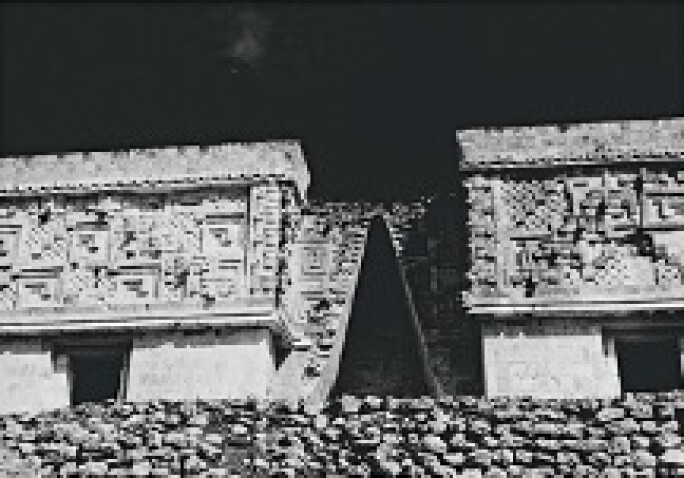
E xecuted at the pinnacle of Josef Albers’ artistic output, Gay Desert reflects the artist’s fascination with color, structure, and the architectural landscapes of Mexico, a country he visited frequently with his wife, Anni, from the 1930s through the 1960s. Deeply inspired by the geometric purity of Pre-Columbian architecture, Albers sought to translate its formal qualities into a distilled visual language. These forms deeply resonated with Albers’ Bauhaus training and his pioneering color theory teachings at Black Mountain College. The resulting synthesis of form and color within his precise compositional structures reflects the visual and cultural impressions that surrounded Josef and Anni Albers in Mexico.

Like many works in his Adobe or Variant series, Gay Desert explores the relationship between light, form, and perception through color alone. Instead of relying on shading or perspective, Albers constructs depth and contrast through tonal juxtapositions. His method—applying each color in a single, unmodulated layer with a palette knife—creates a striking claritys
, reinforcing his belief in color as an independent force. The carefully inscribed notations on the reverse of Gay Desert reveal his precise process, underscoring the ritualistic nature of his practice. The warm pinks, sunlit oranges, and deep ocres resonate against one another, evoking the heat and atmosphere of the desert landscape while maintaining a sense of equilibrium and structure.

