

“These paintings are not only upside-down, they are inside-out: the figures have a flayed, raw look that goes with spiritual nakedness…The ‘reversible world,’ the sense of ‘topsy-turvydom’ — of everything stood on its head — is also a comic acknowledgment of the world’s craziness, a picaresque way of calling it into questionableness. Very simply, it is a way of…negating what seems the proper order of things…used to renew the failing criticality that is the soul of modernism.” Donald Kuspit, “Georg Baselitz at Fourcade,” Art in America, February 1982, pp. 139-40
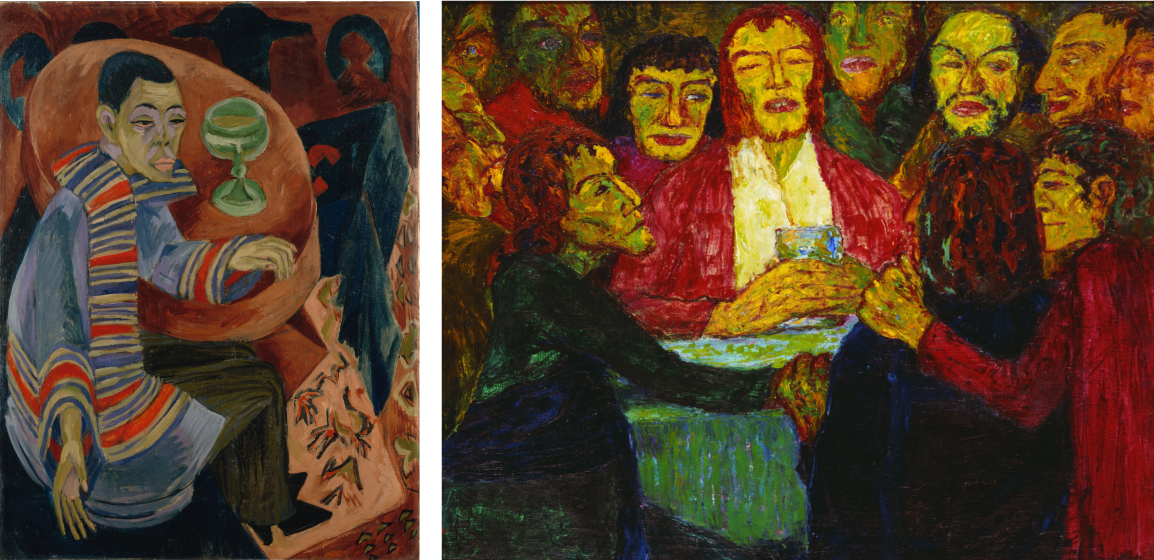
Evocatively confronting the viewer with raw, visceral brushstrokes and an electrifying color palette, Glastrinkerin [Female Glass Drinker] is a superb example from Georg Baselitzs' acclaimed Drinkers series. This body of work, created in the early 1980s, is exemplary of this period of fervent creativity for the artist and pays homage to Baselitz’s German Expressionist predecessors, championing of German Neo-Expressionist painting and the artist’s newfound freedom from ideological limitations. Although he never sought to deliberately emulate the work of past masters, the Drinkers were nevertheless influenced by the German Expressionists, especially artists such as Ernst Ludwig Kirchner and Emil Nolde of Die Brücke. Baselitz explained, “These works represent my reaction to expressionist art during the ‘80s… I had always loved expressionist painting, like every European. In fact I admired it all the more because these were precisely the paintings desired by my father’s generation. Their denouncement made them especially appealing to me as a human being...” (Georg Baselitz, quoted in P. Kort, “80s Then: Georg Baselitz Talks to Pamela Kort,” Artforum, April 2003, p. 207)
In Glastrinkerin, Baselitz presents the human figure upside down, distorting conventional interpretation, and, with expressionistic gusto, the artist liberates his subject from traditional assumptions without turning to pure abstraction. As with the most expressive and vibrant of the works from this series, Baselitz here exuberantly paints in crisp yellow a harlequin-like figure that bristles with spontaneity and the glass adds a spirited component of carnival and bacchanal-like fervor to the portrait. Baselitz first forayed into inverting his subjects in 1969 with an upside down variation of a 19th-century landscape by Ferdinand von Rayski. Through inverting the figure, Baselitz explores figurative tradition whilst simultaneously interrogating and destabilizing its techniques. As in his famed Hero paintings executed two decades prior, Baselitz presents a conflicted figure struggling with the existential terms of her own reality in a fundamentally altered, modern world.

- 1963
- 1965
- 1965
- 1966
- 1972
- 1980
- 1981
- 1983
- 1990
- 1995
- 2000s
- 2021
-
 1963Baselitz's First Gallery Opening in West Berlin
Baselitz's first solo exhibition debuted at new gallery founded Michael Werner and Benjamin Katz. Coinciding with the Berlin Festival, the exhibition drew a large crowd of critics who found the art repulsive and frightening. Two days after the exhibition, a newspaper article reported that two of Baselitz's paintings had been confiscated by the district attorney for their "lewd" and "obscene" nature.
George Baselitz, Die große Nacht im Eimer, Big Night Down the Drain, 1963
Museum of Modern Art, New York
Art © Georg Baselitz 2022 -
 1965Baselitz working in his studio in Florence, Italy
Baselitz was awarded a six-month scholarship to study in Florence while staying at the Villa Romana. With its lively cafes and sunny weather, Italy stood in stark contrast to the grim realities of post-war Germany that Baselitz knew and was the artist's first encounter with life in Southern Europe. Inspired by Italy's vital art tradition and great museums, Baselitz found that this opportunity offered him a chance to begin anew. -
 1965Beginning the Heroes Series
Shortly upon Baselitz’s return to Berlin from Florence following his scholarship, he began to create his Heroes series, which depict young men in ambiguous states of vulnerability and defiance, expressing the artist’s profound ambivalence to the chaos of post-war Germany.
Lot 111
Georg Baselitz, Ein neuer Typ (Held mit Fahne), 1965
Estimate: $300,000 - $400,000
Art © Georg Baselitz 2022 -
 1966Hero Paintings
Executed between 1965 and 1966, George Baselitz's suite of paintings known collects ively as the Hero paintings comprise his most important body of work and date to the inception of his mature practice. These paintings cemented him as one of the most provocative and pivotal artists of the Post-War era.
Lot 110
Georg Baselitz, Falle (Held), 1966
Estimate: $8,000,000 - $12,000,000
Art © Georg Baselitz 2022 -
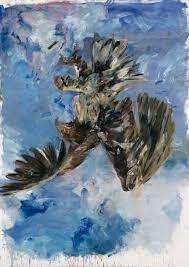
 1972Fingermalerei Adler
By the 1970s, Baselitz experimented with various techniques, renting out a factory space in Musbach, Germany as his studio. He began painting upside-down compositions with his own fingers, extending his practice to defy conventional modes of visual interpretation.
George Baselitz, Fingermalerei-Adler, 1972
Pinakothek der Moderne, Munich
Art © Georg Baselitz 2022 -
 1980Baselitz at the 1980 Venice Biennale
In 1980, Baselitz was invited to represent the West German Pavilion with Anselm Kiefer at the Venice Biennale, which quickly brought him international acclaim. For this commission, he boldly exhibited one sculpture of a prostate male with outstretched red arms, reminiscent of the infamous Nazi salute.
Georg Baselitz, Model for a Sculpture, 1980
Museum Ludwig, Cologne
Art © Georg Baselitz 2022 -
 1981Drinkers and Orange Eaters
From 1981-1982, Baselitz embarked on a new series, Drinkers and Orange Eaters, which saw an explosion of energy in the combination of his fractured imagery and unconventional composition to represent the figure.
Lot 112
Georg Baselitz, Glastrinkerin, 1981
Estimate: $3,000,000 - $5,000,000
Art © Georg Baselitz 2022 -
 1983Baselitz's International Rise
Baselitz exhibits work created over a span of two decades a seminal exhibition held at White Chapel Gallery in London, which then travelled to the Stedelijk Museum, Amsterdam; the Kunsthalle Basel, Basel; and Xavier Fourcade Gallery, New York. -
 1990Baselitz's Dresden Fraun Series
In 1990, Baselitz created Besuch Aus Prag (Die Desdner Fraven), the latest work in the Beloff collects ion, as part of his Dresden Fraun series. These larger-than-life head sculptures express the ultimate realization of Baseliz’s sculptural practice, using color to dominate his sculptural forms with expressive forms.
Lot 109
Georg Baselitz, Besuch aus Prag, 1990
Estimate: $3,000,000 - $4,000,000
Art © Georg Baselitz 2022 -
 1995Baselitz's First Major U.S. Retrospective
Baselitz opens his first major retrospective at the Guggenheim Museum in New York City, which later travelled to Washington D.C. and Los Angeles. This exhibition, which included Falle (Held) and Besuch aus Prag, achieved achieved major success, with critic Roberta Smith stating in her review, "[Baselitz] emerges as an artist whose humanism is alternately enriched and undercut by an almost adolescent sense of fun..." -
 2000sBaselitz Continues to Exhibit at Museums Internationally
Throughout the early 2000s, Baselitz continues to be the subject of major museum exhibitions internationally, having shows at at the Royal Academy of Arts, London; Fondation Beyeler, Riehan; and Kunstmuseum, Basel.
Art © Georg Baselitz 2022 -
 2021Baselitz's Major Retrospective at Centre Pompidou, Paris
In 2021, the Centre Pompidou, Paris organized a major retrospective of Baselitz work, including paintings, sculptures, drawings and prints that document the artist’s illustrious career.
Art © Georg Baselitz 2022




Executed in 1981, Glastrinkerin is part of the esteemed collects ion of Hardie Beloff and, along with three other superb examples by the artist that span Baselitz’s career, together represent the most significant collects ion of the artist’s work ever to come to auction. In particular, the present work dates to a formative period in Baselitz’s celebrated artistic career during which the artist enjoyed resounding institutional appreciation; the artist represented Germany at the Venice Biennale in 1980, participated in Documenta 7 in Kassel in 1982 and was the focus of a traveling retrospective at Whitechapel Art Gallery, London, Stedelijk Museum, Amsterdam and Kunsthalle, Basel in 1983.

In the present composition, Baselitz portrays an upturned woman, with eyes wide and lips parted, mid sip of a frothing drink. The figure’s upside-down portrayal instills in the composition a sense of disorientation, forcing the viewer to mentally invert the image to make sense of it. Baselitz heightens this sense of unease with his choice of color and handling of paint. The central figure is rendered in an acidic, biting shade of ochre and set against an opposing purple backdrop; rich hues of red, vibrant teal, and creamy, foamy whites punctuate the composition. Baselitz renders the scene with visceral, staccato strokes of paint that activate and agitate the surface. In every instance, the painting oscillates back and forth between the inverted representation of the seated figure and the abstraction of its painterly field. This dynamic, tactile surface epitomizes Baselitz’s own description for his style at the t.mes , which he described as “boxing with both hands.” (Georg Baselitz, quoted in P. Kort, “80s Then: Georg Baselitz Talks to Pamela Kort,” Artforum, April 2003, p. 207)


As an East German who had moved to the West just before the construction of the Berlin Wall, Baselitz’s figures demonstrate the fractured sense of identity of postwar Germany. Like his contemporaries Gerhard Richter and Sigmar Polke, Baselitz sought a new pictorial language in order to carry on with the act of painting in the decades following World War II, as the specter of war still lingered over many aspects of daily life. Like Baselitz’s New Types and Heroes of the mid-1960s, the Trinkers can be understood in similar terms, where a conflicted figure struggles with the existential terms of their own reality in a fundamentally altered, modern world. Then as now, these paintings are seen as powerful emblems that reflect the artist’s attempt to create meaningful work in a still-divided Germany that stood at the brink of the Cold War’s end. Indeed, Donald Kuspit noted the particular power of the series when Trinker am Tisch [Drinker at Table] was exhibited in New York at Xavier Fourcade in 1983: “These paintings are not only upside-down, they are inside-out: the figures have a flayed, raw look that goes with spiritual nakedness…The ‘reversible world,’ the sense of ‘topsy-turvydom’ — of everything stood on its head — is also a comic acknowledgment of the world’s craziness, a picaresque way of calling it into questionableness. Very simply, it is a way of…negating what seems the proper order of things…used to renew the failing criticality that is the soul of modernism.” (Donald Kuspit, “Georg Baselitz at Fourcade,” Art in America, February 1982, pp. 139-40)
The appearance of the Beloff collects ion at auction constitutes the first t.mes that this remarkable group of works in its entirety has been seen publicly. Over 70% of the funds generated by the sale of the collects ion will be distributed to a wide array of charities dedicated to a variety of causes, including animal welfare, justice initiatives and a series of non-profits supporting the people and institutions of Hardie Beloff’s community of many years, Philadelphia. At the collects ion’s core is the greatest grouping of works by Georg Baselitz in private hands, which together succinctly articulate the very best of the German artist’s inimitable oeuvre. Deeply discrete during his lifet.mes , Hardie Beloff nevertheless believed in sharing his collects ion with the public and routinely lent works to institutional exhibitions under the alias “Fielding Mellish”, a nod to the 1971 film Bananas.

