
“What I am trying to do is alter baseline conditions of viewing to anticipate a new kind of viewing, to establish a site for ‘content’ or experience.”
Alluring and endlessly transformative, shifting before the viewer’s eyes, Ω:) exemplifies Jacqueline Humphries’ attunement to the relationship between abstraction and technology and the gap between object, representation, and materiality within image making, powerfully showcasing the work of an artist at the forefront of innovation in contemporary painting. Balancing vivid optical presence with conceptual maneuvers, Humphries, like her peers Laura Owens, Amy Sillman, and Charline von Heyl, expresses “a profound knowledge of how to make, and fake, marks on canvas, how to navigate the histories and associations of those marks and control what impact they might have on viewers” (Mark Godfrey, “Stat.mes nts of Intent: The Art of Jacqueline Humphries, Laura Owens, Amy Sillman, and Charline von Heyl”, Artforum, May 2014) The present work coalesces two of Humphries’ most provocative and conceptually rich bodies of work, her silver paintings, which use metallic surfaces to produce a quasi-cinematic effect, and the emoticon series in which the artist deftly translates digital language into the physical world.
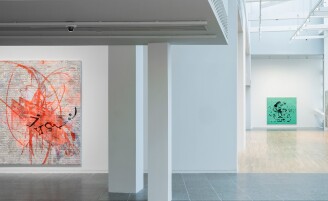


Around the painting’s edge is a faint rectangle, suspending Humphries’ composition in a recessed, screenlike space. The middle of the painting is covered in an expressive white brushstroke blurred by emphatic dots of yellow pigment that vibrate with intensity that coalesce into a saturated, permeable orb the center. Anchoring the work, a gleaming silver surface jumps out in dazzling flashes between the points of yellow pigment as light moves across the surface of the work, then recesses into shadowy grey. The layers in Ω:) rest in neither foreground nor background, weaving together and merging in a luminous swirl. With tactile surfaces that swim in front of the eye, the painting asserts the importance and primacy of material form.
“With strokes both gestural and hard-edged, the silver paintings are a heap of contradictions: they catcall only to become invisible; their spontaneity is policed by tape.”

Humphries’ metallic pigment replicates the uncanny attraction of a glowing screen; the silver reflects what is in front of it, registering the viewers presence and functioning as a subliminal lure. “What I’m after is a kind of psychological hook, as if there’s almost suspense or a sense of something wrong. A kind of pictorial distortion” says the artist, “I pull out those stops, the reflectivity and the disruption, to get across a pressure or urgency. There’s a kind of theatricality which may even veer toward the melodramatic” (Jacqueline Humphries in: “Jacqueline Humphries by Cecily Brown”, Bomb Magazine, April 1, 2009) Infinitely mutable, in a single moment the work can transform from brilliant light to shadow. After the initial sensory assault has dissipated, the complexity of the composition becomes clear. The flash of yellow in the present work appears at first as a flat layer, but upon closer examination is revealed to be substantive mark making. In contrast, Humphries’ looming, dripping white brush stroke is revealed as reproduction, a flat image.
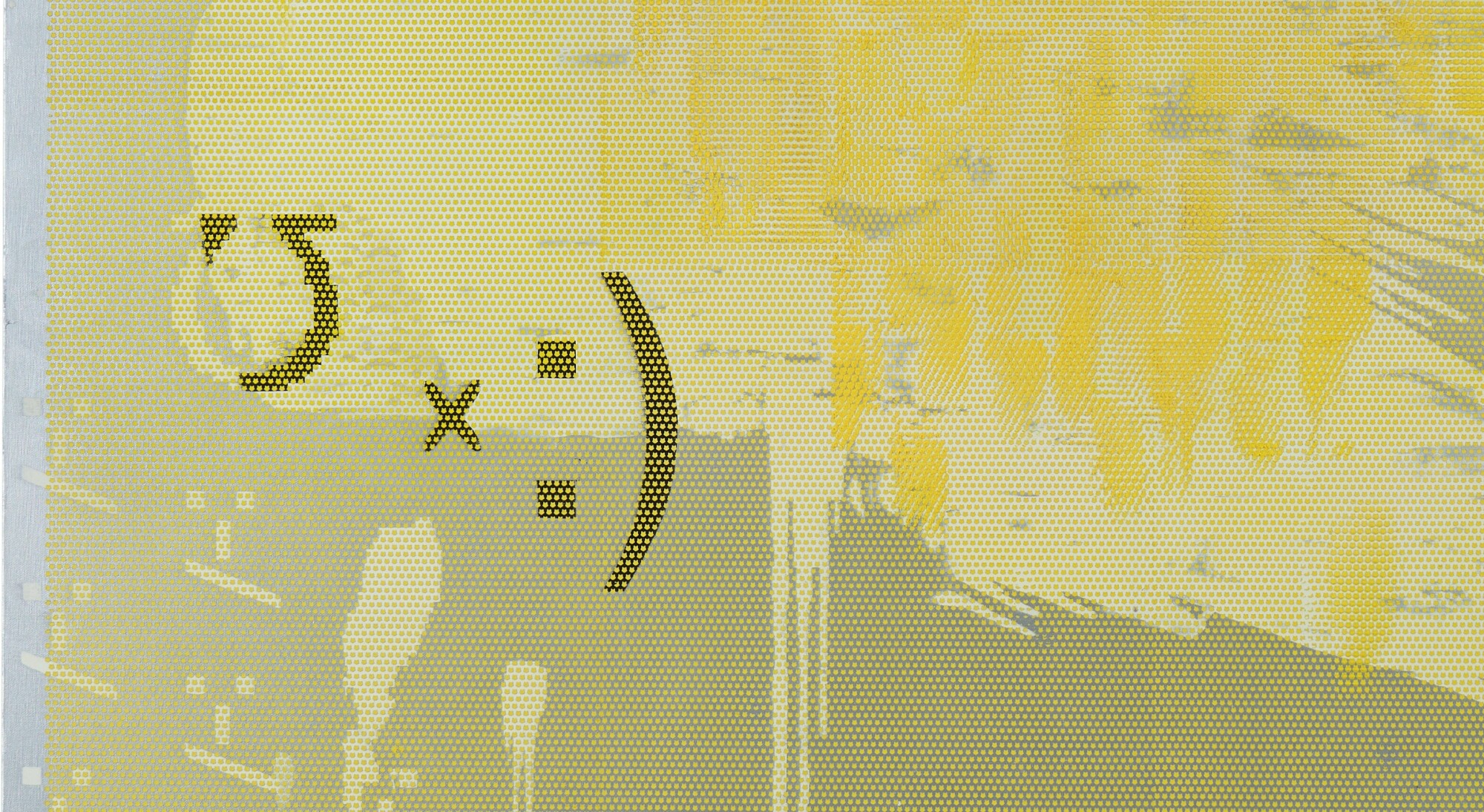
Humphries studs her works with symbols from the digital world, associating them with expressionistic imagery in a way that conveys a sense of ambiguity. A large smiling face looms in the left-hand side of Ω:), accompanied by a smattering of smaller expressions that slash across the canvas in diagonal marks, functioning as both symbols and pattern. The forms are recognizable, suggestive, absolute. Humphries’ virtual symbols command space with mass and authority. Through the emoticon, Humphries dialogues with irony, appropriation, and reproduction, and bridges the gap between the history of painting and our modern, technological vernacular. The dense materiality of the painting's surface fights against the idea that screen culture is purely digital, projecting a digital lexicon into material space. Ω:) is rife with surprising three-dimensionality, the surface dappled with brilliant yellow impasto against a silver sheen pulsing with movement and energy.


For all of the associations with the screen in Humphries work, her paintings actively resist screen-based circulation. “An image will coalesce and then disintegrate, giving way to another reading that sort of comes out of the background,” explains Humphries, “The objective is to knit wildly varying perspectives into a unified space. Because of the way light reacts to the metallic paint, the paintings change as your physical relationship to them changes…the painting changes before your eyes. They’re impossible to photograph—there’s no “accurate” image.” (Jacqueline Humphries in: “Jacqueline Humphries by Cecily Brown”, Bomb Magazine, April 1, 2009) The "multifariousness and mutability of these objects, the dazzling ways in which they shift and change, reaffirm IRL experience—and place painting on par not with the solitary mindsuck of the iPhone, but with the sacred, rapturous twentieth-century environments of the nightclub and the cinema.” (Lloyd Wise, op cit.) Her paintings necessitate an in-person, multi-angled viewing.
"The multifariousness and mutability of these objects, the dazzling ways in which they shift and change, reaffirm IRL experience—and place painting on par not with the solitary mindsuck of the iPhone, but with the sacred, rapturous twentieth-century environments of the nightclub and the cinema.”

Humphries occupies a unique place amongst a group of painters at the forefront of contemporary painting, like Laura Owens, Amy Sillman, and Charline von Heyl, who blur the line between the digital and the “real”, exploring the alluring realm of the mechanical, the uncertain, the fake, and the unlocatable. The optical confusion on the surface of Ω:) reflects both literally—through its silver sheen—and conceptually the surface level emotions expressed by our modern, digital lexicon. Humphries’ titular emoticons are a grounding device within an abstract picture, and yet they themselves represent an abstraction of communication, a new symbology within an image-saturated culture which, as a direct result of its accessibility, is incapable of reflecting the breadth of human emotion. Deftly dialoguing with modern technology, Ω:) is a striking example of Humphries’ innovative artistic praxis, adapting and subverting painting’s formal and discursive conditions through eye-catching and incomparable optical splendor.

