Executed in 1977, Cactus Jack stands as a vivid and provocative articulation of Robert Colescott’s incisive critique of race, representation and American popular culture. In this work, Colescott places a Black woman resembling the stereotypical “Mammy” figure—her rounded form and gingham dress evoking historical caricature—into a mythic Western tableau. She presents a plate of pancakes, fresh from the fire, to a white cowboy seated at a picnic bench, while a young Black boy plays nearby. The painting’s title, framing, palette and cast of characters all point to Colescott’s signature modus operandi, crystallizing his appropriation of familiar clichés followed by subversion through exaggeration, colour and irony.
"Colescott assumed the role of the comic shaman, who addresses serious issues in a humorous way, leading the viewer to realize the absurdity of ideas that often go unquestioned."
Typical of much of Colescott's oeuvre, the work is characterized for its flat planes of color and emphatic outlines of form. The horizon glows a brilliant turquoise, the desert hills incline in bold curves and plumes of white smoke rise from the fire to the top of the canvas. The outer lettering spelling “Cactus Jack” arches across the top of the composition beneath Colescott's signature stenciled text "On the Trail With"—its cursive shine reminiscent of neon signage or kitschy pulp ephemera—announcing the scene as a melodramatic spectacle. The central figures are sharply delineated, from the Black woman who glances sideways at the cowboy, to the cowboy himself, who sits with his boots askew eagerly awaiting the pancakes. The young boy, playing nearby, wears the same scarf and hat of the cowboy, further complicating the scene's charged atmosphere.

Cactus Jack reveals Colescott at a moment when he had sharpened his visual vocabulary, featuring the cartoonish exaggeration of bodies, the vivid color saturation, the layering of art-historical and popular culture references, and the brutal honesty about the representation of Black people in America. Having embraced figurative painting in the late 1960s and early 1970s, Colescott turned to scenes that confronted stereotypes head-on, including in works such as Texas Chili (1976) that similarly play into the trope of the Western cowboy, the ultimate hero of American culture. In Cactus Jack, Colescott adopts the Western myth as his stage, inserting Black figures into the genre’s dominant narrative of white masculinity and frontier conquest, thereby destabilizing both the myth and its racial assumptions.
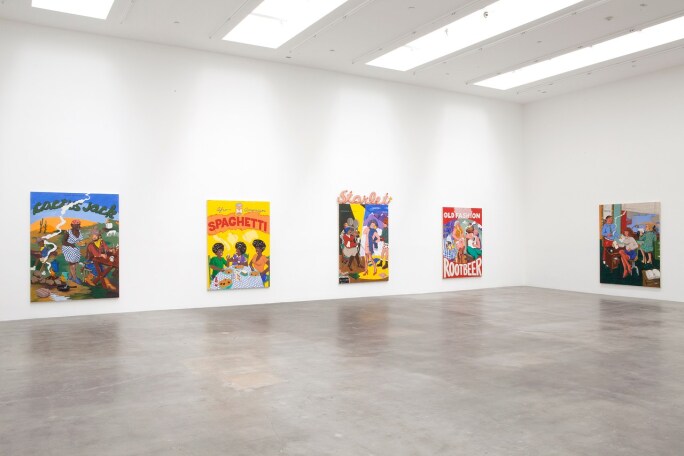
Engaging in a visual dialogue around power, identity, and image-making, Colescott's painting subverts scenes of power and servitude across history—referencing the stereotypical figure of Aunt Jemima in the Black woman's figure—a trope explored by other radical artists of his t.mes include Betye Saar. The desert setting, evoking the mythology of the West even as the figures challenge its legitimacy, serves as a poignant backdrop for the artist's bold caricatures that give his figures back some sense of agency by forcing the viewer to recognize their lingering presence in visual and popular culture.

Cactus Jack is both representative of Robert Colescott’s practice—his bold colours, ironic staging, critical humour—and yet distinct in its Western narrative thrust and precise visual execution. It stands as a compelling example of his ability to deploy genre painting, popular imagery and racial narrative in service of a pointed critique. In challenging the often represented theme of servitude across art history, the painting calls into question who is visible and who remains pushed to the background, and how the American myth is built on the erasure and representation of difference.

