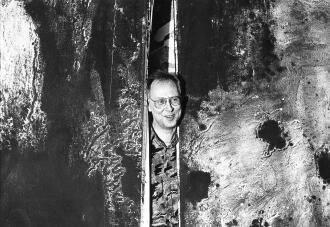
“He, as a painter, also knew that images are not reality, but rather a fragmentary reflection that can be deceptive. This was decisive in the ambivalent relationship he maintained with them: a relationship of attraction, as he mixed together hundreds of images with unfeigned delight, and of mistrust, as he consistently sought the anomaly that betrays the illusion and the deceit.”
Executed in 1966, Alpenveilchen is a radiant example of the revelatory means by which Polke appropriates the mechanics of visual reproduction as a means of subverting its imagery. In his choice of the flower as subject, rather than the consumer goods which served as subject for his American Pop counterparts, Polke is able to visualize the extent to which the throngs of the mass media have encroached upon every facet of modern life. Alongside his contemporaries Gerhard Richter and Konrad Lueg, Polke had founded the Capitalist Realist movement in 1963, specifically in opposition to the shockwave of American capitalism and consumerism which was flooding into West Germany. Critiquing the resulting illusion of material abundance, Polke adopted the Raster dot, the prevailing method of commercial reproduction, to at once probe and expose the artificial character of the modes of visual production which purport to depict the “real.”

“The representation of the world is the representation of its image. This conception of the world forms the basis for Sigmar Polke’s critical approach to the reproductive system of the mass-produced flood of images generated by printing and copying machines. He is concerned with the incapacity for uninterrupted, error-free operations of printing processes in machines that run day and night, machines designed to be installed in order to guarantee the never-ending production of printed material.”
At a cursory glance, the mélange of colors and tonalities seems to appropriately describe his chosen subject. Upon closer inspection, however, we begin to notice how the red shading sits out of register with the stark white blossoms it supposedly describes, leaving some blank save for the suggestion of an outline or shadow of detail. In the passages where the raster dots overlap, the accumulated concentration of medium obscures the subject altogether, only leaving legible the pattern of the printing technique. In its incongruity, Polke makes clear that his painting is a reproduction, but in hand-painting each dot, he leaves it up to the viewer whether the disjunctions within the composition are inherent to his source material or a mistake of his own choosing. It is through these means that Polke reveals the treachery of images, allowing doubt and contradiction to proliferate to the point of destabilizing the source image altogether.


Born in East Germany in the midst of World War II, Polke’s ambivalence towards the media took shape at a young age. When he and his family escaped to the West around 1953, Polke was thrust into a pointedly different cultural sphere. At the t.mes , West Germany was undergoing a radical economic boom that saw a marked increase in affluence among its population, which national publications were quick to glorify and exaggerate. Polke in turn came to learn the dichotomous role played by the media as both a tool for dissemination and an insidious means of deceit, but more than anything as an formative means of shaping public opinion. It was the misalignment between the images of life in West Germany as propagated by popular media, and the fragility of that life in reality which informed his approach to his Rasterbild. As Walter Grasskamp writes of the artist’s work in these early years, “he mapped the cultural landscape as it must have seemed to the stunned observer in this part of the world.” (Petra Lange-Berndt, Sigmar Polke: We Petty Bourgeois! Comrades and Counterparts, the 1970s, Cologne 2011, p. 253) In co-opting and hand-enlarging the optical mechanics of photography, Polke denies the medium the sense of immediacy which endows it with its journalistic credibility. While much of his project is focused on calling out and creating distance between an image and our assumption of what it conveys, in Alpenveilchen, he uses the presumed objectivity of his subject matter to complicate our reliance on medium as a signifier of any sort of universal truth.
Select 1960s Rasterbilder Paintings in Prominent Institutional collects ions

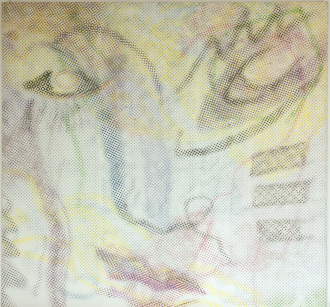
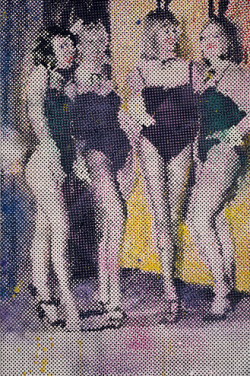


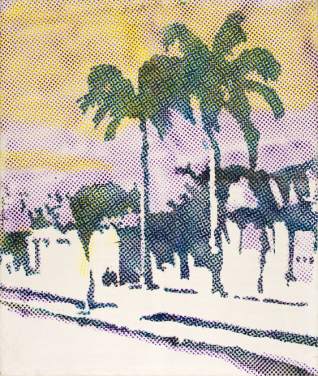

Alpenveilchen comes to be defined by Polke’s misuse of the reprographic process and by the calculated imprecision with which he approached its making. When applied to the flower, a distinctly natural subject matter amidst his more material investigations, Polke’s ubiquitous Raster dots take on a pointedly scientific character. The effect of moving towards the work is akin to that of looking through a microscope: the flowers and surrounding foliage dissolve into their molecular elements, dematerializing until they reach a degree of magnification at which their original form is made utterly unrecognizable. As one moves closer to the work, it also becomes increasingly apparent that the dots expose the mechanics of the photograph’s structure and in so doing, expose the source image itself to be a reproduction. This demystification by way of enlargement interrupts the presumed objectivity of a photograph, destabilizing our reliance on the photographic medium as a neutral and transparent window onto the real. Our understanding of the scientific integrity of the subject matter is thus compromised, placing the work in a delicate tension between our expectations of a medium and the reality of its mechanics.

As such, the work exists in a captivating state of flux: between solid and fluid, photographic and expressive, scientific and aesthetic. It is precisely this indeterminacy between form and formlessness, and the subsequent disruption of the dialectic between figuration and abstraction, which positions Polke as such a revolutionary figure at this moment in art history. He pits against each other the epistemological foundations of figuration and the ontological basis of abstraction, or as Bernard Marcadé so eloquently explains, “he makes use of abstraction to counter the explosion of the image in the media, and uses the image to undermine the metaphysical pretensions of abstraction.” (Bernard Marcadé quoted in: Exh. Cat., Musée de Grenoble, Sigmar Polke, 2013, p. 17) The result is a style which simultaneously defers to and defies both categories. In this liminal place, Alpenveilchen can perhaps be categorized as a new mode of photographic realism, not one which derives its veracity from its verisimilitude to its real-life counterpart, but rather through the honesty with which it bares the structure of its making.