“New Realism is ours; it belongs specifically to Latin America.”


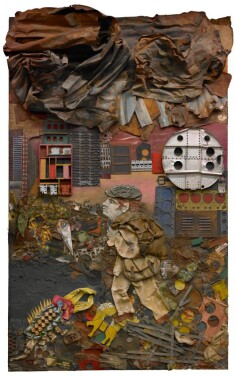
Executed in 1974, Juanito Sleeping belongs to the most iconic series of Antonio Berni’s artistic career. Developing two fictitious characters that would be central, didactic images to his plastic narrative –Juanito Laguna and Ramona Montiel –this emblematic series cemented Berni among the most innovative and transformational artists of the Cold War period: “engaged in an atypical practice whose importance to [art] theory is indisputable […] the Argentine artist voiced his deep commitment to manufacturing a truly revolutionary art in the form of what he conceived as New Realism (Nuevo Realismo)” (Héctor Olea, “Berni and his reality without isms” in Antonio Berni: Juanito and Ramona (exhibition catalogue), Houston, 2013, p. 33). Working almost exclusively on portraits of Juanito and Ramona over the course of a 15-year period (1962-1977) which is regarded as the most prolific and consequential of his career, Berni’s episodic series signaled the birth of a new artistic doctrine.
“My work is an expression of reality, a sort of visual journalism that underscores a sensitive curiosity. I don’t know what direction my work will take. When reality changes, I change as well…My work changes along with my circumstances.”

Giving life to two unlikely personalities living on the fringes of society—Juanito, a boy from the shanty towns surrounding Buenos Aires, and Ramona a middle-class girl who turns to prostitution to survive—Berni creates a recurring visual saga that plays out the complex impacts of Cold War-era consumerism. Juanito and Ramona, in effect, are antiheroes -- casualties of capitalism. For the Juanito series, Berni mimicked the narrative style of 1950s and 1960s collects ible picture cards of sports figures and comic book heroes. In Juanito Sleeping, Berni shows Juanito in an everyday scene, “an antihero and his adventures” (Héctor Olea, “Berni and his reality without isms” in Antonio Berni: Juanito and Ramona (exhibition catalogue), Houston, 2013, p. 23).
Antonio Berni — La historia de Juanito Laguna


Berni relies upon a highly diverse selection of media to create narrative worlds for these two characters, constructing large-scale relief-like assemblages from painted sheet.mes tal, abandoned appliance parts, antiques found at flea markets, and t-shirts, socks and shoes– what lauded Argentine art historian Marcelo E. Pacheco described as “material realism” (Marcelo E. Pacheco, “Juanito Laguna and Ramona Montiel: Two Extinct Creations,” in ibid., p.25).

Right: Robert Rauchnberg, Overdrive, 1963, Replica Shoes 's New York, May 14, 2008, Lot 27, Sold 14,601,000 USD Premium
For Juanito Sleeping, Berni employs papier mâché elements, clothing fabric, smashed cans and scrap metal, plastic parts, plywood, and nails to create an expressive, tactile and three-dimensional environment that served as an expressive vehicle to explore the vastness of Juanito’s daily experiences. Here Berni depicts a quiet moment for the young boy - a mid-afternoon nap accompanied by his two animal guardians. The scene is punctuated by a heavy sepia pink sky and the bright, acid tones of the surrounding field of cans. Between the years of 1972 to 1974, Berni intensively focused on creating idealized circumstances for Juanito - scenes of hope and uplifting scenarios that draw the young boy out of the dystopia of the junkyard and reflect the idyllic, populist ethos of Argentina’s influential Peronist political movement. Produced during this two-year period, Juanito Sleeping belongs to a didactic output considered as the artist’s most pivotal documentary lens of Juanito’s life.
The evolution of Berni’s conceptual and formal practice aligned him visibly closer to developing global artistic movements, most specifically Pop in the Americas (Mari Carmen Ramirez, “Juanito and Ramona in Paris” in ibid., p. 87). Akin to John Chamberlain and Robert Rauschenberg, the artists rely on the appropriation and recycling of materials to create reimagined realities.

Berni’s visual focus also sits parallel to that of Andy Warhol's; both artists focused on recurring subjects. While Warhol serialized images of pop culture icons like Marilyn Monroe, Jacqueline Kennedy Onassis, or Elvis Presley, Berni instead mythologizes an unknown young boy, whose life story unfolds throughout the series. In lionizing the story of Juanito, Berni offers us a counter-narrative, the story of an everyman. "This is why Berni saw New Realism as a ‘way to think about the world’ rather than as an artistic movement." (op. cit., p. 29)
Works from the Juanito and Ramona Series in Important Museum collects ions