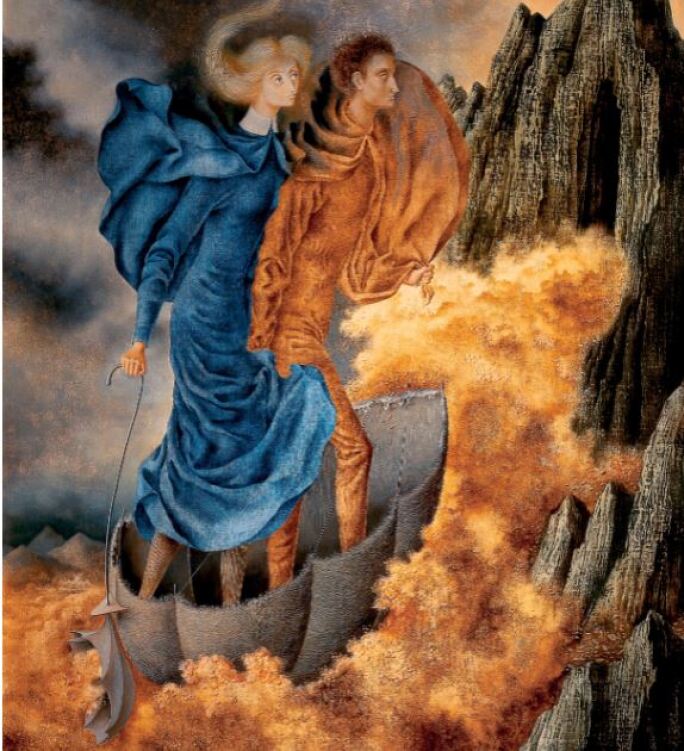
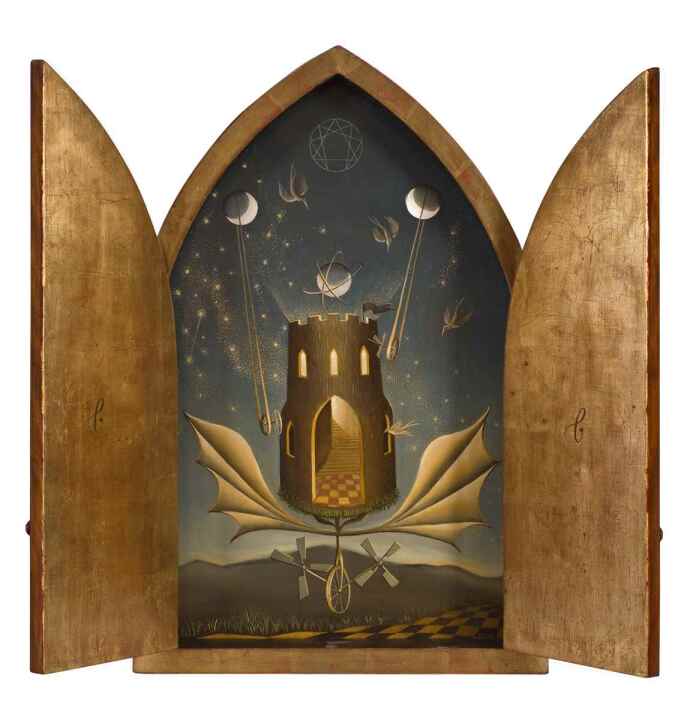
"Remedios Varo's painting has musical resonances, where inaudible melodies are capable of unleashing magical powers and supernatural enchantments, releasing amazing charges of energy that break into the common world of mortals ... Armonía was conceived as a self-portrait where she assumes the functions as the organizer of the universe, using staves to establish communication with beings of other dimensions through magical crystals and quartz stones, as if she were a Hermes Trismegisto, possessor of universal wisdom through alchemy and hermeticism.”
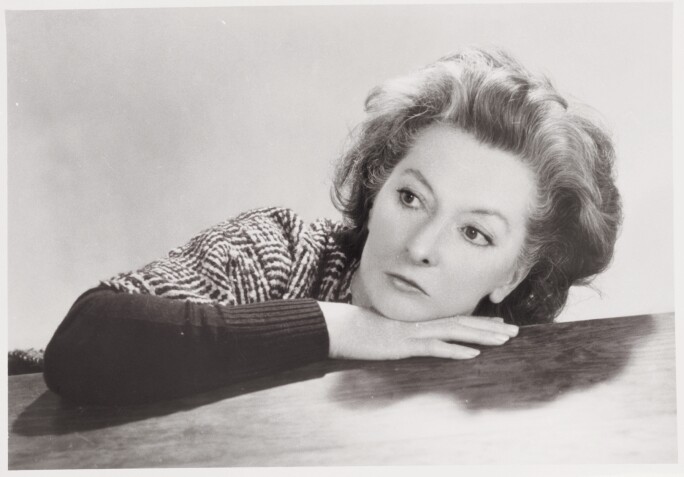
The remarkable creativity evidenced in the work of Remedios Varo stand as some of the most significant contributions to the story of Surrealism. The complex matrix of influences that serve as the foundational architecture and iconography for her paintings—from medieval history and Greek mythology to scientific reason and alchemy, nature, music, and pagan practices—is uniquely her own. While Varo’s reality is abundant with fantasia, she presents her pictorial universe with a scientific sensibility: a methodical explanation of the mystical.
"In each, a solitary figure absorbed in spiritual work sits in a self-contained space of heavy walls, arched doorways and ceilings, clerestory windows, and rich parquetry floors. And in each, there is painstaking attention to detail [;] for both Varo and Antonello this attention to detail derived from similar sources—early Netherlandish style of encyclopedic inventory found in Flemish painting of the fifteenth and sixteenth centuries.”

Executed in 1956, Armonía (Autorretrato sugerente) is a canonical example of Varo’s complex visual lexicon. Her “animistic faith in the power of objects and in the interrelatedness of plant, animal, human, and mechanical worlds“ is hereby poetically displayed. The result is a visual tale of Homeric-like intricacy (W. Chadwick, Women Artists and the Surrealist Movement, New York, 1985, p. 202). An artist who was conscious of craft and technique, there is a compulsive attention to detail visible here as it is throughout her oeuvre; each brushstroke transmitting a clear purpose. In essence, Varo’s are paintings built from details: mimicking the principles of scientific illustration, the technical precision of Armonía harkens the illustrations she produced while a scientific expedition to the Orinoco River in Venezuela a decade prior. More, Varo’s technical prowess imbue her works with a hallucinatory feel and “while we often see everything in [her paintings], we leave the encounter feeling that we have missed a crucial key that would reveal with claritys the meaning to us” (ibid., p. 169). Janet A. Kaplan, the late art historian and chronicler of Varo’s life, points to the sophistication of Varo’s visual hybridization of influential historical and literary sources in Armonía. Likening the painting to Renaissance depictions of saints in their studies, specifically to Saint Jermone in His Study by Antonelloa de Messina (see fig 1.) Kaplan comments: “in each, a solitary figure absorbed in spiritual work sits in a self-contained space of heavy walls, arched doorways and ceilings, clerestory windows, and rich parquetry floors. And in each, there is painstaking attention to detail [;] for both Varo and Antonello this attention to detail derived from similar sources—early Netherlandish style of encyclopedic inventory found in Flemish painting of the fifteenth and sixteenth centuries” (J. A. Kaplan, Remedios Varo, Unexpected Journeys, New York, 2000, p. 194).
“Music [for Varo] is a deliberately patterned construction, and so [it] appears as an agent for organizing life in several of [her] images of creation..."

Suggestive of Varo’s own spiritual quest and autobiographical journeys, she increasingly filled her pictorial universe "with fantastical adventures of enlightenment, spiritual purification” and order (ibid., p. 177). In later works like Hacia la torre, the current global auction record sold in these rooms in 2014, these narratives were more allegorical and biographical; in the instance of Armonía, she relies upon the structural principles of music, which served as a significant symbol of organization in modeling her pictorial stories: “music [for Varo] is a deliberately patterned construction, and so [it] appears as an agent for organizing life in several of [her] images of creation” (A. Friedman, “The Serenity of Science” in Remedios Varo: Catálogo Razonado, Cuartera Edición, Mexico City, 2008, pp. 83-84). A meditative, peaceful energy surrounds the lone figure (Varo herself) while a strange, supernatural chaos takes place around her –floorboards open to release floating sheets of paper, cabinet drawers fling open to reveal various natural ephemera, birds attempt escape yet are confused by tromp l’oeil tricks, ghostly beings appear from the walls. While “confusion reigns in this monastic room, we sense that it is only a matter of t.mes until a [harmonic order] reigns” (W. Chadwick, op. cit., New York, 1985, p. 203).
Object Comparison: Remedios Varo circa 1960


- National Museum of Women in the Arts, Washington, D.C.
La Ilamada, oil on canvas, 1961
39 1/2 x 26 3/4 in. - Museum of Modern Art, New York
The Juggler (The Magician), oil and inlaid mother of pearl on board, 1956
35 13/16 x 48 1/16 in. Farrell, Eva - Princeton University Art Museum, Princeton, New Jersey
Mujer, oil on pressed board, circa 1960
9 1/4 x 6 11/16 in.
© Artists Rights Society (ARS), New York / ADAGP, Paris - Museo de Arte Moderno, Mexico City
El Flautista, oil and mother of pear on Masonite, 1955 Farrell, Eva - Museo de Arte Moderno, Mexico City
Creación de las aves, oil on Masonite, 1957
Farrell, Eva - Museo de Arte Moderno, Mexico City
La Huida, oil on Masonite, 1962 Farrell, Eva - Museo de Arte Moderno, Mexico City
Mujer saliendo del psicoanalista (podría ser Juliana), oil on Masonite, 1960 Farrell, Eva - Centre Georges Pompidou, Paris
La Leçon d'anatomie, gouache and collage on paper, 1935 - Museo Nacional Centro de Arte Reina Sofía, Madrid
Remedios Varo, La faim, Gouache and black chalk on paper, 1938 - Museo de Arte Latinoamericano de Buenos Aires
Ícono, Oil, gold leaf and mother of pearl on panel, 1945 - Museo Nacional Centro de Arte Reina Sofía, Madrid
Remedios Varo, Alegoría del invierno, Gouache on paper, 1948 - The Israel Museum, Jerusalem
Remedios Varo, Insomnia, gouache on paper, 1947 - Museo de Arte Latinoamericano de Buenos Aires

Remedios Varo, Simpatía (La rabia del gato), 1955