“I believed that by a process of what I can only describe as inward dilation of the eyes I could increase my actual vision.”
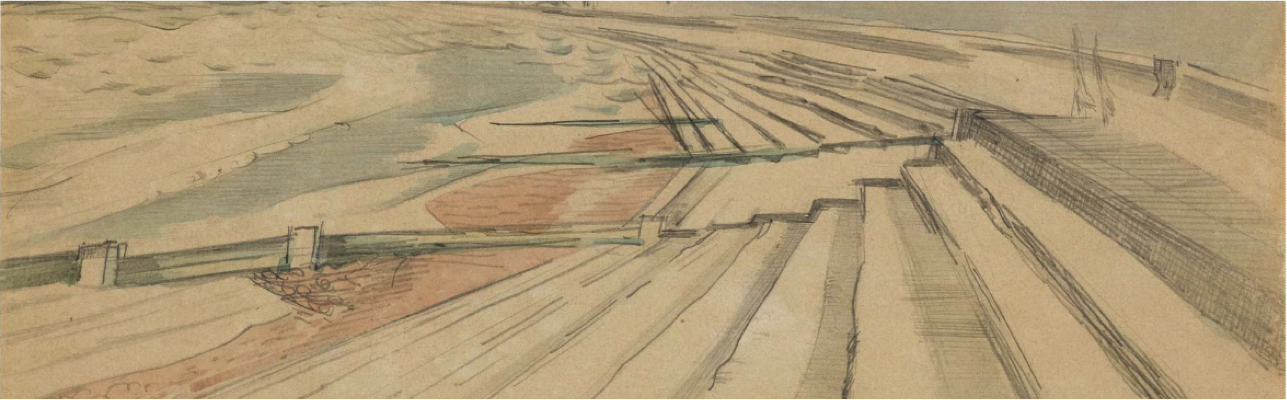
In 1921 Paul Nash suffered a severe breakdown which was diagnosed as ‘war-strain’ and he declared himself ‘a war artist without a war’. In order to recuperate and recover Nash, along with his wife Margaret, retreated to Dymchurch on the Kent coast where they lived until 1925. Nash felt a strong connection to the coast at Dymchurch and to the ancient landscape of the nearby Romney Marshes. In particular Nash was impressed with the vast sea wall at Dymchurch which became the subject for an important series of stark paintings of the sea sweeping relentlessly against these coastal defences. This battle between sea and land became emblematic of the psychological trauma inflicted on Nash during the war. This was compounded by Nash’s deep seated fear of the ocean, he almost drowned as a child, and as a consequence the open sea formed a deeply menacing character, Nash himself wrote, ‘cold and cruel waters, usually in a threatening mood, pounding and rattling along the shore’. In his works of this period the sea is often presented as a threatening force with it’s zigzag rhythms echoing that of the trenches on the Western Front. Perhaps Nash’s most significant painting from this period is The Shore (1923, Leeds Art Gallery) a stark and unpopulated seascape with the jagged lines of the sea defences bisecting the canvas. In this work Nash is beginning to experiment with abstraction translating the sea and landscape into a series of interlocking planes and geometric shapes, influenced by Cézanne’s fragmentation of nature.
The present work was executed in the same year as The Shore and its composition and construction relates closely to the finished oil. Although painted in watercolours Dymchurch also shares the same sense of melancholy and threat and is depicted in the same geometric style that would become the cornerstone of Nash’s work over the proceding years.
The present work belongs to a collects or of early 20th Century British works on paper, for more works from the collects ion please see lots 613, 615, 616, 617 and 618.